
- Your cart is empty
- Continue Shopping
What is the best over-the-counter medicine for vomiting?
- OTC and Self-Care
- Posted on
-
by Enavec Pharmacy
- 0 comments
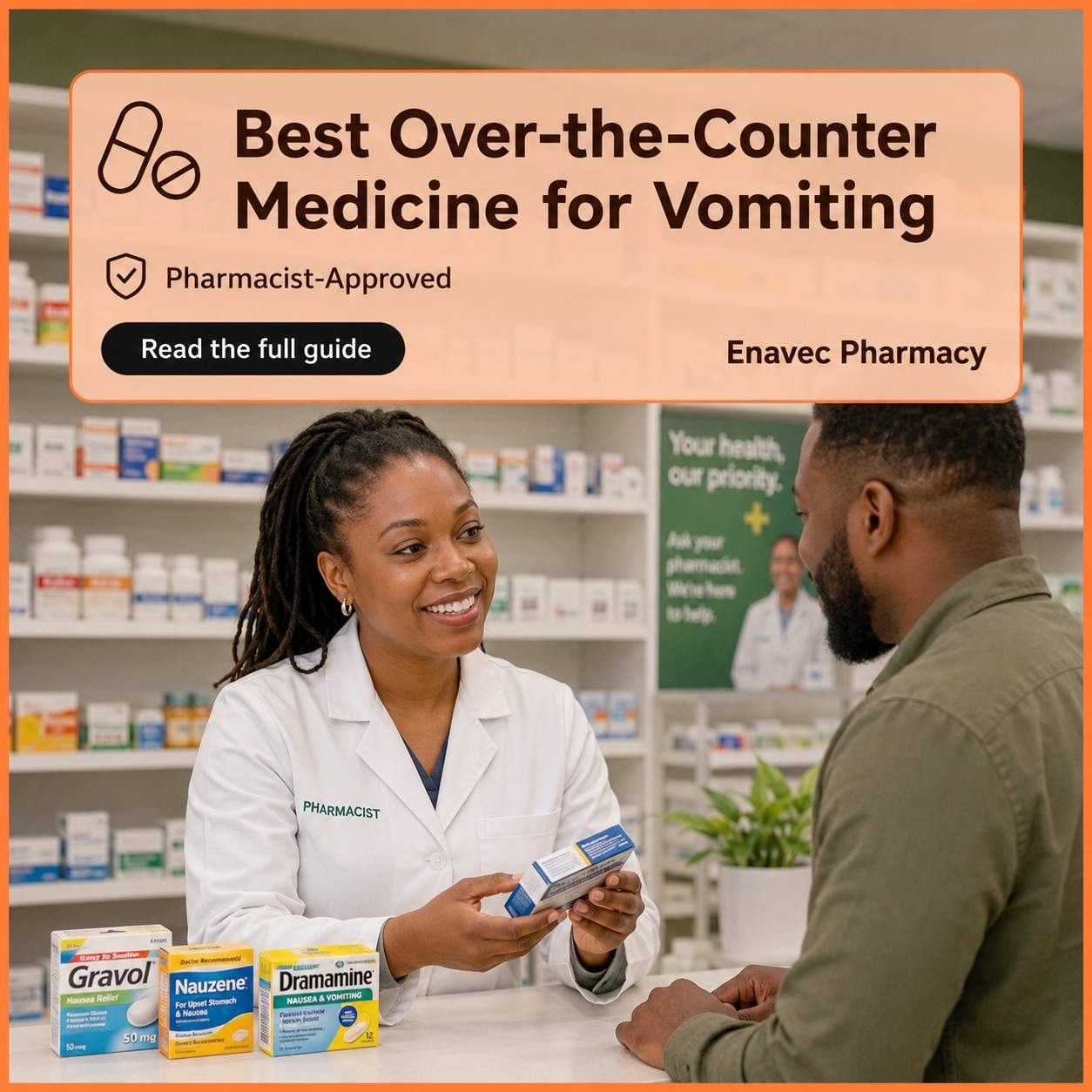
Bismuth subsalicylate, the active ingredient in Pepto-Bismol, and standardized ginger supplements are the two over-the-counter options pharmacists reach for most often when vomiting is tied to a stomach bug. Dimenhydrinate and meclizine, sold as Dramamine and Bonine, work better when motion sickness is the actual trigger. Picking the wrong one for the wrong cause is the single most common mistake I see at my counter.
Vomiting is not one condition with one fix. It is a symptom your body produces for a long list of reasons, and the product that calms a stomach virus will not touch vomiting from a migraine, a new medication, or early pregnancy. This guide breaks down what actually works for which cause, what the evidence says about each option, and when an OTC shelf is the wrong place to be looking at all.
The Three OTC Medicines Pharmacists Actually Recommend
Three over-the-counter products cover most of the vomiting situations safe to treat at home. Here is what each one is actually built for.
Bismuth subsalicylate coats the stomach lining and calms gut irritation, and its FDA label covers upset stomach, heartburn, indigestion, and nausea rather than active vomiting on its own.[1] Emetrol, a phosphorated carbohydrate solution, calms the stomach muscle contractions that lead to vomiting, though the FDA has not formally evaluated how well it works.[2] Dimenhydrinate and meclizine are antihistamines built specifically for vomiting triggered by motion, and they are the products I actually recommend when someone is asking about the best OTC medicine for motion sickness rather than a stomach virus. None of the three were designed to treat the same kind of vomiting, and that mismatch is exactly why so many people buy the wrong bottle.
💡 Key Takeaway: Match the medicine to the cause. Bismuth subsalicylate and Emetrol target stomach-related vomiting, Dramamine and Bonine target motion sickness, and neither category was built for vomiting from infection, migraine, or a medication side effect.
Why Ginger Earns a Spot Next to the Pharmacy Shelf
Ginger is not a folk remedy your pharmacist tolerates out of politeness. It has clinical trial data behind it that some OTC drugs do not.
A trial on patients recovering from abdominal surgery found that ginger essential oil reduced postoperative nausea and vomiting, and a separate trial on first-trimester pregnancy nausea found that ginger capsules eased both the intensity of nausea and how often vomiting happened.[3][4] The mechanism is not mysterious. Gingerols and shogaols, the active compounds in ginger root, interact with serotonin receptors lining the gut, the same receptor family that prescription antiemetics like ondansetron act on from a different angle. In my experience at the pharmacy counter, patients who switch from a vague "ginger tea" habit to a standardized capsule almost always report more consistent relief, simply because they finally know how much active ginger they are actually taking.
Pharmacist Recommended
✦ Pharmacist Pick
Take with food, 1-3x daily
NOW
Foods 250mg · 90 Caps GINGER
EXTRACT
Foods 250mg · 90 Caps GINGER
EXTRACT
Standardized
Ginger Extract
Ginger Extract
NOW Foods
Ginger Root Extract, 250 mg · 90 Veg Capsules
★★
★★
★
- ✓Standardized to 5% gingerols, the compound studied for nausea relief
- ✓Works on the same gut serotonin pathway as prescription antiemetics
- ✓Gentle enough to pair with food, easier on the stomach than NSAIDs
This post contains affiliate links. If you purchase through our iHerb links, we may earn a small commission at no extra cost to you. We only recommend products we would genuinely suggest to our patients.
💡 Key Takeaway: Ginger works through the same gut-brain pathway as prescription antiemetics, and 250mg to 1,000mg of standardized extract daily is the range used in most clinical trials.
When the Cause Changes the Whole Plan
That gut-brain pathway is also why timing matters as much as the medicine itself, something I learned dealing with a different kind of vomiting entirely: a child who cannot keep a dose down long enough for it to work.
💊 From the Pharmacy Counter — Iloanugo Chijioke, B.Pharm, RPh
A common problem parents bring to me is that their child refuses to take the medication, spits it out, vomits immediately after, or screams until the parent gives up. This is one of the most practically important counselling conversations I have because the consequence of a missed paediatric dose is not trivial. For malaria treatment in young children especially, a vomited dose means a missed dose. My practical advice to parents is specific: for very young children, paediatric syrup should be drawn into the oral syringe that comes with the bottle and delivered slowly to the inner cheek, not squirted to the back of the throat, which triggers the gag reflex. For slightly older children who refuse the taste, mixing the syrup into a small amount of juice, not a full cup, just enough to mask the taste, is clinically acceptable for most medications. I also tell parents: if your child vomits within 30 minutes of taking an antimalarial, you should re-dose. If after 30 minutes, do not re-dose. That specific timing instruction is something many parents do not know and that I give out routinely because it directly affects whether the treatment works.
The same logic applies to adults taking any of the medicines above. If vomiting starts within 30 minutes of swallowing a dose, the medicine likely did not stay down long enough to absorb, and taking it again once is usually reasonable. Past the 30-minute mark, the dose has already been absorbed, and a second one only risks doubling up.
Have a question about vomiting medicine? Our PCN-licensed pharmacist answers within 2 hours on WhatsApp → https://wa.me/2347068357391
The Budget Option With Real Evidence: Vitamin B6
Redosing logic only matters once the right medicine is already in hand, and for one specific group of people, that medicine is not ginger at all.
Pyridoxine, listed on a supplement label as vitamin B6, is the most studied nutrient for pregnancy-related nausea and vomiting, and it sits as the first-line non-drug option recommended before reaching for a prescription antiemetic. It will not do much for vomiting from a stomach virus or motion sickness. But for the nausea that shows up in the first trimester, it is often enough on its own, and it costs a fraction of what a prescription combination product does.
Budget Alternative
✦ Pharmacist Pick
Take once daily with water
Solgar
B6 100mg · 100 Tabs VITAMIN
B6
B6 100mg · 100 Tabs VITAMIN
B6
Pyridoxine
Supplement
Supplement
Solgar
Vitamin B6, 100 mg · 100 Tablets
★★
★★
★
- ✓Pyridoxine is the most studied nutrient for pregnancy-related nausea
- ✓One tablet a day, far cheaper than a prescription combination product
- ✓Supports nervous system function tied to nausea signaling pathways
💡 Key Takeaway: Vitamin B6 is the evidence-based first step for pregnancy-related nausea specifically. It is not a general vomiting remedy, and it will not help a stomach virus or motion sickness.
Rehydrating Matters As Much As Stopping the Vomiting
Stopping the vomiting only solves half the problem, because every episode takes sodium, potassium, and water with it.
The NHS and most hospital guidance agree on the same first step for vomiting and diarrhoea: small, frequent sips of fluid rather than large gulps, and an oral rehydration solution once you are losing fluid faster than plain water can replace it.[5] And this is exactly where our complete guide to over-the-counter medicines goes into more depth, since rehydration products sit at the center of OTC self-care for almost any illness that causes fluid loss, not just vomiting.
Specialised Support
✦ Pharmacist Pick
Sip slowly once vomiting stops
Cure
Hydration ORS · 14 Pkts ELECTROLYTE
MIX
Hydration ORS · 14 Pkts ELECTROLYTE
MIX
Oral Rehydration
Electrolyte Mix
Electrolyte Mix
Cure Hydration
Hydrating Electrolyte Mix, Watermelon · 14 Packets
★★
★★
★
- ✓Sodium, potassium, and glucose ratio matches WHO oral rehydration solution
- ✓Replaces what vomiting and diarrhoea actually strip from the body
- ✓No added sugar, gentler on a stomach that is still settling
And if nausea without much active vomiting is the bigger day-to-day issue rather than this kind of acute episode, the approach shifts slightly toward prevention rather than rehydration. We cover that distinction directly in our guide to the best OTC medicine for nausea, including why a medicine that works well for active vomiting is not always the right pick for nausea that lingers without ever resolving into being sick.
Myth vs Fact: What People Get Wrong About OTC Vomiting Medicine
Knowing the right medicine matters less if the myths around it push you toward the wrong decision at the worst possible moment.
❌ MythIf you vomited once, you have food poisoning.
✅ FactVomiting has dozens of causes, including viral gastroenteritis, migraine, motion sickness, pregnancy, and medication side effects. Food poisoning is only one of many.[6]
❌ MythPepto-Bismol will stop vomiting once it has already started.
✅ FactIts FDA-approved label covers upset stomach, heartburn, indigestion, and nausea, not active vomiting, and it works best taken before symptoms escalate.[1]
❌ MythChildren can take adult OTC vomiting medicine in a smaller dose.
✅ FactBismuth subsalicylate carries a Reye's syndrome warning for children under 12, and antihistamine antiemetics have separate age-based dosing rules.[7]
❌ MythEat a full meal right after vomiting stops to regain strength.
✅ FactNHS guidance recommends small sips of fluid first, then bland food in small amounts once fluids are tolerated, not a full meal straight away.[5]
Pharmacist Verdict
If you take away one thing from this guide, take this: start with ginger or bismuth subsalicylate for stomach-related vomiting, save Dramamine or Bonine for motion sickness, and treat vitamin B6 as the pregnancy-specific tool it is, not a general fix. The safety warning I give every patient who reaches for Pepto-Bismol matters most of all. Never give it to a child or teenager recovering from flu-like symptoms or chickenpox, because of the Reye's syndrome risk tied to its salicylate content. None of these products are built to handle vomiting that lasts more than a day, comes with blood, or leaves you unable to hold down water. When that happens, the right next step is a doctor, not another bottle off the shelf.
Signed: Iloanugo Chijioke, B.Pharm, RPh, PCN Reg. No. 020322When Vomiting Is Not a Pharmacy Problem Anymore
Knowing which myths to ignore matters less than knowing when none of this advice still applies.
- Vomiting blood or material that looks like coffee grounds
- Unable to keep any fluids down for more than 24 hours
- Severe abdominal pain, or a stomach that feels rigid or swollen
- Signs of severe dehydration: confusion, a racing heartbeat, sunken eyes, or passing little to no urine
Any one of those on its own is reason enough to call a doctor or go to urgent care rather than reach for another product.[6][8] And the threshold should be even lower for young children, older adults, and anyone managing diabetes or kidney disease, since dehydration moves faster and hits harder in those groups.
Frequently Asked Questions
For most adults, bismuth subsalicylate (Pepto-Bismol) and ginger supplements work best for vomiting tied to stomach upset, while dimenhydrinate or meclizine (Dramamine, Bonine) target vomiting from motion sickness. None of these replace a prescription antiemetic for severe or prolonged vomiting, so see a doctor if it continues past 24 hours.
No. Bismuth subsalicylate carries a Reye's syndrome warning for children under 12, and antihistamine-based antiemetics have separate age and weight based dosing. Always check the label for an age cutoff or ask a pharmacist before giving any OTC vomiting medicine to a child.
Yes. Clinical trials on postoperative nausea and pregnancy related nausea both show ginger reduces nausea intensity and vomiting frequency. Most studies use 250mg to 1,000mg of standardized ginger extract daily. It works best for mild to moderate nausea, not severe vomiting from infection or poisoning.
See a doctor if you cannot keep fluids down for more than 24 hours, vomit blood or material resembling coffee grounds, have severe abdominal pain, or show signs of dehydration like dizziness, dark urine, or confusion. These signs go beyond what any OTC medicine is built to treat.
Generally yes, since they work through different mechanisms, but space the doses apart and check with a pharmacist first if you take blood thinners, since ginger can affect platelet function. Avoid stacking multiple salicylate containing products, as this can push you past the safe daily salicylate limit.
- DailyMed, U.S. National Library of Medicine. Pepto-Bismol (bismuth subsalicylate) label. dailymed.nlm.nih.gov
- GoodRx. Medications for Nausea: OTC and Prescription Options. goodrx.com
- Lee YR, Shin HS. Effectiveness of Ginger Essential Oil on Postoperative Nausea and Vomiting. J Altern Complement Med. 2017. doi.org/10.1089/acm.2015.0328
- Ozgoli G, Goli M, Simbar M. Effects of Ginger Capsules on Pregnancy, Nausea, and Vomiting. J Altern Complement Med. 2009. doi.org/10.1089/acm.2008.0406
- NHS. Dehydration: symptoms, prevention, and rehydration advice. nhs.uk
- NHS. Diarrhoea and vomiting: causes and when to seek help. nhs.uk
- GoodRx. Bismuth Subsalicylate (Pepto-Bismol): Reye's syndrome and age warnings. goodrx.com
- Cleveland Clinic. Why Am I Throwing Up and When To See a Doctor. health.clevelandclinic.org
This article is for informational purposes only and does not constitute medical advice. Always consult your pharmacist or doctor before starting any medicine or supplement.
Found this helpful? Share it:
⚠️
Medical & Affiliate Disclaimer This article is for informational purposes only and does not constitute medical advice. Always consult a qualified healthcare provider before starting any supplement or medication. Some links in this post are affiliate links - if you purchase through them, Enavec Pharmacy may earn a small commission at no extra cost to you.
