
- Your cart is empty
- Continue Shopping
Can I stop antibiotics when I feel better?
- Antibiotics
- Posted on
-
by Enavec Pharmacy
- 0 comments
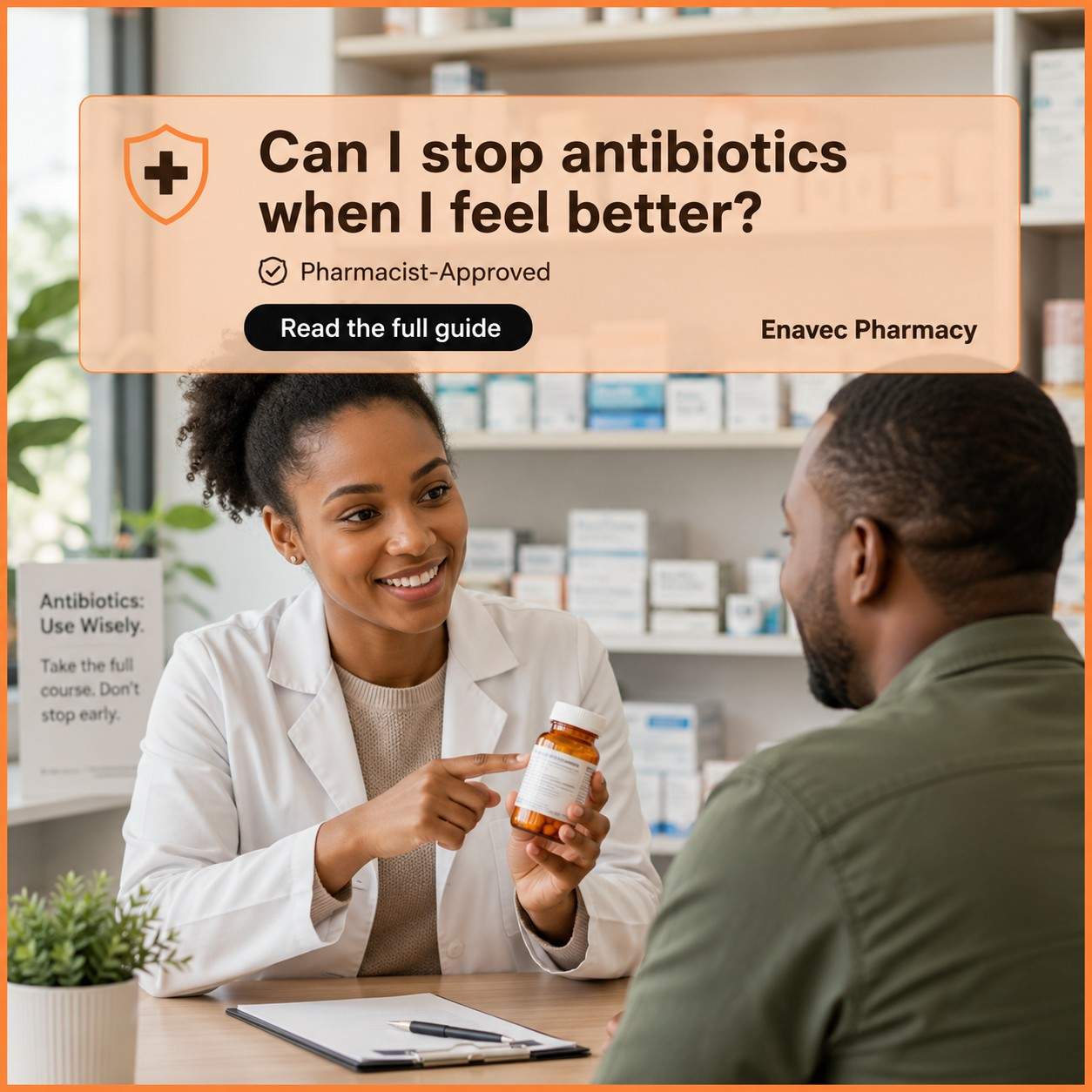
No, you should not stop antibiotics just because you feel better. Feeling better usually means the antibiotic is doing its job. But it does not mean the infection is finished, and stopping the moment you feel normal again is one of the most common ways resistant bacteria get a foothold in your body.
If you want the wider picture of how antibiotics work and where misuse begins, our guide to antibiotic uses, misuse, and resistance covers that in detail. This post answers the specific question that brings most readers here: is it safe to stop once the symptoms go away?
Why Feeling Better Is Not the Same as Being Cured
Antibiotics do not kill every bacterium in your body at the same speed. The weakest, most exposed bacteria die first, usually within the first one to two days. That early drop in bacterial numbers is exactly why your fever breaks and your energy comes back so quickly.
What is left behind, though, is the harder group. These are the bacteria that were slightly better hidden, slightly slower growing, or slightly less sensitive to the drug from the start. They are still alive when you start feeling like yourself again. In my experience at the pharmacy counter, this is the hardest thing to explain to a patient who has just spent three days feeling miserable and finally feels normal. Symptom relief is a sign the bacterial population has shrunk below the level that triggers fever and pain. It is not proof the population has reached zero.
The type of antibiotic matters here too. A narrow-spectrum drug targets a specific bacterium and usually clears it faster. A broad-spectrum antibiotic works against a wider range of organisms, which is part of why the full course tends to run longer. If you want to understand how that distinction affects your own prescription, our piece on the difference between broad-spectrum and narrow-spectrum antibiotics breaks it down clearly.
💡 Key Takeaway: Feeling better tells you the drug is working. It does not tell you the bacteria are gone. The course length is calculated to deal with the slower, tougher survivors, not just the ones that died on day one.
What Actually Happens Inside Your Body When You Stop Too Soon
Stop the medicine the day you feel better, and you leave that tougher group of bacteria alive inside you. They are not weak. They survived the first wave specifically because they had some trait, a thicker cell wall, a faster pump that expelled the drug, a mutation in the target site, that made them harder to kill. Without the antibiotic finishing the job, those survivors multiply again.
And here is the part that worries me most as a pharmacist. The infection that comes back is not always the same infection you started with. It can be slightly more resistant than before, because the bacteria that repopulate your body carry the very traits that let them survive the first round. Patients then need a second course, frequently a stronger or broader drug than the first, and the cycle of exposure grows instead of shrinking.
💊 From the Pharmacy Counter: Iloanugo Chijioke, B.Pharm, RPh
One of the clearest cases of antibiotic resistance I have witnessed in practice came in the form of a patient who had been on three different antibiotic courses in two months for what he described as a persistent throat and chest infection. He came to me after the third course failed and was asking for something stronger. When I reviewed what he had taken (ciprofloxacin, amoxicillin, and azithromycin) and asked how he had taken them, the pattern was immediately obvious. He had not completed a single course. Each time he felt better after four or five days, he stopped. Each time the infection returned, slightly changed, slightly more resistant. What I explained to him, using an analogy he responded to, was this: imagine you are fighting an army. You defeat 90% of them, declare victory, and go home. The 10% that survived are not the weak ones. They are the ones who survived because they were stronger. When they regroup and attack again, they bring those survival traits with them. The next antibiotic has to fight a tougher enemy. That is what he had been doing to his own body for two months.
💡 Key Takeaway: The bacteria that survive an incomplete course are the strongest ones in the population. Stopping early does not just risk relapse, it can hand the infection an upgrade.
Have a question about stopping antibiotics early? Our PCN-licensed pharmacist answers within 2 hours on WhatsApp → https://wa.me/2347068357391
Is "Finish the Course" Outdated Advice? What the Evidence Actually Says
That story is exactly why the advice to finish the course has been repeated for decades. But the science behind it has shifted, and a good pharmacist should tell you that honestly rather than repeat a slogan.
In 2017, a team of UK infectious disease specialists published an analysis in The BMJ arguing that the link between stopping early and resistance is weaker than public health messaging suggests.[4] Their real concern was the opposite problem: courses that run longer than the infection actually needs. Extra days of antibiotic exposure give resistant strains more time to establish themselves in your gut and on your skin, even after the original infection is gone.
That paper did not change official guidance overnight, and it has not changed it now. The CDC still tells patients to take antibiotics exactly as prescribed and to talk to a healthcare professional rather than stop on their own.[1] The NHS gives the same instruction.[2] The World Health Organization continues to list completing the prescribed course among its core recommendations for slowing antimicrobial resistance.[3] What has changed is the duration itself. Doctors increasingly prescribe shorter courses for infections where the evidence supports it, five days instead of ten for some chest infections, rather than leaving patients to decide when enough is enough.
So the honest answer sits in the middle. Stopping because you personally feel the course has gone on long enough is not supported by current evidence or guidance. Stopping because your prescriber told you the duration for your specific infection is shorter than the old default? That is exactly the direction modern antibiotic stewardship is heading.
💡 Key Takeaway: The debate among researchers is about how long courses should be, decided by your doctor, not about whether you get to decide when you feel finished.
🧮 Know Your Numbers: Wondering how your own antibiotic habits affect your resistance risk? Use our free Antibiotic Resistance Risk Quiz to get a personalised assessment in under 2 minutes, no sign-up needed.
When It Might Be Safe to Stop, and When It Never Is
There is one situation where stopping early is the right call, and it has nothing to do with feeling better. If you develop a serious allergic reaction, spreading rash, swelling of the face or throat, difficulty breathing, or severe watery diarrhoea that does not settle, stop the dose and contact your prescriber or emergency services immediately. That is a medical decision made with a clinician, not a personal judgement call made because the medicine tastes unpleasant or the cough has quietened down.
Outside of that, the rule stays simple. If you have already missed a dose somewhere along the way and are unsure how that affects your timeline, our guide on what to do if you miss a dose of antibiotics walks through exactly what to do next, rather than guessing.
Completing the full course also matters for your gut, not just the infection. Antibiotics do not distinguish between the bacteria making you sick and the helpful bacteria living in your digestive tract.[5] That is part of why a finished course sometimes leaves you with mild bloating or looser stools for a few days afterward. A daily probiotic taken a couple of hours apart from your antibiotic dose can support your gut bacteria while you complete treatment properly, rather than giving you a reason to stop early.
Pharmacist Recommended
✦ Pharmacist Pick
Take 2 hrs after antibiotic dose
California
Gold 30B CFU PROBIOTICS
8 Strains
Gold 30B CFU PROBIOTICS
8 Strains
Shelf-Stable
Probiotic
Probiotic
California Gold Nutrition
LactoBif 30 Probiotics, 30 Billion CFU · 60 Veggie Caps
★★
★★
★
/ 5 · 3,100+ reviews
- ✓8 active strains, including 5 Lactobacilli and 3 Bifidobacteria
- ✓Shelf-stable formula, no refrigeration needed during a course
- ✓Supports gut flora disrupted by a full antibiotic course
This post contains an affiliate link. If you purchase through our iHerb link, we may earn a small commission at no extra cost to you. We only recommend products we would genuinely suggest to our patients.
💡 Key Takeaway: Stop early only for a genuine medical reaction, and only with your prescriber's input. Everything else, including gut discomfort, is usually managed alongside the course, not by abandoning it.
Myth vs Fact: Stopping Antibiotics Early
❌ MythOnce my symptoms go away, the bacteria are gone too.
✅ FactSymptoms ease once the bacterial population drops below the level that triggers fever and inflammation. The toughest bacteria are often still alive and can multiply again within days of stopping early.[4]
❌ MythStopping early protects me from unnecessary side effects.
✅ FactPatients who relapse after stopping early frequently need a second, often stronger, antibiotic course. That means more total drug exposure and more side effect risk, not less.[1]
❌ MythI can save the leftover tablets for next time I feel the same symptoms.
✅ FactLeftover antibiotics are dosed for a specific infection that has already passed. A new illness may involve a different bacterium entirely, and a partial leftover course is rarely enough to treat anything properly.[2]
❌ MythEvery antibiotic course has to run for the same length, no matter what.
✅ FactDuration is increasingly tailored to the specific infection by your prescriber. Some chest and urinary infections now have evidence-based shorter courses, but that decision belongs to your doctor, not to how you feel on day three.[3][4]
⚖️ Pharmacist Verdict
My verdict is straightforward. Do not stop your antibiotics because you feel better. Finish the exact course your doctor gave you, at the dose and frequency written on the label, and call your pharmacist if side effects show up along the way. The one exception is a genuine allergic reaction or severe adverse effect, which needs urgent medical attention, not patience. I have watched a patient cycle through three antibiotics in two months because he kept stopping at the four day mark. He is on my mind every time someone tells me they feel fine already. Finish what was started.
Signed, Iloanugo Chijioke, B.Pharm, RPh, PCN Reg. No. 020322
Frequently Asked Questions
No. Feeling better usually means the antibiotic has reduced the bacteria enough to ease your symptoms, not that the infection is gone. The toughest, most resistant bacteria often survive longer than the symptoms do. Stopping early lets them multiply again, sometimes causing a relapse that needs a second, stronger course of treatment.
The surviving bacteria, the ones least affected by the drug, can regrow and cause the infection to return. Because these survivors were already harder to kill, the relapse can be more resistant to treatment than the original infection. This is one of the clearest drivers of antibiotic resistance seen at the pharmacy counter.
The research has nuance, not a reversal. A 2017 BMJ analysis argued that overly long courses, not early stopping, drive resistance. Official bodies like the CDC, NHS, and WHO still advise taking antibiotics exactly as prescribed. Duration is increasingly tailored by doctors, but shortening a course is their decision, not yours.
Contact your pharmacist or doctor rather than restarting on your own. They will check how many doses you missed, how long ago you stopped, and whether your symptoms have returned before deciding if you need to resume the same course, start fresh, or simply monitor for now.
Yes, indirectly. Stopping before the prescribed duration allows tougher bacteria to survive and regrow, often requiring a second course of treatment. More total antibiotic exposure across multiple incomplete courses gives bacteria more chances to develop resistance than one properly finished course would.
Only when you experience a serious reaction, such as a spreading rash, facial swelling, breathing difficulty, or severe diarrhoea. In that case, stop the dose and contact your prescriber or emergency services immediately. Feeling better, mild nausea, or disliking the taste are not medical reasons to stop on your own.
References
- Centers for Disease Control and Prevention. Healthy Habits: Antibiotic Do's and Don'ts. cdc.gov
- NHS. Antibiotics. nhs.uk
- World Health Organization. Antimicrobial resistance. who.int
- Llewelyn MJ, Fitzpatrick JM, Darwin E, et al. The antibiotic course has had its day. BMJ. 2017. pubmed.ncbi.nlm.nih.gov
- National Center for Complementary and Integrative Health, NIH. Probiotics: Usefulness and Safety. nccih.nih.gov
This article is for informational purposes only and does not constitute medical advice. Always consult your pharmacist or doctor before starting any medicine or supplement.
Found this helpful? Share it:
⚠️
Medical & Affiliate Disclaimer This article is for informational purposes only and does not constitute medical advice. Always consult a qualified healthcare provider before starting any supplement or medication. Some links in this post are affiliate links - if you purchase through them, Enavec Pharmacy may earn a small commission at no extra cost to you.
