
- Your cart is empty
- Continue Shopping
Antibiotics: Uses, Misuse, and Resistance Explained
- Antibiotics
- Posted on
-
by enavec_pharmacy
- 0 comments
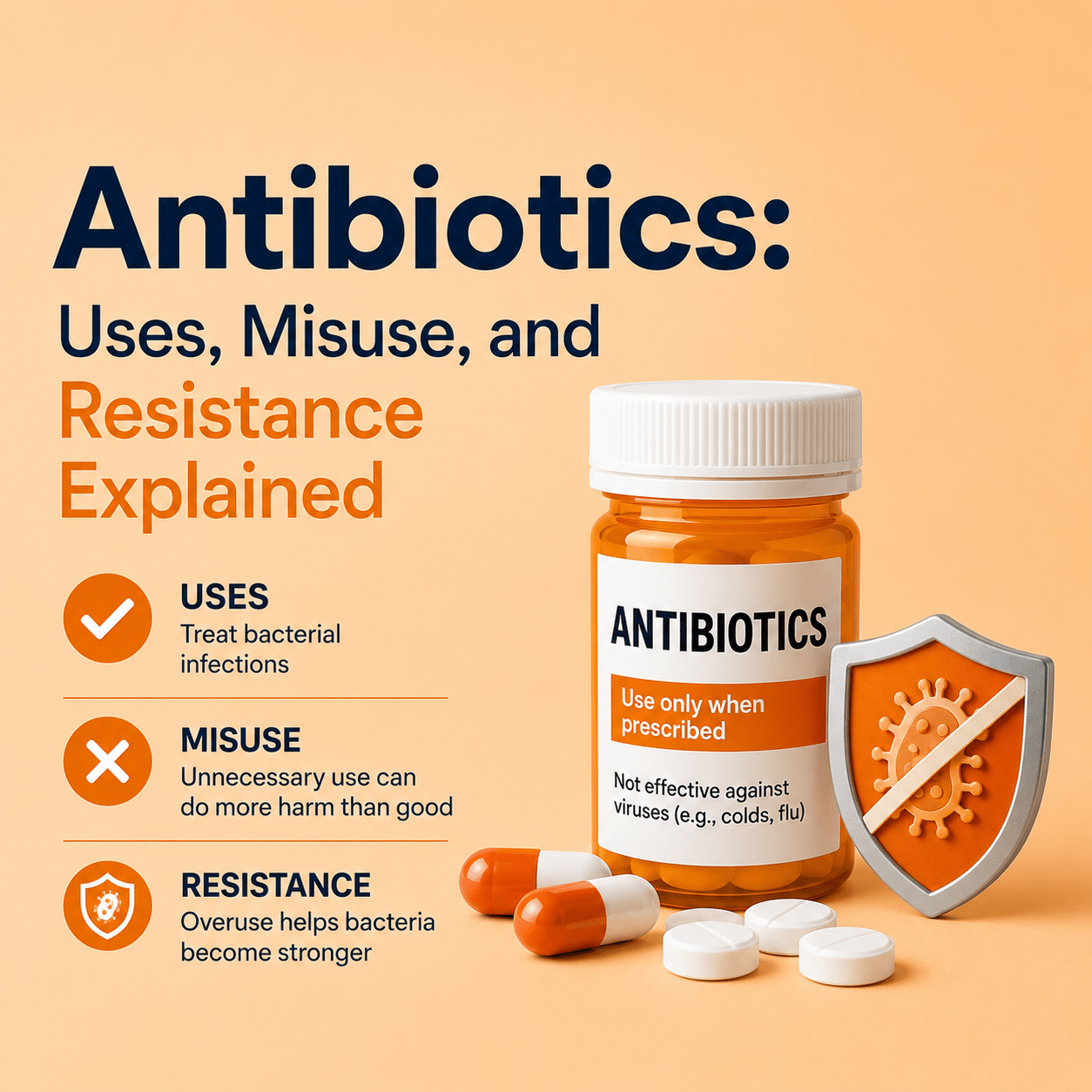
Medicines & Drugs · Antibiotics
Antibiotics: Uses, Misuse, and Resistance Explained
Antibiotics are prescription medicines that kill or stop the growth of bacteria. But they do not work against viruses, and taking them incorrectly is one of the most serious threats to global public health right now. Here is what every patient needs to understand before, during, and after an antibiotic course.
By 2050, antimicrobial resistance (AMR) could cause 10 million deaths per year if nothing changes.[1] That number matters whether you are in the United States, the United Kingdom, Nigeria, or anywhere else. Resistant bacteria do not stay in one country. They travel. And every unnecessary antibiotic course, every unfinished prescription, every roadside purchase without a diagnosis makes the problem worse. This guide covers everything a patient needs to know to use antibiotics responsibly.
What Are Antibiotics and How Do They Work?
How a drug that kills bacteria manages to leave your own cells mostly unharmed — and why that same biology is what resistance eventually exploits.
An antibiotic kills or stops the growth of bacteria by targeting structures that exist in bacterial cells but not in human cells.[2] Bacteria have a fundamentally different architecture from our cells. Different cell walls. Different ribosomes (the machinery that builds proteins). Different DNA replication systems. Antibiotics attack those bacterial-specific systems, which is why they can be effective at therapeutic doses without destroying your own tissue at the same time.
The main ways antibiotics do this:
- Cell wall disruption. Bacteria need rigid cell walls to survive. Penicillins and cephalosporins block the enzymes that build and repair that wall. Without it, the bacterium swells and bursts. Human cells have no cell wall, so this mechanism cannot harm us the same way.
- Protein synthesis blockade. Macrolides (azithromycin, erythromycin), aminoglycosides, and tetracyclines bind to bacterial ribosomes and stop them making proteins. Bacterial ribosomes differ slightly in structure from ours, which is what makes selective targeting possible.
- DNA replication blockade. Fluoroquinolones (ciprofloxacin, levofloxacin) inhibit bacterial enzymes needed to copy and repair DNA. Bacteria that cannot replicate their DNA cannot multiply.
- Cell membrane disruption. Polymyxins, used in severe hospital infections, directly damage the bacterial outer membrane until it collapses.
- Metabolic pathway blockade. Sulfonamides block bacteria from synthesising folic acid, which they must produce themselves. Humans get folic acid from food, so this pathway is bacterial-specific.
💡 Key Takeaway
Antibiotics are genuinely unable to work on viruses. Viruses have completely different biology — no bacterial cell wall to disrupt, no bacterial ribosome to block. Taking an antibiotic for a cold, flu, or COVID-19 gives you zero benefit and contributes directly to resistance.
The Main Antibiotic Classes — What Each One Treats
Why your prescriber chose a specific drug, and why substituting a different antibiotic yourself is never a safe shortcut.
| Class | Examples | Common Clinical Uses | Key Caution |
|---|---|---|---|
| Penicillins | Amoxicillin, Augmentin (Amoxicillin-clavulanate), Flucloxacillin | Ear, throat, chest, skin, dental, and urinary infections | Penicillin allergy is common. Declare it every time. |
| Cephalosporins | Cefalexin, Cefuroxime, Ceftriaxone | Skin, respiratory, urinary tract, and hospital infections | Cross-allergy possible if you are penicillin-allergic |
| Macrolides | Azithromycin, Clarithromycin, Erythromycin | Chest infections, atypical pneumonia, skin, STIs | Significant interactions with statins and some antihistamines |
| Fluoroquinolones | Ciprofloxacin, Levofloxacin, Ofloxacin | Urinary tract, gastrointestinal, respiratory, bone infections | Tendon damage risk. Avoid in children and pregnancy. |
| Tetracyclines | Doxycycline, Minocycline, Tetracycline | Malaria prophylaxis, acne, chlamydia, Lyme disease | Avoid in pregnancy and children under 8. Take with food, not dairy. |
| Nitroimidazoles | Metronidazole (Flagyl) | Anaerobic bacteria, H. pylori, dental and pelvic infections | Severe alcohol interaction. No alcohol for the entire course and 48 hours after.[3] |
| Sulfonamides | Co-trimoxazole (Septrin) | UTI, PCP pneumonia in HIV, some tropical infections | Sulfa allergy; kidney impairment; G6PD deficiency |
I often see patients come in asking for ciprofloxacin — specifically requesting it because they see it as powerful and all-purpose. And yes, it is broad-spectrum. But that breadth is exactly the problem with using it as a first choice. When you take a broad-spectrum antibiotic, you are not just pressuring the bacteria causing your infection to adapt. You are pressuring every bacterium in your body. The resistance fallout from that is much wider than treating with a narrow-spectrum drug that targets only what needs treating.[4]
💡 Key Takeaway
Different antibiotic classes target different bacteria through different mechanisms. The right choice depends on the organism, the site of infection, your allergies, and your other medicines. Never swap one antibiotic for another on your own.
💊 From the Pharmacy Counter — Iloanugo Chijioke, B.Pharm, RPh, PCN 020322
This conversation has happened many times but the first time stays with me. A patient came back to the pharmacy looking genuinely shaken, saying he had taken a beer the night before while on his Flagyl course and within an hour felt like he was dying. His heart was racing, his face flushed deep red, he was vomiting and sweating, and his wife had been about to call an ambulance.
I explained what metronidazole does when combined with alcohol. The drug inhibits the enzyme that breaks down acetaldehyde, a toxic byproduct of alcohol metabolism. Acetaldehyde accumulates in the blood and causes exactly what he experienced: flushing, racing heart, nausea, sweating, profound discomfort. When I asked why he had drunk while on the medication, he said nobody told him not to.
I have since made it a rule that every patient I dispense metronidazole to hears this warning from me directly, out loud, before they leave the counter. Not just on the label. Out loud.
Iloanugo Chijioke, B.Pharm, RPh · Enavec Pharmacy · Lagos, Nigeria
Have a question about antibiotics or your prescription?
Our PCN-licensed pharmacist answers within 2 hours on WhatsApp →
When Do You Actually Need an Antibiotic?
Most common infections do not need an antibiotic. Getting this right is the single biggest thing any individual can do to fight resistance.
Antibiotics work on bacteria. They are completely ineffective against viruses.[5] Most upper respiratory infections — colds, most sore throats, most coughs, most adult ear infections — are viral. Taking an antibiotic for these gives you side effects (diarrhoea, yeast infections, allergic reactions) and contributes to resistance. No therapeutic benefit at all.
Infections That Generally Need Antibiotics
- Confirmed bacterial pneumonia
- Streptococcal throat infection (Group A Strep, confirmed by throat swab)
- Urinary tract infections with positive urine culture
- Cellulitis, impetigo, and infected wounds with systemic signs
- Sexually transmitted infections: gonorrhoea, chlamydia, syphilis
- Typhoid fever confirmed by blood culture
- H. pylori eradication (the bacterium behind most gastric ulcers)
- Lyme disease, bacterial meningitis, sepsis
Infections That Generally Do Not Need Antibiotics
- The common cold
- Influenza (flu) — antivirals exist, but not antibiotics
- COVID-19
- Most chesty coughs in otherwise healthy adults
- Most sore throats — roughly 80–90% are viral[6]
- Most acute sinusitis
- Viral gastroenteritis without systemic signs
⚠️ The Widal Test and Typhoid Overdiagnosis
The Widal test used to diagnose typhoid has a very high false-positive rate in Nigeria, India, and parts of Southeast Asia because many people in these populations carry background Salmonella antibodies from prior exposure. Patients receive antibiotic courses for typhoid based on a Widal result alone, when the actual cause of their fever is malaria, viral illness, or something else entirely. The Widal test should guide clinical suspicion. It should not replace a blood culture when making a treatment decision.[7]
💡 Key Takeaway
Most infections that bring people to pharmacies are viral. Before starting any antibiotic, ask one question: is this definitely bacterial? If you don't know, ask your pharmacist or doctor before taking anything.
5 Rules Every Antibiotic Patient Needs to Know
Not guidelines. Not suggestions. Rules — because getting these wrong has consequences for you and for everyone else.
- Finish the full course. Every time. The most dangerous antibiotic mistake is stopping early because you feel better. You feel better when the drug has reduced the bacterial population to a level your immune system can manage. But the bacteria that survived to that point are not the weak ones. They are the most resistant. Stop early and you give them room to regroup. Your next infection is harder to treat.[8]
- Never take someone else's antibiotics. Antibiotics are prescribed for a specific infection, organism, and patient. Your friend's leftover amoxicillin may be the wrong drug, wrong dose, or wrong duration for what you have. And it will almost certainly be too short a course.
- Do not save antibiotics for next time. Patients keep leftover tablets and self-treat future infections. But a saved partial course is rarely enough, and there is no way for you to know without a proper assessment whether the next infection is even bacterial. This habit is one of the primary drivers of resistance globally.
- Do not ask for an antibiotic "just in case." Patients ask me this regularly for colds and flu. My answer is always the same: taking an antibiotic when you do not have a bacterial infection does not prevent one from developing. It only selects for resistant bacteria in your gut, throat, and urinary tract.
- Declare your allergies. Every single time. Penicillin allergy is the most common drug allergy globally.[9] A cross-allergy between penicillins and cephalosporins exists in a small but real percentage of patients. Tell every prescriber and every pharmacist, not just the first one who ever prescribed you an antibiotic.
💡 Key Takeaway
The most impactful thing you can do to fight antibiotic resistance is personal. Complete every course. Never self-prescribe. Never pressure a prescriber for antibiotics when your infection is likely viral. These habits matter more than any public health campaign.
How Antibiotic Resistance Actually Develops
Resistance is not a distant future problem. It is happening in your body right now, shaped partly by how you have used antibiotics in the past.
1.27M
Deaths directly caused by AMR in 2019 globally[10]
10M
Projected annual AMR deaths by 2050 without action[1]
700K
People dying from drug-resistant infections every year right now[11]
Resistance develops through natural selection. When antibiotics kill most bacteria in a population, the few with a mutation that helps them survive are left behind. Those survivors reproduce. Their offspring carry the resistance gene. With each antibiotic exposure, more susceptible bacteria die and the resistant ones multiply. Eventually the antibiotic stops working.[12]
Here is what most patients do not realise: resistance does not just happen "out there" in hospitals or research labs. It develops in the bacteria living in your own body. A person who takes multiple antibiotic courses in a year, especially incomplete ones, is selecting for resistant organisms in their own gut, skin, throat, and urinary tract. The next infection they develop may come from those very organisms. And it may be significantly harder to treat than it would have been before that antibiotic history.
How Bacteria Become Resistant
- Enzyme production. Some bacteria produce beta-lactamase enzymes that destroy penicillins and cephalosporins before they can act. Co-amoxiclav (Augmentin) was developed specifically to address this: the clavulanate component inhibits the enzyme.
- Efflux pumps. Bacteria develop protein pumps that push the antibiotic back out of the cell before it reaches its target.
- Target modification. Bacteria mutate the specific structure the antibiotic binds to, so it no longer fits. This is how MRSA works.
- Reduced permeability. Bacteria modify their outer membrane to make it harder for antibiotics to enter.
- Horizontal gene transfer. Perhaps most alarming: bacteria can pass resistance genes directly to other bacteria, even across different species, without reproduction. Resistance can spread through an entire bacterial community in hours.
💊 From the Pharmacy Counter — Iloanugo Chijioke, B.Pharm, RPh, PCN 020322
One of the clearest cases of antibiotic resistance I have seen in practice involved a patient who had taken three different antibiotic courses in two months for a persistent throat and chest infection. He came to me after the third course failed, asking for something stronger. When I went through what he had taken, the picture was obvious. Ciprofloxacin, amoxicillin, azithromycin. And he had not completed a single course. Each time he felt better after four or five days, he stopped. Each time the infection came back, slightly changed, slightly more resistant.
I explained it to him like this. Imagine you are fighting an army. You defeat 90% of them, declare victory, and go home. The 10% that survived are not the weak ones. They survived because they were stronger than the rest. When they regroup and attack again, they bring those survival traits with them. The next antibiotic has to fight a tougher enemy. That is what he had been doing to his own body for two months.
Iloanugo Chijioke, B.Pharm, RPh · Enavec Pharmacy · Lagos, Nigeria
💡 Key Takeaway
Antibiotic resistance develops in your own body's bacterial flora. Every unnecessary course and every unfinished prescription contributes to a global crisis that is already killing over a million people per year. This is not abstract. It is personal.
🧮 Know Your Risk
How much does your antibiotic use pattern contribute to resistance risk? Take our free Antibiotic Resistance Risk Quiz — a personalised assessment in under 2 minutes, no sign-up needed.
→ Take the Antibiotic Resistance Risk QuizSide Effects — What to Expect and What to Watch For
Most antibiotic side effects are manageable. A small number require urgent attention. Knowing the difference matters.
- Gastrointestinal upset. The most common side effect across almost every antibiotic class. Antibiotics disrupt the gut microbiome, causing nausea, diarrhoea, bloating, and cramping. Taking most antibiotics with food reduces this. Note the exception: some penicillins like flucloxacillin work better on an empty stomach, so check the label.[13]
- C. difficile diarrhoea. Broad-spectrum antibiotics can disrupt the gut severely enough that Clostridioides difficile, a bacterium normally kept in check by healthy gut flora, overgrows and causes severe diarrhoea, sometimes with blood and mucus. Risk is highest in elderly patients and anyone on multiple antibiotics. Any diarrhoea that starts during or within 8 weeks of an antibiotic course and is accompanied by fever or blood needs urgent medical review, not self-treatment.[14]
- Allergic reactions. Range from mild skin rash to life-threatening anaphylaxis. Penicillin allergy is the most common drug allergy globally. Any rash, facial swelling, or breathing difficulty during an antibiotic course requires immediate medical assessment.
- Yeast infections. Antibiotics kill the beneficial Lactobacillus bacteria that normally suppress fungal growth. Oral thrush or vaginal candidiasis during or after a course is predictable and manageable with fluconazole or topical clotrimazole.
- Photosensitivity. Tetracyclines and fluoroquinolones increase skin sensitivity to sunlight significantly. Use high-SPF sunscreen and avoid prolonged sun exposure while on these antibiotics.
- Tendon damage. Fluoroquinolones carry a documented risk of tendinitis and tendon rupture, particularly of the Achilles tendon. Risk rises in patients over 60, those on corticosteroids, and anyone with kidney impairment. Tendon pain during fluoroquinolone treatment should be reported to a doctor immediately and the drug should be stopped until review.[15]
Supporting Your Gut During and After Antibiotics
The most evidence-backed strategy for reducing antibiotic-related gut side effects is taking probiotics alongside the course.[16] The timing is everything: take the probiotic at least 2 hours away from the antibiotic dose. If you take them simultaneously, the antibiotic kills the probiotic bacteria before they reach the gut. Continue probiotics for at least 4 weeks after finishing the antibiotic.
CALIFORNIA
GOLD
25B CFU
PROBIOTICS
10 Strains 180 Veggie Caps
10 Strains 180 Veggie Caps
California Gold Nutrition
LactoBif Probiotics 25 Billion CFU · 180 Veggie Capsules
Gut Health · Post-Antibiotic · 10-Strain BlendRestore your gut microbiome after antibiotics. 10 clinically studied strains. Third-party iTested verified. Take at least 2 hours apart from your antibiotic dose; continue for 4 weeks after finishing the course.
🛒 Buy on iHerbThis post contains affiliate links. If you purchase through our iHerb links, we may earn a small commission at no extra cost to you. We only recommend products we would genuinely suggest to our patients.
💡 Key Takeaway
Gut upset is manageable. Take the antibiotic with food where permitted, and run a probiotic alongside it with at least 2 hours gap. But rash spreading rapidly, breathing difficulty, or blood in your stool during an antibiotic course are not manageable at home. Get medical review the same day.
Drug Interactions You Need to Know About
Some of these interactions are dangerous. Every one of them is preventable with a five-minute conversation at your pharmacy counter.
- Metronidazole (Flagyl) and alcohol. No alcohol for the entire course and 48 hours after the last dose. The interaction is severe: flushing, rapid heart rate, nausea, vomiting. See the clinical story above.[3]
- Fluoroquinolones (ciprofloxacin) with antacids, iron, or dairy. Calcium, magnesium, iron, and aluminium ions bind fluoroquinolones in the gut and block absorption. Take ciprofloxacin at least 2 hours before or 6 hours after any antacid, iron supplement, or dairy product.
- Macrolides (azithromycin, clarithromycin) with statins. Macrolides inhibit the liver enzyme that metabolises several statins. Simvastatin and atorvastatin can reach dangerous concentrations in the blood, raising the risk of muscle damage (rhabdomyolysis).[17]
- Macrolides and fluoroquinolones with QT-prolonging drugs. Both classes can prolong the QT interval on ECG. Combined with other QT-prolonging drugs such as certain antihistamines, antipsychotics, or antiarrhythmics, this raises the risk of a dangerous cardiac arrhythmia. Your pharmacist can check this combination quickly.
- Any antibiotic with warfarin. Antibiotics disrupt gut bacteria that produce Vitamin K, which warfarin depends on. The anticoagulant effect of warfarin can increase unpredictably. Patients on warfarin should have their INR checked more frequently during any antibiotic course.[18]
🧮 Drug Interaction Checker
Taking other medicines alongside your antibiotic? Check the combination before you start the course.
→ Open the Drug Interaction Checker
💡 Key Takeaway
Tell your pharmacist everything you are taking before starting an antibiotic. The interactions above are avoidable. They are also the kind of thing I catch at the counter every week because patients assumed one medication had nothing to do with the other.
4 Antibiotic Myths That Cause Real Harm
These are the four most common misconceptions I encounter at the pharmacy counter. Each one has a measurable impact on patient outcomes and resistance.
❌ Myth 1
"I felt better after two days so the antibiotic worked and I don't need to finish the course."
✅ Fact
Feeling better means the bacterial population has dropped, not that it has been eliminated. The bacteria that survived to day two are the most resistant ones. Stop early and you give them room to regroup. The next infection will be harder to treat.[8]
❌ Myth 2
"Taking an antibiotic when I have a cold will prevent a bacterial infection from developing."
✅ Fact
Prophylactic antibiotic use for viral infections is not supported by evidence, increases your side effect risk, and selects for resistant bacteria in your gut. It does not prevent secondary bacterial infections.[5]
❌ Myth 3
"A stronger antibiotic is always more effective than a weaker one."
✅ Fact
The right antibiotic matches the specific organism. A narrow-spectrum drug that targets the causative bacterium precisely is more effective and safer than a broad-spectrum drug that kills indiscriminately.[4]
❌ Myth 4
"Antibiotic resistance is a hospital problem, not something that affects ordinary people."
✅ Fact
Resistance develops in your own body's bacteria. Every unnecessary course and every incomplete prescription directly selects for resistant organisms in your personal microbiome. This is an individual-level problem with collective-level consequences.[12]
Questions Patients Ask Me Most
Direct answers. No filler.
For most antibiotics, moderate alcohol is not directly dangerous but is best avoided. Alcohol impairs immune function, disrupts sleep, and can worsen dehydration when you are already fighting an infection. But with metronidazole (Flagyl) and tinidazole, alcohol is absolutely off limits. The combination causes a severe reaction: flushing, racing heart, nausea and vomiting. The restriction extends to 48 hours after the last dose.
Take it as soon as you remember, unless it is almost time for your next dose. In that case skip the missed one and continue your normal schedule. Never double up to compensate. Maintaining a consistent level of antibiotic in your blood matters for effectiveness, so set a phone reminder if you keep forgetting.
Antibiotics target bacterial structures: cell walls, bacterial ribosomes, bacterial enzymes. Viruses have none of these. A virus is simply genetic material inside a protein coat. It replicates using your own cellular machinery. There is nothing for an antibiotic to bind to or block. Antivirals exist for some viruses but they work through completely different mechanisms.
Most antibiotics start killing bacteria within hours of the first dose. You should notice real symptom improvement within 48 to 72 hours for most infections. Skin infections can take 3 to 5 days to show obvious change. If there is no improvement after 72 hours, contact your doctor. The antibiotic may not be the right choice for the organism causing your infection. Do not stop the course on your own, but do get a review.
In the UK, USA, Canada, Australia, and most of Europe, antibiotics are prescription-only. In some countries they are sold over the counter at pharmacies and open markets without regulation, which is one of the primary drivers of resistance in those regions. NAFDAC classifies all antibiotics as prescription-only in Nigeria, though enforcement is uneven. The prescription requirement exists because inappropriate antibiotic use causes measurable, irreversible public health harm.
Yes. The evidence supports taking probiotics to reduce antibiotic-associated diarrhoea and support gut microbiome recovery.[16] The critical point is timing: take the probiotic at least 2 hours away from the antibiotic dose so the antibiotic does not kill the probiotic bacteria before they reach the gut. Continue for at least 4 weeks after finishing the course. Multi-strain products with Lactobacillus and Bifidobacterium species are the most studied.
💊 Pharmacist's Verdict — Iloanugo Chijioke, B.Pharm, RPh, PCN 020322
Let me be direct about what I disagree with most in how antibiotics are used in this part of the world. Doctors prescribing broad-spectrum antibiotics without any investigation into whether the infection is bacterial, viral, or parasitic. Patients stopping a course on day three because they feel better. Roadside purchases of whatever antibiotic a neighbour recommended. All three of these things are happening every day, and all three are contributing directly to a future where the drugs we rely on stop working.
If you have been prescribed an antibiotic: finish the course without exception. Same time every day. Never combine metronidazole with alcohol. And tell your pharmacist every other medicine you are taking before you start, because the interactions I catch at my counter every week are almost always preventable with that one conversation.
Resistance is not a future problem. The patients I see who have been on their third antibiotic course in two months because none of the previous ones were finished, they are living inside that future already. The ten extra minutes it takes to get a proper diagnosis before starting an antibiotic is not inconvenient. It is how we protect everyone, including you, the next time you are seriously ill and need these drugs to actually work.
Iloanugo Chijioke, B.Pharm, RPh, PCN Reg. No. 020322 · Enavec Pharmacy · Lagos, Nigeria
Commonly Searched Topics
what are antibiotics used for
antibiotic resistance explained
can I drink alcohol on antibiotics
why finish antibiotic course
amoxicillin side effects
ciprofloxacin interactions
metronidazole and alcohol
probiotics with antibiotics
antibiotic for UTI
MRSA resistant bacteria
antibiotic allergy penicillin
AMR global health threat
Related Guides
OTC & Self-Care
Over-the-Counter Medicines: The Complete Guide
Every major OTC category — what they treat, how to use them safely, and when to escalate to prescription medicine.
Travel HealthOTC Medicine Survival Guide for Nigerians Abroad
What to buy without a prescription in the UK and USA, including when you can get free antibiotics through NHS Pharmacy First.
Medicine SafetyDrug Interaction Checker
Free tool — check whether your antibiotic interacts with any of your other medicines before starting a course.
Disclaimer: This article is for informational purposes only and does not constitute medical advice. Antibiotics are prescription medicines in most countries. Always consult your pharmacist or doctor before starting, stopping, or changing any antibiotic or other prescription medicine. If you experience a severe allergic reaction during an antibiotic course, call emergency services immediately.
References
- O'Neill J. Antimicrobial Resistance: Tackling a Crisis for the Health and Wealth of Nations. Review on Antimicrobial Resistance. London: HM Government & Wellcome Trust; 2014. amr-review.org
- Kohanski MA, Dwyer DJ, Collins JJ. How antibiotics kill bacteria: from targets to networks. Nature Reviews Microbiology. 2010;8(6):423–435. doi:10.1038/nrmicro2333
- Williams CS, Woodcock KR. Do ethanol and metronidazole interact to produce a disulfiram-like reaction? Annals of Pharmacotherapy. 2000;34(2):255–257.
- Spellberg B et al. The epidemic of antibiotic-resistant infections: a call to action for the medical community. Clinical Infectious Diseases. 2008;46(2):155–164.
- Costelloe C et al. Effect of antibiotic prescribing in primary care on antimicrobial resistance in individual patients. BMJ. 2010;340:c2096.
- Chow AW et al. IDSA Clinical Practice Guideline for Acute Bacterial Rhinosinusitis. Clinical Infectious Diseases. 2012;54(8):e72–e112.
- Mweu E, English M. Typhoid fever in children in Africa. Tropical Medicine & International Health. 2008;13(4):532–540.
- Llewelyn MJ et al. The antibiotic course has had its day. BMJ. 2017;358:j3418. doi:10.1136/bmj.j3418
- Macy E, Romano A, Khan D. Practical Management of Antibiotic Hypersensitivity in 2017. Journal of Allergy and Clinical Immunology: In Practice. 2017;5(3):577–586.
- Murray CJL et al. Global burden of bacterial antimicrobial resistance in 2019: a systematic analysis. The Lancet. 2022;399(10325):629–655.
- World Health Organization. Antimicrobial resistance: Global report on surveillance 2014. WHO Press; 2014. who.int
- Levy SB, Marshall B. Antibacterial resistance worldwide: causes, challenges and responses. Nature Medicine. 2004;10(12 Suppl):S122–S129.
- McFarland LV. Antibiotic-associated diarrhea: epidemiology, trends and treatment. Future Microbiology. 2008;3(5):563–578.
- Surawicz CM et al. Guidelines for Diagnosis, Treatment, and Prevention of Clostridium difficile Infections. American Journal of Gastroenterology. 2013;108(4):478–498.
- FDA Drug Safety Communication. FDA updates warnings for fluoroquinolone antibiotics. U.S. Food & Drug Administration; 2018. fda.gov
- Goldenberg JZ et al. Probiotics for the prevention of Clostridium difficile-associated diarrhea. Cochrane Database of Systematic Reviews. 2017;(12):CD006095.
- Patel AM, Shariff S, Bailey DG. Statin toxicity from macrolide antibiotic coprescription: a population-based cohort study. Annals of Internal Medicine. 2013;158(12):869–876.
- Baillargeon J et al. Concurrent use of warfarin and antibiotics and the risk of bleeding in older adults. American Journal of Medicine. 2012;125(2):183–189.
Found this helpful? Share it:
⚠️
Medical & Affiliate Disclaimer This article is for informational purposes only and does not constitute medical advice. Always consult a qualified healthcare provider before starting any supplement or medication. Some links in this post are affiliate links - if you purchase through them, Enavec Pharmacy may earn a small commission at no extra cost to you.
