
- Your cart is empty
- Continue Shopping
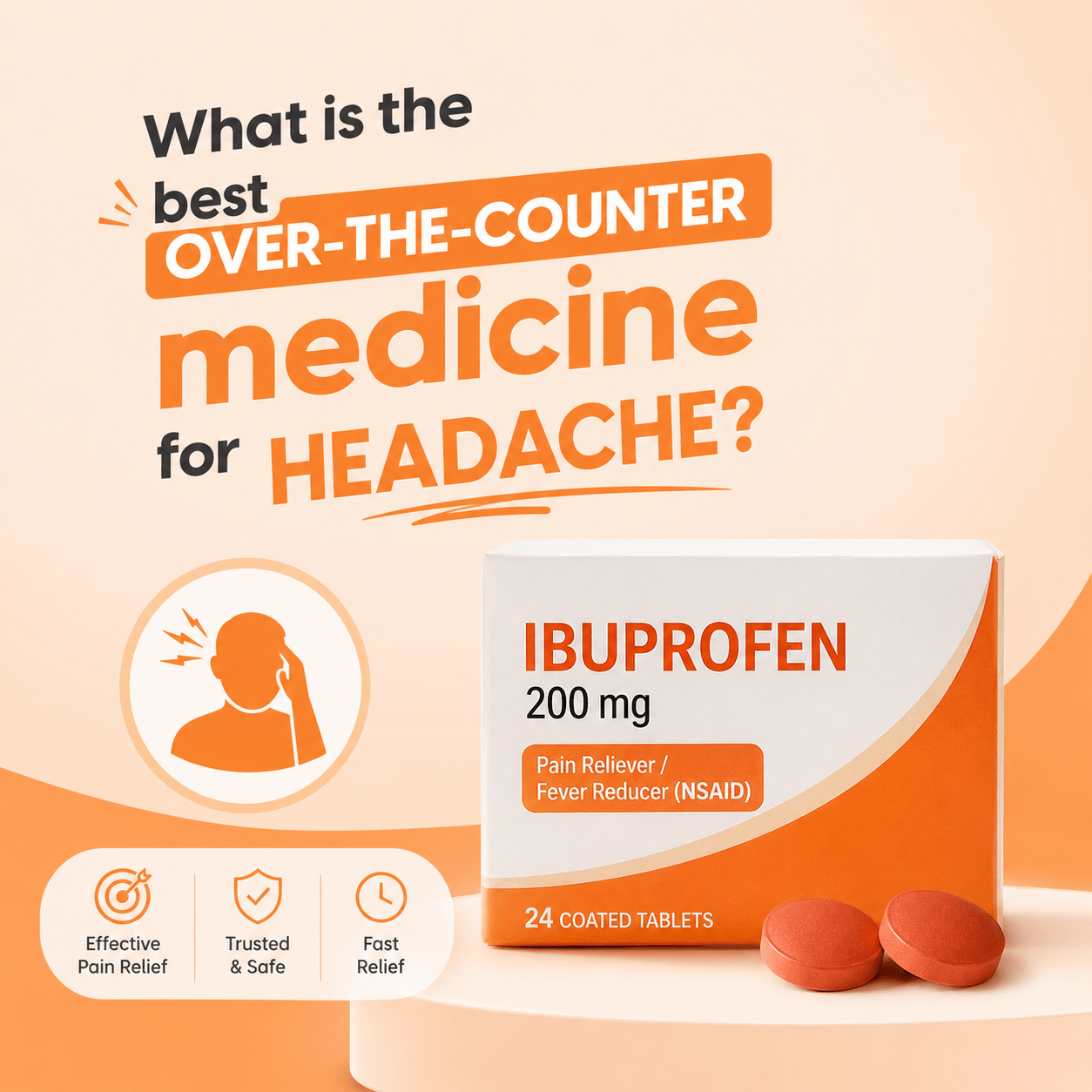
What is the best over-the-counter medicine for headache?
- OTC and Self-Care
- Posted on
-
by enavec_pharmacy
- 0 comments
OTC & Self-Care · Headache Relief
What Is the Best Over-the-Counter Medicine for Headache?
The best OTC medicine for a tension headache is ibuprofen or paracetamol. For migraine, the triple-action formula of paracetamol + aspirin + caffeine (Excedrin) is the #1 neurologist-recommended OTC option. The right choice depends on your headache type — and getting that wrong is the most common reason OTC headache medicines fail.
Headaches are one of the most common reasons people visit a pharmacy. The problem is that "headache" is not a single condition — it is a symptom with dozens of causes, and a medicine that works brilliantly for one type can be completely ineffective for another.[1] A tension headache responds well to ibuprofen taken early. A migraine needs the caffeine amplifier. A sinus headache may need a decongestant alongside pain relief. Getting the diagnosis right first is the most important step.
This pillar guide covers the six most popular OTC headache and head-health categories, the clinical evidence behind each choice, correct dosing, red-flag warnings, and pharmacist-verified product recommendations for each category.
Step One: Identify Your Headache Type
Choosing the right OTC starts with knowing which type of headache you have. The three most common types have different causes and different optimal treatments.
🔵


Tension Headache
Dull, pressing or band-like pain on both sides of the head. Stress, posture, eye strain, or dehydration. ~80% of all headaches.
🟣
Migraine
Pulsating, one-sided, moderate-to-severe. Often with nausea and light/sound sensitivity. Can last 4–72 hours untreated.
🟢
Sinus / Congestion
Pressure around cheeks, eyes, forehead. Accompanies cold, flu, or allergies. May need a decongestant alongside pain relief.
In my experience at the pharmacy counter, the most common mistake I see is a patient with a true migraine taking a single paracetamol tablet — then concluding that "nothing works." Paracetamol at standard doses has limited evidence for migraine.[2] Migraine needs a different strategy: earlier treatment, higher anti-inflammatory activity, and caffeine to enhance drug absorption.
| Medicine | Best For | Onset | Key Caution |
|---|---|---|---|
| Ibuprofen 400mg First Line | Tension headache | 20–30 min | Take with food; avoid in stomach ulcer, kidney disease, pregnancy |
| Paracetamol 1,000mg | Tension headache (NSAID-sensitive) | 30–45 min | Max 4g/day; check other products for hidden paracetamol |
| Paracetamol + Aspirin + Caffeine Migraine | Migraine | 30 min | Not for children under 16; max 2 doses/day; max 10 days/month |
| Naproxen 220mg | Migraine / long-duration headache | 30–60 min | Longer-acting NSAID; avoid in heart failure |
💡 Key Takeaway
Tension headaches respond to ibuprofen or paracetamol taken at the first sign of pain. Migraines need the triple-action formula (paracetamol + aspirin + caffeine). Sinus headaches may need a decongestant. Getting the type wrong is the most common reason OTC headache medicines fail.
What the Evidence Actually Says About OTC Headache Medicines
The clinical evidence on OTC headache relief is more nuanced than most labels suggest — this section summarises what the research actually shows.
A 2015 Cochrane Review of over 5,000 patients found ibuprofen 400mg significantly superior to paracetamol 1,000mg for tension-type headache pain relief at 2 hours.[3] The reason: tension headaches have a significant inflammatory and muscle-tension component that paracetamol alone does not address. Ibuprofen attacks both pain and underlying inflammation simultaneously.
For migraine, the acetaminophen + aspirin + caffeine combination has the strongest evidence base of any OTC formulation. The caffeine acts through two separate mechanisms: it constricts dilated blood vessels that contribute to throbbing migraine pain, and it increases the absorption rate and peak concentration of both aspirin and paracetamol by approximately 40%.[4] Clinical trials published in Cephalalgia and Archives of Neurology demonstrated significant superiority over placebo for migraine pain relief, light sensitivity, and nausea at 2 hours.[5]
Patients frequently ask me whether they can take ibuprofen and paracetamol together for a headache — and my answer is yes, they can be combined or alternated safely. The two medicines work through entirely different pathways with no pharmacological interaction. This combination approach can provide stronger relief than either alone for moderate-to-severe tension headache.[6]
💡 Key Takeaway
For tension headache: ibuprofen 400mg is clinically superior to paracetamol alone. For migraine: the triple-action formula is the strongest OTC available. Paracetamol and ibuprofen can be safely combined or alternated for stronger relief — they work through different mechanisms with no interaction.
Have a question about headache medicines?
Our PCN-licensed pharmacists answer within 2 hours on WhatsApp →
Pharmacist-Verified OTC Picks — 6 Categories, 2 Products Each
The most in-demand OTC headache and pain-relief categories — with two pharmacist-verified products per category, all available on iHerb for worldwide delivery.
Tension Headache Relief
Fast-acting NSAID & paracetamol options · Available Worldwide on iHerbIbuprofen is the clinical first-line for tension headache. Liquid-gel capsules absorb faster than standard tablets — onset in as little as 15–20 minutes. Paracetamol is the safe alternative when NSAIDs are contraindicated.
ADVIL
LIQUI-GELS
Ibuprofen 200mg
160 Capsules
Advil
Liqui-Gels Ibuprofen 200 mg · 160 Capsules
Best Overall · Tension Headache · Fast 15-Min OnsetIbuprofen pre-dissolved in a liquid-gel capsule — absorbs faster than any standard tablet. Targets both pain and inflammation. Take 200–400 mg with food every 6–8 hrs. Max 1,200 mg/day OTC.
🛒 Buy on iHerb
TYLENOL
500 mg
EXTRA STRENGTH
Acetaminophen 50 Caplets
Acetaminophen 50 Caplets
Tylenol
Extra Strength Acetaminophen 500 mg · 50 Caplets
Safe on Empty Stomach · Pregnancy · No NSAID RiskGold-standard paracetamol. Best when NSAIDs are contraindicated — stomach ulcer, pregnancy, kidney disease. Safe on an empty stomach. 500–1,000 mg every 4–6 hrs. Max 4,000 mg/day — check all other products for hidden paracetamol.
🛒 Buy on iHerbThis post contains affiliate links. If you purchase through our iHerb links, we may earn a small commission at no extra cost to you. We only recommend products we would genuinely suggest to our patients.
Migraine Relief
Triple-action formula & targeted NSAID · #1 Neurologist-Recommended OTCMigraine needs a different approach from tension headache. The triple-action formula (paracetamol + aspirin + caffeine) is the most evidence-backed OTC option. Take at the very first warning sign — early treatment gives dramatically better results.
EXCEDRIN
MIGRAINE RELIEF
TRIPLE ACTION 200 Caplets
TRIPLE ACTION 200 Caplets
Excedrin
Migraine Relief · 200 Caplets · Triple-Action
#1 Neurologist-Recommended · Migraine OTCAcetaminophen 250mg + Aspirin 250mg + Caffeine 65mg. Blocks pain signals, reduces vascular dilation, amplifies absorption with caffeine. Take 2 caplets at first sign. Not for under-16s. Max 2 doses/day. Max 10 days/month.
🛒 Buy on iHerb
ADVIL
MIGRAINE
Ibuprofen 200mg
80 Capsules
Advil
Migraine Liquid-Filled Capsules 200 mg · 80 Capsules
OTC Migraine · Fast Liquid Ibuprofen · Aspirin-FreeFDA-approved OTC migraine treatment with solubilised ibuprofen for fast absorption. Best for migraine sufferers who cannot take aspirin. Take 2 capsules with water. No caffeine — better for those caffeine-sensitive. Max 400mg/attack, 1,200mg/day.
🛒 Buy on iHerbAffiliate disclosure: purchases through our iHerb links support Enavec Pharmacy at no extra cost to you.
⚠️ Excedrin + Medication Overuse Warning
Excedrin contains both paracetamol and aspirin — never combine with other paracetamol products (cold tablets, Tylenol, PM formulas). Never give to children under 16 (aspirin). Limit all headache medicines to a maximum of 10 days per month — using them more frequently causes medication overuse headache (MOH), where the treatment makes headaches worse over time.[7]
Sinus & Congestion Headache
Decongestant + expectorant support · OTC · Available Worldwide on iHerbSinus headache is driven by nasal and sinus congestion — a decongestant or nasal rinse often provides more relief than a pain reliever alone. These two products address both the congestion and the mucus that cause sinus pressure.
NEILMED
SINUS RINSE
DRUG-FREE Kit + 50 Sachets
DRUG-FREE Kit + 50 Sachets
NeilMed
Sinus Rinse Complete Kit · Bottle + 50 Sachets
Drug-Free · Sinus Pressure · Congestion ReliefSaline nasal rinse flushes allergens, mucus, and irritants from sinus passages. No drug limit — use twice daily. Evidence-backed for sinus headache, allergic rhinitis, and post-nasal drip. Often more effective than oral decongestants for blocked nasal passages.
🛒 Buy on iHerb
MUCINEX
12-HOUR RELIEF
EXPECTORANT 40 Tablets
EXPECTORANT 40 Tablets
Mucinex
Guaifenesin 600 mg · 40 Extended-Release Tablets
OTC Expectorant · 12-Hour · Chest & Sinus Congestion#1 doctor-recommended expectorant. Thins and loosens mucus in sinuses and chest for easier drainage — directly relieving sinus pressure headache. Extended-release formula works for 12 hours. Take with a full glass of water. Drink 2L+ fluids daily for best effect.
🛒 Buy on iHerbAffiliate disclosure: purchases through our iHerb links support Enavec Pharmacy at no extra cost to you.
Topical & Cooling Headache Relief
Non-oral fast relief · Drug-free options · Available Worldwide on iHerbTopical cooling products provide fast local relief without adding to your oral medicine load — particularly useful when you have already taken your maximum daily dose of paracetamol or ibuprofen, or when you prefer a drug-free approach.
TIGER BALM
ULTRA STRENGTH
TOPICAL RELIEF 44g Ointment
TOPICAL RELIEF 44g Ointment
Tiger Balm
Ultra Strength Pain Relieving Ointment · 44g
Topical · Tension Headache · Neck & Temple ReliefMenthol + camphor + clove oil — apply a small amount to temples, forehead, and back of neck for tension headache relief within minutes. Drug-free, no daily limit. Trusted across Asia, Africa, and globally for headache and muscle pain. A trusted staple in Nigerian households worldwide.
🛒 Buy on iHerb
BIOFREEZE
COOLING
PAIN RELIEF Menthol 3.5% Roll-On Gel
PAIN RELIEF Menthol 3.5% Roll-On Gel
Biofreeze
Cooling Pain Relief Roll-On · Menthol 3.5% · 2.5 oz
Topical · Neck & Tension Headache · Drug-FreeClinically used in physiotherapy — roll-on applicator makes it easy to apply to the back of the neck and shoulders for tension-related headache relief. Cooling effect begins in seconds. No oral drug limit interaction. Used by physiotherapists globally for cervicogenic (neck-origin) headache.
🛒 Buy on iHerbAffiliate disclosure: purchases through our iHerb links support Enavec Pharmacy at no extra cost to you.
Headache Prevention Supplements
Evidence-based supplements for frequent headache & migraine prevention · Available on iHerbIf you are taking OTC headache medicines more than 10 days per month, prevention is more important than treatment. Three supplements have genuine clinical evidence for reducing migraine and tension headache frequency: magnesium, riboflavin (B2), and CoQ10.
NOW FOODS
MAGNESIUM
GLYCINATE
Prevention 180 Tablets
Prevention 180 Tablets
NOW Foods
Magnesium Glycinate 180 Tablets
Headache Prevention · Migraine · Sleep & MuscleMagnesium deficiency is a documented trigger for both migraine and tension headache. Cochrane-reviewed evidence supports 400–600mg daily for migraine prevention. Glycinate form is most absorbable and gentlest on the stomach. Take 1–2 tablets before bed. Results within 4–6 weeks of consistent use.
🛒 Buy on iHerb
NOW FOODS
B-2
RIBOFLAVIN
400mg Migraine 100 Capsules
400mg Migraine 100 Capsules
NOW Foods
Riboflavin (Vitamin B-2) 400 mg · 100 Capsules
Migraine Prevention · B-Vitamin · Mitochondrial SupportRiboflavin 400mg/day is endorsed by the European Headache Federation for migraine prevention — improves mitochondrial energy metabolism in brain cells. Multiple controlled trials show 50% reduction in migraine frequency at 3 months. Note: urine turns bright yellow — harmless. Safe long-term at this dose.
🛒 Buy on iHerbAffiliate disclosure: purchases through our iHerb links support Enavec Pharmacy at no extra cost to you.
Children's Headache & Pain Relief
OTC · Paediatric · Weight-Based Dosing · Available Worldwide on iHerbChildren's headache medicine follows different rules. Aspirin must never be given to anyone under 16. Dose by weight, not age. Liquid formulations allow precise weight-based measurement. Use the Children's OTC Dose Calculator below for the exact safe dose.
GENEXA
160mg/5ml
KIDS' PAIN
& FEVER LIQUID Ages 2–11 · 4 fl oz
& FEVER LIQUID Ages 2–11 · 4 fl oz
Genexa
Kids' Pain & Fever · Acetaminophen 160mg/5ml · 4 fl oz
OTC Paediatric · Ages 2–11 · Clean Label · OrganicOrganic acetaminophen liquid — no artificial dyes, parabens, or synthetic flavours. Measure precisely by weight using the included dosing cup. Safe, effective headache and fever relief for children ages 2–11. Blueberry flavour. Always dose by weight — use the calculator below.
🛒 Buy on iHerb
GENEXA
80mg/tablet
KIDS' CHEWABLE
ACETAMINOPHEN Ages 2–11 · 24 Tabs
ACETAMINOPHEN Ages 2–11 · 24 Tabs
Genexa
Kids' Pain & Fever Chewable · 80 mg · 24 Tablets · Grape
OTC Paediatric · Chewable · Ages 2–11 · Clean LabelClean-label chewable acetaminophen for children who struggle with liquid medicine. Organic grape flavour. Non-GMO, gluten-free, no artificial ingredients. Dose by weight — 80mg per tablet makes weight-based dosing straightforward for older children. Never exceed 5 doses in 24 hours.
🛒 Buy on iHerbAffiliate disclosure: purchases through our iHerb links support Enavec Pharmacy at no extra cost to you.
🧮 Free Tool — Children's OTC Dose Calculator
Not sure of the safe paracetamol or ibuprofen dose for your child's weight? Enter their weight for the precise safe amount — no sign-up needed.
→ Open Children's OTC Dose Calculator
💡 Key Takeaway
Never give aspirin to children under 16. Always dose children's paracetamol by weight — 15 mg/kg per dose, max 5 doses in 24 hours. Use a liquid formulation with a measuring cup for under-6s, chewable tablets for older children who resist liquids.
The Medication Overuse Headache Trap — How to Avoid It
One of the most overlooked causes of chronic daily headache is the very medicines people take to treat them. Understanding this trap prevents a cycle that affects millions globally.
Medication overuse headache (MOH) occurs when OTC pain medicines are used too frequently, causing the brain to become sensitised and produce headaches between doses.[7] The threshold is lower than most people expect: simple analgesics (paracetamol, ibuprofen) used on more than 15 days per month; combination products with caffeine (Excedrin) on more than 10 days per month.
From what I see in practice, MOH is one of the most frustrating and under-recognised conditions because patients increase their OTC use in response to worsening headaches — not realising the medicine is the cause. The pattern to watch for: headaches that are consistently worse in the morning, improve shortly after taking an analgesic, then return several hours later, creating a cycle. Breaking this cycle requires a supervised withdrawal period under medical guidance.
🧮 Drug Interaction Checker
Taking other medicines alongside headache treatment? Always check for interactions before combining OTC and prescription medicines — especially blood pressure medicines, antidepressants, or anticoagulants.
→ Open the Drug Interaction Checker
💡 Key Takeaway
Using any OTC headache medicine more than 10–15 days per month causes medication overuse headache — where the treatment makes the problem progressively worse. If your headache frequency is increasing despite regular OTC use, see a doctor rather than increasing the dose or frequency.
Red-Flag Headache Symptoms That Need a Doctor — Not an OTC
Most headaches are benign. But certain patterns are warning signs of conditions that require urgent medical assessment — not more tablets.
- "Thunderclap headache" — sudden, explosive, reaching maximum intensity within 60 seconds. Medical emergency. Can indicate subarachnoid haemorrhage.[8]
- Headache + fever + stiff neck + light sensitivity — classic triad of bacterial meningitis
- Headache + sudden weakness, speech difficulty, or visual loss — possible stroke
- "Worst headache of my life" — always warrants emergency evaluation
- Headache that wakes you from sleep or is consistently worse in the morning
- New headache in someone over 50, or progressive worsening over weeks
- Headache after head trauma persisting more than 24 hours
⚠️ Call Emergency Services Immediately If:
A sudden, explosive headache — "like being hit on the head" or "the worst of my life" — reaching peak severity within 60 seconds requires immediate emergency care. Call 999 (UK), 911 (US), or your local emergency number. Do not take an OTC and wait.
💡 Key Takeaway
A thunderclap headache is a medical emergency, not an OTC situation. Headache with fever and stiff neck, neurological symptoms, or progressively worsening daily pattern all require urgent medical evaluation. No OTC medicine is the right response to these patterns — it risks masking a dangerous underlying cause.
Myth vs. Fact — 4 Headache Medicine Misconceptions
These are the four most dangerous myths I hear at the pharmacy counter, and the facts that protect patients from harm.
❌ Myth 1"Paracetamol is just as good as ibuprofen for any headache."
✅ FactFor tension headache, ibuprofen 400mg is clinically superior to paracetamol 1,000mg in controlled trials. Paracetamol is indicated when NSAIDs are contraindicated — not as an equivalent substitute. [3]
❌ Myth 2"Taking headache medicine every day prevents headaches from getting severe."
✅ FactUsing analgesics more than 10–15 days per month causes medication overuse headache — the medicine itself becomes the cause of daily headaches. Frequency must be strictly limited. [7]
❌ Myth 3"Ibuprofen and paracetamol cannot be taken together — dangerous combination."
✅ FactParacetamol and ibuprofen work through entirely different pathways with no pharmacological interaction — they can be safely combined or alternated. What is dangerous is combining two NSAIDs (ibuprofen + aspirin). [6]
❌ Myth 4"A sudden severe headache just means I need a stronger OTC."
✅ FactA thunderclap headache — sudden maximum-severity onset within 60 seconds — is a medical emergency requiring immediate evaluation, not a stronger tablet. Taking more OTC medicine risks masking a life-threatening cause. [8]
💊 Pharmacist's Verdict · Enavec Pharmacy
My single best recommendation: match your medicine to your headache type and take it early. For tension headache in a healthy adult — Advil Liqui-Gels 400mg at the very first sign of pain. The liquid-gel formulation absorbs faster than any standard tablet and targets both pain and inflammation simultaneously. Don't wait until the headache peaks — early treatment at 15–20 minutes is dramatically more effective than the same dose given 2 hours later.
For migraine, Excedrin Migraine is the strongest evidence-backed OTC option available without a prescription. The triple-action formula attacks migraine through three different mechanisms. Again: take it at the very first warning sign. If you find yourself using it more than 10 days a month, that is the signal for a proper migraine management plan from a neurologist or GP — not a different OTC.
For prevention: if you have frequent headaches, magnesium glycinate 400mg daily and riboflavin 400mg daily are the two supplements with the strongest evidence for reducing headache and migraine frequency. Give them at least 6–8 weeks of consistent use before evaluating the effect. And always check every product in your medicine cabinet for hidden paracetamol before your next dose — this single check prevents the most common and most dangerous OTC headache medicine error.
PCN-Licensed Pharmacist · Enavec Pharmacy · Lagos, Nigeria
Commonly Searched Headache Topics
>Best OTC for tension headache
>Ibuprofen vs paracetamol headache
>Excedrin Migraine UK equivalent
>OTC migraine medicine fast relief
>Headache medicine during pregnancy
>Medication overuse headache symptoms
>Best OTC for sinus headache
>Thunderclap headache emergency
>Magnesium for migraine prevention
>Children's paracetamol dose by weight
Disclaimer: This article is for informational purposes only and does not constitute medical advice. Always consult your pharmacist or doctor before starting any medicine or supplement, particularly if you are pregnant, breastfeeding, managing a chronic health condition, or taking prescription medicines.
References
- Olesen J et al. The International Classification of Headache Disorders, 3rd edition. Cephalalgia. 2018;38(1):1–211.
- Derry S, Moore RA. Paracetamol (acetaminophen) with or without an antiemetic for acute migraine headaches in adults. Cochrane Database of Systematic Reviews. 2013;(4):CD008040.
- Rabbie R, Derry S, Moore RA. Ibuprofen with or without an antiemetic for acute migraine headaches in adults. Cochrane Database of Systematic Reviews. 2013;(4):CD008039. doi:10.1002/14651858.CD008039.pub3
- Sawynok J, Yaksh TL. Caffeine as an analgesic adjuvant: a review of pharmacology and mechanisms of action. Pharmacological Reviews. 1993;45(1):43–85.
- Goldstein J et al. Acetaminophen, aspirin, and caffeine versus ibuprofen for migraine. Cephalalgia. 2006;26(8):987–994.
- National Institute for Health and Care Excellence (NICE). Headaches in over 12s: diagnosis and management. Clinical Guideline CG150. NICE; 2012 (updated 2021). nice.org.uk
- Diener HC et al. Medication-overuse headache: risk factors, pathophysiology and management. Nature Reviews Neurology. 2019;15(2):78–92.
- Linn FHH et al. The clinical characteristics of the thunderclap headache: a prospective study. Headache. 1998;38(4):256–261.
- Schoenen J et al. Effectiveness of high-dose riboflavin in migraine prophylaxis. Neurology. 1998;50(2):466–470.
- Peikert A, Wilimzig C, Köhne-Volland R. Prophylaxis of migraine with oral magnesium. Cephalalgia. 1996;16(4):257–263.
Found this helpful? Share it:
⚠️
Medical & Affiliate Disclaimer This article is for informational purposes only and does not constitute medical advice. Always consult a qualified healthcare provider before starting any supplement or medication. Some links in this post are affiliate links - if you purchase through them, Enavec Pharmacy may earn a small commission at no extra cost to you.
