
- Your cart is empty
- Continue Shopping
What should I do if I miss a dose of antibiotics?
- Antibiotics
- Posted on
-
by Enavec Pharmacy
- 0 comments
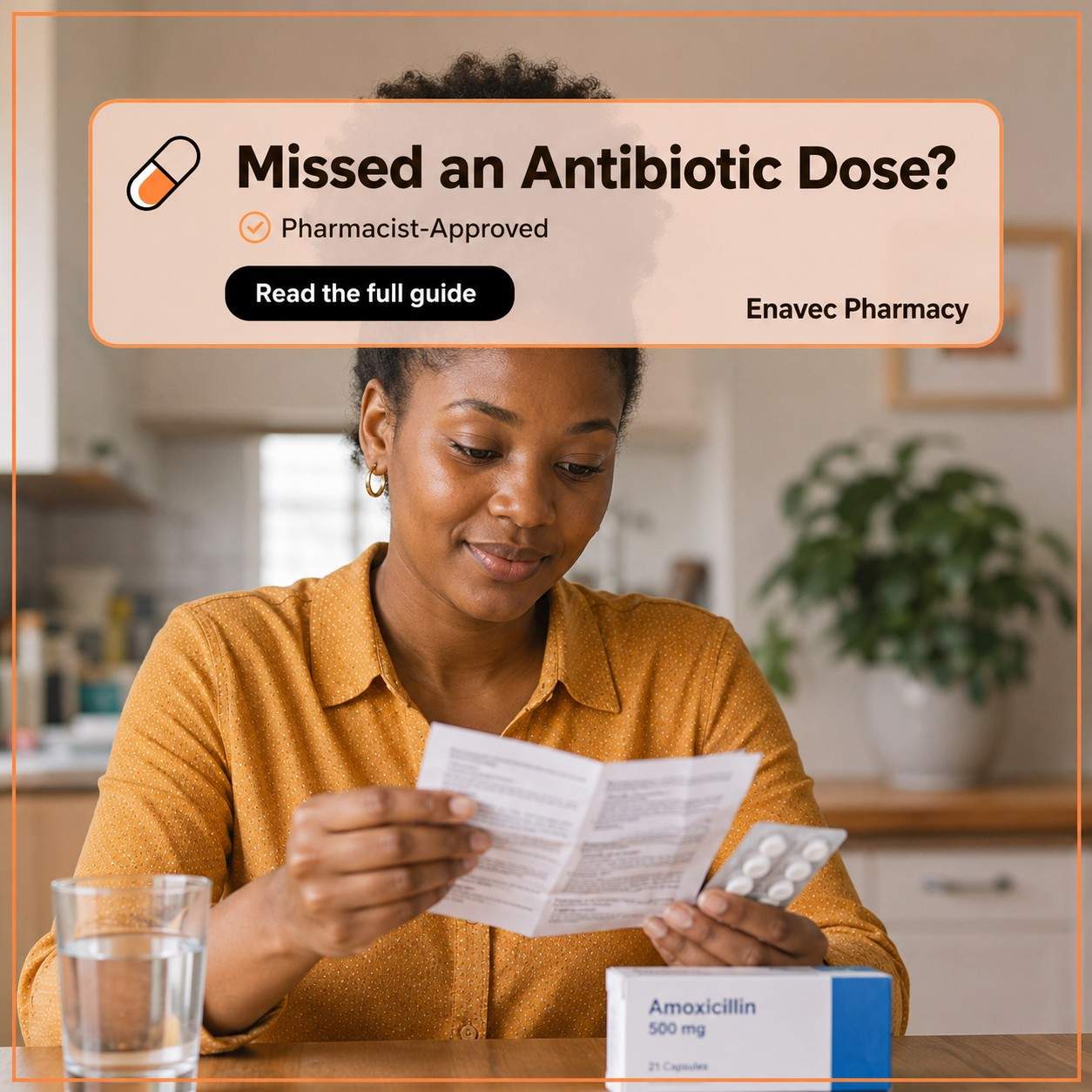
If you miss a dose of antibiotics, take it as soon as you remember. But if your next scheduled dose is only a couple of hours away, skip the missed one entirely and carry on as normal. Never take two doses at the same time to catch up. That single rule covers 90% of the situations patients ask me about at my counter.
But there is more to this than the quick answer. The reason the timing rule matters, what happens to your treatment when you skip doses, and how to make sure it never becomes a habit worth worrying about, all of that is worth understanding properly. So let us go through it.
The Exact Rule for a Missed Antibiotic Dose
Antibiotic dosing schedules exist for one reason: to keep the drug concentration in your blood high enough to kill bacteria, continuously, for the full course of treatment.[1] When you take your dose late, there is a window where blood levels drop. Most of the time, one delayed dose does not cause the whole treatment to fail. But doubling up introduces the opposite problem.
Taking two doses at once pushes the drug concentration far above the therapeutic range. For certain antibiotics, particularly those processed by the liver or kidneys, this can cause serious side effects: severe nausea, liver stress, and in some cases real toxicity.[2] The antibiotic does not become more effective at twice the dose. It simply becomes harder on your body.
Here is the practical rule broken down clearly:
If you remember within a few hours: Take the dose immediately and continue your normal schedule from there.
If your next dose is only 2 to 3 hours away: Skip the missed one completely. Take the next dose at its usual time. Continue the rest of the course as prescribed.
Always check your specific antibiotic leaflet, because a few medications have specific advice that differs slightly. When in doubt, call your pharmacist. That is exactly what we are here for.
💡 Key Takeaway
Take a missed antibiotic dose as soon as you remember. If the next dose is nearly due, skip it. Never double dose. Continue the full prescribed course no matter what.
Why Missing Multiple Doses Is a Bigger Problem Than Missing One
One missed dose, caught quickly and handled correctly, rarely derails a course of antibiotics. The problem builds when one missed dose turns into two, then three, then the patient decides to stop because they feel better. That pattern is one of the main drivers of antibiotic resistance worldwide.[3]
Here is what happens inside your body when blood antibiotic levels drop repeatedly. Bacteria do not die all at once. At full therapeutic concentration, the antibiotic suppresses bacterial growth and kills the most vulnerable organisms first. The ones that survive early in a course tend to be more resistant. They survive precisely because they have some natural defence against the drug.
When levels drop below the minimum inhibitory concentration (the lowest concentration that stops bacterial growth), those surviving bacteria get a window. They replicate. Some of their offspring inherit the resistance traits that allowed them to survive. By the time you resume the antibiotic, you are fighting a slightly tougher population. Miss enough doses and the drug may no longer work effectively at all.[4]
I often see patients come in asking about this after their infection returned. What they describe is almost always the same story: they felt better on day three or four, life got busy, doses were skipped, and now they are back feeling worse. The second course is harder. Sometimes we need to switch to a stronger or different antibiotic. That escalation is avoidable.
💡 Key Takeaway
Missing one dose is manageable. Missing multiple doses, or stopping early because you feel better, risks treatment failure and pushes bacteria toward resistance. Always finish the full course. This is explained in depth on our complete guide to antibiotics, misuse, and resistance.
Have a question about your antibiotic course? Our PCN-licensed pharmacist answers within 2 hours on WhatsApp. Send a message →
How Antibiotics Are Dosed and Why Timing Matters
Each antibiotic has a half-life: the time it takes for the concentration in your blood to fall by half. For amoxicillin, that half-life is roughly 1 to 1.3 hours.[5] This is why amoxicillin is prescribed every 8 hours, not once daily. The aim is to maintain enough drug in the blood continuously, without letting the concentration fall too low between doses.
Other antibiotics work differently. Azithromycin, for example, has a half-life of around 68 hours and accumulates in tissues, which is why a 3-day or 5-day course achieves clinical effects that extend well beyond when you finish the pack.[6] If you miss a dose of azithromycin, the consequence is less immediate than missing a dose of amoxicillin. But you should still not double up.
Once-daily antibiotics like doxycycline and ciprofloxacin (in single-dose regimens) are somewhat more forgiving if a dose is missed by a few hours. But antibiotics prescribed three or four times daily are far more sensitive to schedule gaps. The window between "still effective" and "dropped too low" is shorter.
And this is the point I always emphasise to patients: the schedule on the label is not a suggestion. It is the clinical dosing interval that was established through pharmacokinetic research. When you shift it by skipping doses, you are substituting your own judgment for a calculation made by someone who spent years studying how this drug behaves in the human body.
💊 From the Pharmacy Counter | Iloanugo Chijioke, B.Pharm, RPh, PCN 020322
One of the clearest cases of antibiotic resistance I have witnessed in practice came in the form of a patient who had been on three different antibiotic courses in two months for what he described as a persistent throat and chest infection. He came to me after the third course failed and was asking for something stronger. When I reviewed what he had taken and asked how he had taken them, the pattern was immediately obvious. He had not completed a single course. Each time he felt better after four or five days, he stopped. Each time the infection returned, slightly changed, slightly more resistant.
What I explained to him was this: imagine you are fighting an army. You defeat 90% of them, declare victory, and go home. The 10% that survived are not the weak ones. They are the ones who survived because they were stronger. When they regroup and attack again, they bring those survival traits with them. The next antibiotic has to fight a tougher enemy. That is what he had been doing to his own body for two months.
💡 Key Takeaway
The dosing interval on your antibiotic label is based on pharmacokinetics, not convenience. A once-daily antibiotic tolerates a delayed dose better than a four-times-daily one. Still: never double up, and always complete the course.
Practical Tips to Stop Missing Antibiotic Doses
The most common reason patients miss doses is not carelessness. It is a life that does not naturally pause at 8am, 2pm, and 10pm to take a tablet. Antibiotic courses are short. The habits required to take them correctly are not instinctive. Here is what actually works.
Set a phone alarm before you take the first dose. Name the alarm after the antibiotic, not just "medicine." Seeing "Amoxil 500mg" on your lock screen is harder to dismiss than a generic reminder.
Link each dose to a fixed daily habit. For a twice-daily antibiotic: dose one with your morning toothbrush, dose two with your evening toothbrush. For three-times-daily: breakfast, lunch, and bedtime. The habit anchors the dose so you do not have to rely on memory alone.
A weekly pill organiser is underrated for short courses. Load it at the start of the course and you will see at a glance whether today's dose was taken. Guessing "did I take it?" becomes unnecessary.
If you are travelling or your routine changes during a course, set an extra alarm that morning. One disrupted day is enough to throw off a carefully maintained schedule.
From my experience at the pharmacy counter, the patients who finish their antibiotic courses consistently are the ones who set up their reminders before leaving the pharmacy. Not later. Before they step outside. That extra minute at the counter makes a real difference to outcomes.
🧮 Know Your Numbers — Wondering how your antibiotic habits might affect resistance risk over time? Use our free Antibiotic Resistance Risk Quiz for a personalised assessment in under 2 minutes — no sign-up needed. →
💡 Key Takeaway
Set alarms before leaving the pharmacy. Link doses to fixed daily habits. A pill organiser removes the guesswork. One minute of preparation at the start prevents five days of wondering whether you took your dose.
What About Probiotics During an Antibiotic Course?
Antibiotics kill bacteria. That is the point. But they do not discriminate perfectly between the pathogenic (harmful) bacteria causing your infection and the commensal (beneficial) bacteria living in your gut. Broad-spectrum antibiotics in particular, such as amoxicillin-clavulanate (Augmentin) and ciprofloxacin, significantly disrupt gut microbiome diversity during a course.[7]
This disruption is why antibiotic-associated diarrhoea is so common. It can also lower the natural competitive suppression that healthy gut bacteria provide against opportunistic organisms like Clostridioides difficile.
Taking a multi-strain probiotic during and after your antibiotic course helps restore that microbial balance. The key clinical detail that most patients do not know is the timing rule: take your probiotic at least two hours after your antibiotic dose, not at the same time. If you take the probiotic immediately after the antibiotic, the still-active drug in your gut will kill much of the probiotic bacteria before they reach the intestine. Two hours apart gives the antibiotic time to be absorbed and reduces that conflict.[8]
Continue the probiotic for at least two weeks after finishing the antibiotic course. Gut microbiome recovery takes time. One week of probiotics during the course alone is not enough to fully restore what a 7-day antibiotic course disrupts.
Pharmacist Recommended
✦ Pharmacist Pick
Take 2 hrs after antibiotic dose
California
Gold 30B CFU PROBIOTICS
8 Strains
Gold 30B CFU PROBIOTICS
8 Strains
Multi-strain
Probiotic
Probiotic
California Gold Nutrition
LactoBif Probiotics 30B CFU · 60 Veggie Caps
★★
★★
★
/ 5 · 2,400+ reviews
- ✓8 clinically studied strains including L. acidophilus and B. longum
- ✓Restores gut microbiome disrupted by antibiotic treatment
- ✓Shelf-stable, individually foil-sealed capsules — no refrigeration needed
This post contains affiliate links. If you purchase through our iHerb links, we may earn a small commission at no extra cost to you. We only recommend products we would genuinely suggest to our patients.
💡 Key Takeaway
Take a probiotic at least two hours after each antibiotic dose, not at the same time. Continue for at least two weeks after finishing the antibiotic course. This supports the gut microbiome recovery that antibiotics disrupt. Read more in our guide on why stopping antibiotics early is a problem.
Myth vs Fact: Common Misconceptions About Missed Antibiotic Doses
Patients tell me things at my counter that they have heard from neighbours, read on social media, or simply assumed over time. Several of these beliefs are wrong in ways that affect real health outcomes. Let us set them straight.
❌ Myth
"If I miss a dose, I should take double the next time to make up for it."
✓ Fact
Doubling up raises blood concentration above the therapeutic range without making the antibiotic more effective. It increases the risk of side effects significantly.[2] Skip the missed dose if the next one is close. Never double dose.
❌ Myth
"Once I feel better, the antibiotic has done its job. Finishing the rest is optional."
✓ Fact
Feeling better means the drug is working, not that the bacteria are gone. The survivors of the early treatment days are the most resistant ones. Stopping early lets them multiply.[3] Finish every dose.
❌ Myth
"One missed dose will ruin my whole treatment course."
✓ Fact
One missed dose handled correctly (take it as soon as you remember, or skip if the next is close) will not typically cause treatment failure.[1] Consistently missing multiple doses is the real danger.
❌ Myth
"Saving leftover antibiotics for next time saves money and is just as effective."
✓ Fact
Leftover antibiotics are rarely enough for a full second course, may be wrong for the new infection, and the drug can degrade over time. Self-prescribing saved antibiotics is a direct driver of resistance.[4] Dispose of leftovers safely.
✦ Pharmacist Verdict
Take the missed dose as soon as you remember. If the next dose is coming up soon, skip it. Never double up. And finish the entire course, even when you feel completely fine by day four. I have seen too many patients come back with a returned infection, a tougher one, because they stopped three days early.
The most important antibiotic you will ever take is the one sitting on your bedside table right now at 10pm that you are tempted to leave until morning. That one dose matters. Set the alarm. Take it. There is very little in medicine that costs less effort and makes more difference than finishing an antibiotic course correctly. Pair it with a probiotic taken two hours apart, and your gut will also thank you when the course ends.
And if in Nigeria, look for antibiotics with a valid NAFDAC registration number on the packaging before you buy. Internationally, brands with NSF or USP certification are the ones to trust for quality assurance.
Iloanugo Chijioke, B.Pharm, RPh, PCN Reg. No. 020322
Frequently Asked Questions
Take the missed dose as soon as you remember, unless your next scheduled dose is only a few hours away. If the next dose is coming up soon, skip the missed one and continue your normal schedule. Never double up to make up for a missed dose. Stick to the remaining doses and complete the full course.
Taking two doses at once raises the drug concentration in your blood beyond the therapeutic range. This can cause serious side effects including severe nausea, vomiting, liver stress, and kidney strain. It does not improve the effectiveness of the antibiotic. Always skip the missed dose if the next one is due soon.
One missed dose is unlikely to make your treatment fail if you take it as soon as you remember and then complete the full course. The danger is missing several doses over multiple days, which lowers drug levels enough to allow surviving bacteria to multiply, potentially leading to treatment failure or antibiotic resistance.
Yes, probiotics are safe to take alongside antibiotics. However, you should space them at least two hours apart from your antibiotic dose. This prevents the antibiotic from killing the probiotic bacteria before they reach your gut. A multi-strain probiotic taken during and after your antibiotic course helps restore healthy gut bacteria.
No. Feeling better means the antibiotic is working, not that the infection is gone. The bacteria that survive early into the course are often the strongest ones. Stopping early allows them to regroup, can cause the infection to return, and contributes to antibiotic resistance. Always complete the full prescribed course. See our full guide: Can I Stop Antibiotics When I Feel Better?
Set a phone alarm timed to your dose schedule before you take the first tablet. Link each dose to a daily habit you never skip, such as brushing your teeth or eating breakfast. A weekly pill organiser helps you see at a glance whether you have taken your dose. If forgetting is a persistent problem, speak to your pharmacist about whether a simpler once-daily antibiotic is an option for your infection.
Commonly Searched Topics
missed antibiotic dose
antibiotic dosing schedule
can I double dose antibiotics
probiotics with antibiotics
antibiotic resistance
finish antibiotic course
antibiotic half-life
Related Posts
References
- Lacy CF, Armstrong LL, Goldman MP, et al. Drug Information Handbook. 29th ed. Lexicomp; 2021. Antibiotic pharmacokinetic dosing principles.
- World Health Organization. Antibiotic Resistance: Key Facts. WHO; 2023. https://www.who.int/news-room/fact-sheets/detail/antibiotic-resistance
- Llor C, Bjerrum L. Antimicrobial resistance: risk associated with antibiotic overuse and initiatives to reduce the problem. Ther Adv Drug Saf. 2014;5(6):229-241. doi:10.1177/2042098614554919
- Centers for Disease Control and Prevention. Antibiotic Use and Antibiotic Resistance. CDC; 2023. https://www.cdc.gov/antibiotic-use/index.html
- Nightingale CH, Ambrose PG, Drusano GL, Murakawa T, eds. Antimicrobial Pharmacodynamics in Theory and Clinical Practice. 2nd ed. Informa Healthcare; 2007. Amoxicillin pharmacokinetics, pp. 45-48.
- Drew RH. Azithromycin: Pharmacology and Clinical Uses. UpToDate; 2024. https://www.uptodate.com
- Dethlefsen L, Relman DA. Incomplete recovery and individualized responses of the human distal gut microbiota to repeated antibiotic perturbation. Proc Natl Acad Sci USA. 2011;108(Suppl 1):4554-4561. doi:10.1073/pnas.1000087107
- Suez J, Zmora N, Segal E, Elinav E. The pros, cons, and many unknowns of probiotics. Nat Med. 2019;25(5):716-729. doi:10.1038/s41591-019-0439-x
This article is for informational purposes only and does not constitute medical advice. Always consult your pharmacist or doctor before starting any medicine or supplement.
Found this helpful? Share it:
⚠️
Medical & Affiliate Disclaimer This article is for informational purposes only and does not constitute medical advice. Always consult a qualified healthcare provider before starting any supplement or medication. Some links in this post are affiliate links - if you purchase through them, Enavec Pharmacy may earn a small commission at no extra cost to you.
