
- Your cart is empty
- Continue Shopping
What is the best over-the-counter medicine for motion sickness?
- OTC and Self-Care
- Posted on
-
by Enavec Pharmacy
- 0 comments
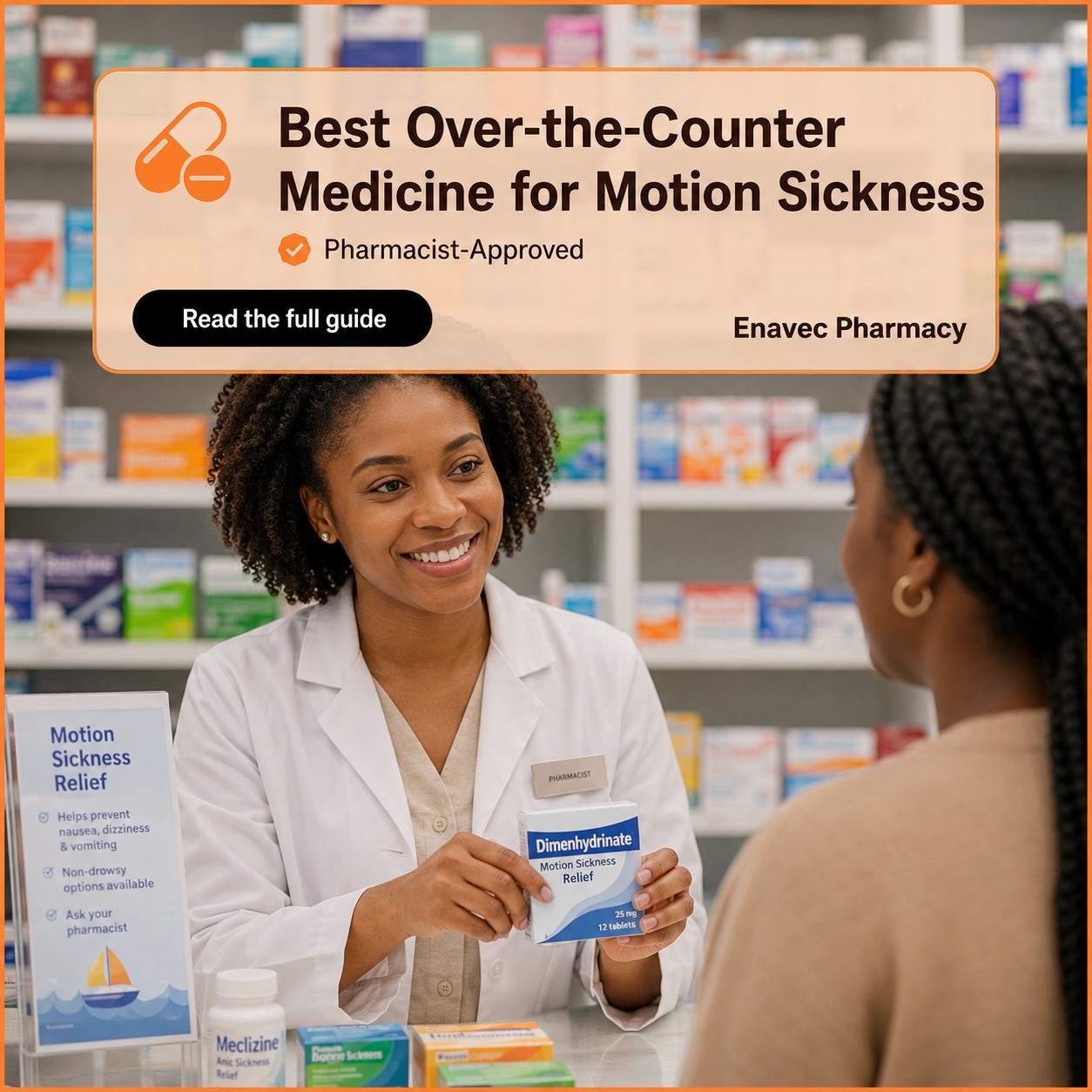
For most adults, the best over-the-counter medicine for motion sickness is an antihistamine like dimenhydrinate (Dramamine) or meclizine (Dramamine Less Drowsy, Bonine), taken 30 to 60 minutes before you travel.[1] If you would rather stay alert than sleep through the trip, a ginger-based supplement is the strongest non-drowsy alternative, and the clinical trials genuinely back it up.[3]
I have sold both options across the counter for ten years, and the right pick really depends on what you are protecting against: the nausea itself, or the drowsiness that comes with treating it. This guide walks through both paths, including the specific products I actually recommend, and it pairs naturally with our complete guide to over-the-counter medicines if you want the wider picture first.
Why Motion Sickness Happens in the First Place
Motion sickness happens when your inner ear, which tracks balance and movement, sends your brain a different story than your eyes do.[2][4] Sit inside a moving car reading a book, and your eyes report that nothing is moving while your inner ear insists otherwise. Your brain does not know which signal to trust, and that confusion is what produces the nausea, sweating, and dizziness you feel.
Children between roughly two and twelve years old are the most susceptible group, and most outgrow it by their late teens.[4] Pregnant women and migraine sufferers also tend to react more strongly to the same triggers. One early warning sign that patients often miss is yawning. They describe feeling fine one minute and unusually restless the next, right before the nausea sets in properly.
It helps to separate this from other kinds of nausea before you reach for anything. If your queasiness shows up alongside heartburn rather than travel, you are probably dealing with reflux instead, and our guide to the best OTC medicine for acid reflux covers that separately.
Key takeaway: Motion sickness comes from a mismatch between what your eyes see and what your inner ear feels, not from anything wrong with your stomach. That is why staring at the horizon often helps more than any tablet.
The Best OTC Option for Most People: Antihistamines
That sensory mismatch is exactly what antihistamines are built to interrupt. Dimenhydrinate and meclizine calm the signal traffic between your inner ear and the part of your brain that triggers vomiting, and both are sold without a prescription in pharmacies across the US, UK, Canada, and most of Europe.[1] Take either one 30 to 60 minutes before you set off, not after you already feel unwell, since they prevent the reaction far better than they reverse it.
Drowsiness is the trade-off, and it is not a minor one. Meclizine in particular can leave you groggy for hours, which is exactly why CDC travel guidance flags sedating antihistamines as unsuitable for anyone who needs to drive, operate machinery, or supervise small children during the journey.[2] And if you have glaucoma or trouble passing urine, check with your pharmacist first, since the related drug scopolamine is specifically contraindicated in both conditions.[1]
In my experience at the pharmacy counter, the patients who do best with motion sickness medicine are the ones who take it before they feel anything, not after the nausea has already started. By the time someone reaches for a tablet mid-journey, gastric emptying has slowed and the medicine has a much harder job absorbing properly.
💬 Have a question about motion sickness medicine? Our PCN-licensed pharmacist answers within 2 hours on WhatsApp → https://wa.me/2347068357391
Key takeaway: Antihistamines remain the best-studied OTC option for moderate to severe motion sickness, but the drowsiness means they are not the right choice for anyone who needs to stay sharp during travel.
Non-Drowsy Alternative: Ginger-Based Supplements (Our Pharmacist Picks)
Drowsiness is exactly why so many travellers ask me about ginger instead. Unlike antihistamines, ginger does not act on the brain's vomiting centre directly. It appears to work on the stomach itself, speeding gastric emptying and calming the same serotonin pathways that trigger nausea.[3] A systematic review of randomised clinical trials found ginger genuinely outperforms placebo for seasickness and several other forms of nausea, though the effect tends to be milder than a full antihistamine dose.[3]
Patients frequently ask me whether ginger can really replace Dramamine, and my answer is always: for mild to moderate motion sickness, it often comes close, without the grogginess that follows you off the plane. I recommend starting with a product like this one if you specifically need to drive on arrival, mind children, or simply hate feeling foggy on holiday.
Pharmacist Recommended
✦ Pharmacist Pick
Chew 30 min before travel
Natural
Factors 500mg · 90ct GINGER
CHEWABLE
Factors 500mg · 90ct GINGER
CHEWABLE
Chewable
Ginger Tablet
Ginger Tablet
Natural Factors
Chewable Ginger, 500 mg · 90 Chewable Tablets
★★
★★
★
/ 5 · 463 reviews
- ✓20mg organic ginger extract per tablet, equal to 500mg ginger
- ✓Backed by randomised trials showing ginger eases motion-related nausea
- ✓Sugar-free, stevia-sweetened, and the 90-tablet pack lasts most travellers months
This post contains affiliate links. If you purchase through our iHerb links, we may earn a small commission at no extra cost to you. We only recommend products we would genuinely suggest to our patients.
If you specifically struggle with seasickness or long car journeys and want something built around a brand already known for travel sickness rather than a general digestive supplement, Gravol's ginger tablets are worth keeping in your bag too.
Pharmacist Recommended
✦ Pharmacist Pick
Take 30-60 min pre-departure
Gravol
Ginger 20mg · 20ct TRAVEL
SICKNESS
Ginger 20mg · 20ct TRAVEL
SICKNESS
Ginger
Coated Tablet
Coated Tablet
Gravol
Ginger, 20 Coated Tablets
★★
★★
★
/ 5 · 5 reviews
- ✓Certified organic ginger standardised to 25% gingerols per tablet
- ✓Made by Gravol, a brand already trusted for motion sickness relief
- ✓Coated and taste-free, so there is no lingering ginger aftertaste
Key takeaway: Ginger will not replace a sedating antihistamine for severe motion sickness, but for mild to moderate cases, and for anyone who needs to stay alert, it is a genuinely evidence-backed first choice.
When Dizziness Is the Bigger Problem, and Who Should Be Careful
Some people experience motion sickness less as nausea and more as straightforward dizziness, with the floor still tilting under them long after the car has stopped. For that specific picture, a ginger formula paired with grape seed extract, like Dr. Barton's Dizzy Stop, targets the inner ear and circulatory side of the problem rather than just the stomach.
Pharmacist Recommended
✦ Pharmacist Pick
Start the day before travel
Dr. Barton's
DizzyStop 1,025mg Blend VERTIGO
SUPPORT
DizzyStop 1,025mg Blend VERTIGO
SUPPORT
Ginger +
Grape Seed
Grape Seed
Dr. Barton's
Dizzy Stop Control, 80 Capsules
★★
★★
★
/ 5 · 43 reviews
- ✓Combines ginger root powder with grape seed extract in a 1,025mg blend
- ✓Formulated for dizziness and vertigo, not only stomach-based nausea
- ✓Non-drowsy dosing schedule starts the day before travel for extra cover
But persistent or recurring dizziness that shows up even when you are not travelling deserves a proper checkup rather than another supplement, since it can point to an inner ear condition that needs its own treatment.[2]
Children need the most caution of anyone in this picture. Dimenhydrinate is generally considered appropriate from age two upward, but the dose has to be worked out by weight, and giving a child an adult formulation in a guessed "smaller" amount is not the same thing as giving a correct paediatric dose.[5]
💊 From the Pharmacy Counter, Iloanugo Chijioke, B.Pharm, RPh
The question about giving adult Benylin to a child in a smaller dose is one I handle very carefully because the answer is not simply about arithmetic. Adult Benylin formulations contain antihistamines and cough suppressants, diphenhydramine, dextromethorphan, or guaifenesin depending on the variant, at concentrations calibrated for adult body weight and adult liver metabolism. A child's liver does not process these compounds the same way. In very young children, antihistamines can cause paradoxical hyperexcitability or, at higher doses, respiratory depression. The concept of "smaller dose" is deceptively simple: the parent does not know what concentration is safe, what the child's exact weight-based dose should be, or whether the specific formulation is safe for their child's age at all. What I always say is: bring me the child's weight and age, and I will tell you exactly what is appropriate and at what dose. Paediatric cough syrups exist for a reason. I do not guess with children's medication, and I do not let parents guess either.
🧮 Know Your Numbers — Working out a safe children's dose for an OTC motion sickness product? Use our free Children's OTC Medicine Dose Calculator to get a personalised, weight-based estimate in under 2 minutes, no sign-up needed. → https://enavecpharmacy.com/childrens-otc-medicine-dose-calculator/
And if nausea has already tipped over into vomiting rather than staying as plain queasiness, the approach changes again. Our guide to the best OTC medicine for vomiting walks through what to do once you are past the prevention stage.
Key takeaway: Sedating antihistamines and ginger both carry real cautions for children, pregnancy, glaucoma, and pre-existing dizziness. When in doubt, confirm the dose with a pharmacist rather than guessing from an adult pack.
Motion Sickness: Myths vs Facts
❌ Myth
If a medicine doesn't make you drowsy, it can't actually be working.
✅ Fact
True for non-sedating antihistamines specifically, since CDC travel guidance notes that antihistamines without a drowsy effect generally don't relieve motion sickness.[2] Ginger is the exception. It works through a different pathway, and trials show it still reduces nausea without sedation.[3]
❌ Myth
You should wait until you actually feel sick before taking something.
✅ Fact
Both antihistamines and ginger work far better as prevention. Mayo Clinic guidance recommends taking either one 30 to 60 minutes before travel begins, not after symptoms appear.[1]
❌ Myth
Ginger is just a kitchen spice, so it can't really compete with real medicine.
✅ Fact
Multiple randomised, placebo-controlled trials have tested ginger specifically for seasickness and other forms of nausea, and a systematic review concluded the effect is real, not anecdotal.[3]
Pharmacist Verdict
If you already know a long flight, ferry, or winding road wrecks you, take dimenhydrinate or meclizine 30 to 60 minutes before you leave and accept that you might nap through part of the trip. If your motion sickness is mild, occasional, or you need to stay alert to drive or watch children, start with a ginger-based product like the ones above instead. I do not recommend stacking a sedating antihistamine with another sleep-inducing supplement on the same trip, and I never recommend giving a child an adult motion sickness tablet in a guessed "smaller" dose. Get the weight-based dose right, or don't give it at all.
Iloanugo Chijioke, B.Pharm, RPh, PCN Reg. No. 020322
Frequently Asked Questions
For most adults, antihistamines such as dimenhydrinate (Dramamine) and meclizine (Bonine) are the best-studied OTC options, taken 30 to 60 minutes before travel. Ginger-based supplements work well for milder symptoms without causing drowsiness, making them a good first choice if you need to stay alert during travel.
Some antihistamines like dimenhydrinate are approved for children over age 2, but dosing must be calculated by weight, not guessed. Sedating antihistamines can cause paradoxical excitement in young children rather than sleepiness, so a pharmacist or doctor should confirm the dose before you give any OTC product.
Yes, to a meaningful degree. Several randomized controlled trials have found ginger reduces nausea and vomiting from motion sickness and seasickness compared with placebo, although it tends to work best when started before symptoms begin rather than after you already feel unwell.
Generally yes, since ginger and antihistamines work through different mechanisms and don't typically interact. Many people use ginger first and add an antihistamine only if symptoms are severe, but check with your pharmacist if you take blood thinners, since ginger can mildly affect clotting.
Most OTC antihistamines and ginger supplements work best taken 30 to 60 minutes before you start travelling, not after symptoms appear. If you know you're prone to motion sickness, starting the day before a long trip with ginger can offer extra protection.
Related Reading
Commonly Searched Topics
Motion sickness remedies
Dramamine vs Bonine
Ginger for nausea
Travel sickness in children
Seasickness tablets
Non-drowsy motion sickness
Scopolamine patch
Car sickness tips
References
- Mayo Clinic. Motion sickness: First aid. mayoclinic.org
- CDC Yellow Book. Motion Sickness. cdc.gov
- Efficacy of ginger for nausea and vomiting: a systematic review of randomized clinical trials. PubMed. pubmed.ncbi.nlm.nih.gov
- NHS. Motion sickness. nhs.uk
- Mayo Clinic. Car sickness in children: Can I prevent it? mayoclinic.org
This article is for informational purposes only and does not constitute medical advice. Always consult your pharmacist or doctor before starting any medicine or supplement.
Found this helpful? Share it:
⚠️
Medical & Affiliate Disclaimer This article is for informational purposes only and does not constitute medical advice. Always consult a qualified healthcare provider before starting any supplement or medication. Some links in this post are affiliate links - if you purchase through them, Enavec Pharmacy may earn a small commission at no extra cost to you.
