
- Your cart is empty
- Continue Shopping
What is the best over-the-counter medicine for acid reflux?
- OTC and Self-Care
- Posted on
-
by Enavec Pharmacy
- 0 comments
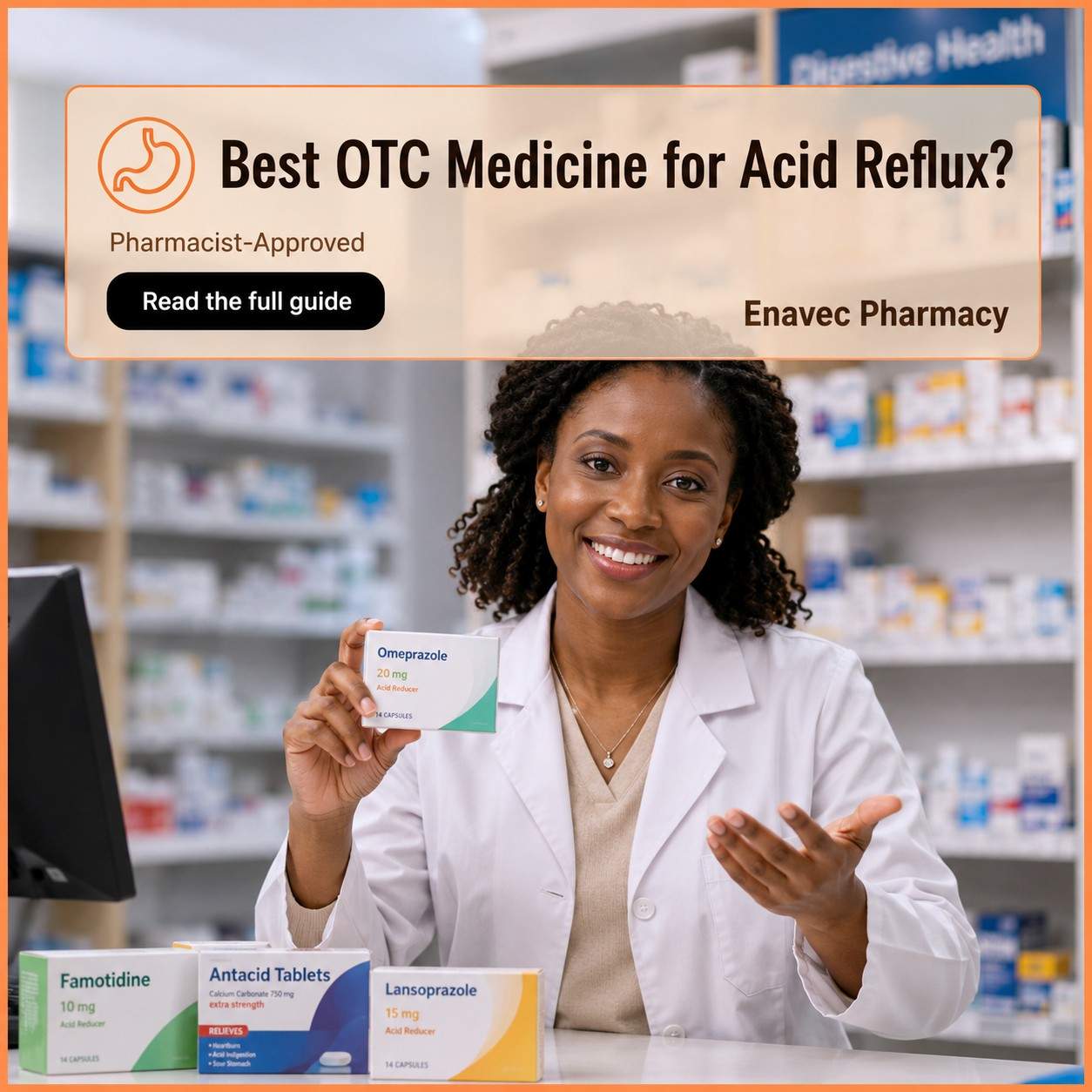
For heartburn that strikes once in a while, a calcium carbonate antacid like Tums or Rolaids works fastest. For heartburn that shows up two or more days a week, omeprazole (Prilosec OTC), a proton pump inhibitor, is the over-the-counter option pharmacists reach for most, and famotidine (Pepcid AC) sits in between as a same-day option that lasts longer than an antacid. None of the three is universally "best." The right one depends on how often your reflux happens and how fast you need it gone.
Acid reflux is one of the most self-treated conditions on a pharmacy shelf, and also one of the most mismatched. Patients reach for whatever they have always used, even when the actual pattern of their symptoms has changed. This guide breaks down what each OTC category genuinely does, when a supplement like DGL licorice or mastic gum earns a real place next to the antacids, and exactly when reflux stops being a problem a pharmacy can solve on its own. For the wider picture on self-care choices beyond reflux specifically, our complete guide to over-the-counter medicines covers the full OTC aisle drug by drug.
ℹ️ All recommendations are for informational purposes. Always consult a healthcare provider before starting a new supplement or medication.
Antacids, H2 Blockers, and PPIs: What Each One Actually Does
Three categories of OTC medicine treat acid reflux, and each one interrupts the problem at a different point in the chain. Matching the category to your actual pattern of heartburn matters far more than brand loyalty.
Antacids such as calcium carbonate (Tums) and magnesium hydroxide (Maalox) neutralize acid that is already sitting in your stomach. They start working within minutes, which makes them the right call for an occasional flare after a heavy meal, but the relief rarely lasts past an hour or two. H2 blockers, mainly famotidine (Pepcid AC), block the histamine signal that tells your stomach to make acid in the first place. They take roughly 15 to 60 minutes to kick in and can cover you for up to 12 hours, so they work well taken ahead of a meal you already know will trigger you. Proton pump inhibitors, led by omeprazole (Prilosec OTC), shut down the acid pump itself instead of just one signal feeding it. They are the strongest of the three, but they are not a rescue product. The label is explicit that omeprazole is not intended for immediate relief and may take one to four days to reach its full effect.[3]
| Medicine | Mechanism | Onset | Best For |
|---|---|---|---|
| Antacid (Tums, Maalox) | Neutralizes existing acid | Minutes, lasts 1-2 hours | Occasional, after-meal heartburn |
| Famotidine (Pepcid AC) | Blocks the histamine signal that triggers acid | 15-60 min, lasts up to 12 hours | A known trigger meal, or symptoms 2x a week |
| Omeprazole (Prilosec OTC) | Blocks the stomach's acid pump directly | 1-4 days for full effect | Frequent heartburn, 2+ days a week, 14-day course |
💡 Key Takeaway: Pick by frequency, not habit. Occasional heartburn calls for an antacid, a known trigger meal calls for famotidine taken ahead of time, and heartburn most days of the week calls for a full 14-day omeprazole course, not another single tablet.
Antacids: Fast Relief With a Short Clock
Antacids are the product most people already have in a kitchen drawer, and for good reason. They are the fastest thing on the shelf, even if they are also the shortest acting.
Calcium carbonate and magnesium hydroxide both work the same basic way. They are mild bases that react directly with the acid already in your stomach, lowering the burn within minutes rather than preventing the next wave of acid from forming. Take them with food or right after eating, since that is when reflux is most likely and when the antacid has the most acid available to neutralize.
In my experience at the pharmacy counter, the patients who get the least value from antacids are the ones taking them on a strict daily schedule like a maintenance medicine. That is not what they are built for. Calcium-based antacids can cause constipation at high doses, magnesium-based ones can cause the opposite, and anyone with reduced kidney function should check with a pharmacist before regular use, since both minerals are cleared through the kidneys.
💡 Key Takeaway: Antacids are for the moment heartburn starts, not for preventing it across the whole day. If you are reaching for one more than a couple of times a week, you have moved into territory that calls for famotidine or omeprazole instead.
Famotidine and Omeprazole: When Reflux Happens More Than Twice a Week
Once heartburn stops being occasional, the product needs to change with it. Famotidine and omeprazole both work ahead of the burn rather than after it.
Famotidine blocks histamine receptors on the cells that produce stomach acid, cutting the supply before it builds up. It takes effect within an hour and keeps working for up to 12 hours, long enough to cover a problem dinner and the hours afterward. Many people use it the way I recommend: 15 to 30 minutes before the meal they already know will set them off, rather than waiting for the burning to start.
Omeprazole works further upstream, blocking the actual proton pump inside the cells that manufacture acid. But it is built around a 14-day course, not a single dose. The Prilosec OTC label is direct about this: it treats heartburn that occurs two or more days a week, it is not intended for immediate relief, and it can take one to four days before you feel the full benefit.[3] Patients frequently ask me whether they can just keep taking it every single day past two weeks since it never asks for a prescription, and my answer is always: the label caps a course at 14 days and limits repeat courses to once every four months unless a doctor says otherwise, and that limit exists for a reason.
The reason is fracture risk. The FDA has flagged a possible increased risk of hip, wrist, and spine fractures tied to long-term or high-dose proton pump inhibitor use, mostly in people taking them for a year or longer.[4] Short courses at the OTC dose are not where that risk shows up. Repeating course after course without ever seeing a doctor is.
💡 Key Takeaway: Famotidine is the better choice for a known trigger meal because it works fast enough to take right before eating. Omeprazole is the stronger option for frequent reflux, but it is a 14-day commitment, not a rescue tablet, and repeat courses beyond the label's limit need medical input.
Where DGL Licorice and Mastic Gum Actually Fit In
Neither of the two supplements below replaces an antacid mid-burn or a PPI for frequent reflux. But they earn a place on the shelf for a different reason: supporting the lining that the acid is irritating in the first place.
Deglycyrrhizinated licorice, sold as DGL, is licorice root with the compound responsible for raising blood pressure (glycyrrhizin) removed. What remains appears to support the stomach and esophagus's own mucus layer rather than reducing acid directly. A randomized, placebo-controlled trial on a standardized DGL extract found a clinically significant improvement in heartburn and regurgitation scores starting from the second week of treatment, with quality of life scores improving more than in the placebo group.[5]
Pharmacist Recommended
✦ Pharmacist Pick
Chew 20 min before meals
Natural
Factors 400mg DGL LICORICE
ROOT
Factors 400mg DGL LICORICE
ROOT
Deglycyrrhizinated
Licorice
Licorice
Natural Factors
DGL, Deglycyrrhizinated Licorice Root Extract · 90 Chewable Tablets
★★
★★
★
Pharmacist favorite for heartburn support
- ✓Supports the stomach and esophagus's own protective mucus lining against acid
- ✓Glycyrrhizin removed, so it will not raise blood pressure the way whole licorice can
- ✓A randomized placebo-controlled trial found DGL improved heartburn scores within two weeks[5]
This post contains affiliate links. If you purchase through our iHerb links, we may earn a small commission at no extra cost to you. We only recommend products we would genuinely suggest to our patients.
Mastic gum works through a different route entirely. It is a resin from the Pistacia lentiscus tree, and laboratory studies, including one published in the New England Journal of Medicine, have shown it kills Helicobacter pylori directly, the same bacteria responsible for a meaningful share of stubborn gastritis and reflux that does not respond well to antacids alone.[6] If a doctor has confirmed H. pylori as part of your reflux picture, mastic gum is one of the few supplements with laboratory evidence specifically against that organism, rather than general digestive marketing language.
Pharmacist Recommended
✦ Pharmacist Pick
Take before breakfast
Jarrow
Formulas 500mg MASTIC
GUM
Formulas 500mg MASTIC
GUM
Vegan Mastic
Gum Resin
Gum Resin
Jarrow Formulas
Vegan Mastic Gum · 500 mg · 60 Veggie Capsules
★★
★★
★
Trusted pick for H. pylori-related reflux
- ✓Resin shown in laboratory studies to act directly against H. pylori[6]
- ✓Supports the natural mucosal lining of the stomach and duodenum
- ✓Vegan, non-GMO, gluten-free veggie capsule
This post contains affiliate links. If you purchase through our iHerb links, we may earn a small commission at no extra cost to you. We only recommend products we would genuinely suggest to our patients.
💬 Have a question about acid reflux or which product matches your pattern of symptoms? Our PCN-licensed pharmacist answers within 2 hours on WhatsApp → https://wa.me/2347068357391
💡 Key Takeaway: DGL and mastic gum support the gut lining, and mastic gum specifically works against a bacteria tied to reflux. Use them alongside, not instead of, an antacid, famotidine, or omeprazole when those are what your symptom pattern calls for.
What Makes Reflux Worse: NSAIDs, Trigger Foods, and Timing
Picking the right medicine only helps if you are not simultaneously feeding the problem. A handful of everyday habits undo a perfectly good antacid or PPI faster than people expect.
Fatty meals slow stomach emptying and leave more acid sitting around longer than usual. Caffeine, alcohol, chocolate, and carbonated drinks relax the same valve that is already not closing properly in people with reflux.[1] Lying down within a few hours of eating gives gravity nothing to work with, which is why raising the actual head of the bed by 10 to 20 centimetres helps more than stacking extra pillows, since extra pillows just add pressure on your stomach instead of elevating your chest.[1]
NSAIDs deserve their own warning. Ibuprofen, naproxen, and aspirin irritate the stomach lining directly, on top of whatever reflux is already doing to your esophagus, and the combination is worse than either problem alone.
💊 From the Pharmacy Counter — Iloanugo Chijioke, B.Pharm, RPh, PCN 020322
The combination question I answer most often at my counter — easily several times a week — is whether paracetamol and ibuprofen can be taken together. Most patients are not asking because they are curious. They are asking because they have already taken both and are worried, or they plan to take both because one alone is not working. The most dangerous misunderstanding I correct is that taking both simultaneously makes the pain relief stronger. It does not work that way. Paracetamol and ibuprofen work through completely different mechanisms — paracetamol acts centrally on pain signals, ibuprofen reduces inflammation at the site. They can be used together in a staggered schedule — one every three hours alternating — but they should not be swallowed at the same time, and ibuprofen should never be taken on an empty stomach. The patients who worry me most are the ones who take ibuprofen daily for chronic pain without eating first. I have seen the gastric consequences of that habit, and they are not mild.
But the lesson for reflux specifically is simpler than the painkiller question itself. If you already deal with regular heartburn and you need a painkiller, paracetamol is the gentler choice on your stomach. Save ibuprofen for short courses, taken with food, and tell your pharmacist if you are also on a regular reflux medicine.
💡 Key Takeaway: Fatty food, caffeine, alcohol, late meals, and lying down too soon are the everyday habits that undo good reflux medicine. NSAIDs taken on an empty stomach make it worse twice over, irritating the same lining that acid is already attacking.
When Acid Reflux Stops Being a Pharmacy Problem
Most heartburn is genuinely a self-care situation. A smaller number of cases are something else wearing a heartburn costume.
See a doctor rather than reaching for another OTC product if any of the following apply:
- Heartburn persists beyond two to three weeks of consistent antacid, famotidine, or omeprazole use
- Food or pills feel like they are sticking on the way down (dysphagia)
- Unexplained weight loss alongside reflux symptoms
- Vomiting blood, or material that looks like coffee grounds
- Chest pain that is not clearly tied to eating or position, since reflux and heart-related pain can feel similar[2]
Any one of these crosses the line from self-treatable into something an endoscopy or a doctor's exam should rule out, particularly for anyone over 50, anyone with a long personal history of reflux, or anyone whose symptoms have changed character recently rather than just frequency.[1][2]
And if what actually shows up alongside your reflux is active vomiting rather than the burning sensation itself, the approach shifts. Our guide to the best OTC medicine for vomiting covers rehydration and the antiemetics that matter once fluid loss becomes the bigger concern. The same goes the other direction: if your queasiness only ever shows up with travel rather than with meals, you are more likely dealing with motion sickness rather than reflux, and that guide covers the antihistamines and ginger options that actually address that specific mechanism.
🧮 Know Your Numbers — Wondering whether your symptoms point to a deeper digestive issue beyond simple reflux? Use our free Digestive Health & Gut Score Calculator to get a personalised assessment in under 2 minutes, no sign-up needed.
💡 Key Takeaway: Persistent symptoms beyond three weeks, trouble swallowing, unexplained weight loss, or anything resembling blood in vomit are reasons to see a doctor, not reasons to try a fourth OTC product.
Myth vs Fact: What People Get Wrong About Acid Reflux Medicine
❌ MythHeartburn means your stomach is producing too much acid.
✅ FactMost reflux happens because the valve between your esophagus and stomach weakens and lets normal stomach acid travel upward, not because your stomach suddenly makes more acid than usual.[1][2]
❌ MythOmeprazole works as fast as an antacid.
✅ FactThe Prilosec OTC label states the drug is not intended for immediate relief and may take one to four days for full effect, which is why pharmacists often pair it with an antacid for the first few days.[3]
❌ MythYou can repeat 14-day omeprazole courses back to back if heartburn keeps returning.
✅ FactThe label allows one 14-day course repeated no more than once every four months unless a doctor says otherwise, partly because long-term, high-dose PPI use has been linked to an increased risk of hip, wrist, and spine fractures.[3][4]
❌ MythNatural options like DGL licorice or mastic gum are just folklore with no real evidence.
✅ FactA randomized, placebo-controlled trial found DGL improved heartburn and regurgitation scores within two weeks, and mastic gum has shown direct bactericidal activity against H. pylori in laboratory studies.[5][6]
Pharmacist Verdict
If I had to put one product in your hand without knowing anything else about your reflux, it would depend entirely on how often it shows up. Heartburn once or twice a month gets an antacid, chewed or swallowed right when the burning starts. Heartburn that shows up two or more days a week gets omeprazole, taken every morning for a full 14-day course rather than stopped the moment symptoms ease. Famotidine sits in between, and I tell patients who know a specific meal will set them off to take it 15 to 30 minutes before eating rather than after.
What worries me most is not which product people choose. It is how many of them keep buying the same box every month for a year without ever mentioning it to anyone. Repeated 14-day courses are not a long-term treatment plan. They are a sign that something underneath the reflux needs a proper look. And ibuprofen on an empty stomach undoes whatever an antacid or PPI is trying to do. Fix that habit before reaching for anything else.
Signed: Iloanugo Chijioke, B.Pharm, RPh, PCN Reg. No. 020322
Frequently Asked Questions
For occasional heartburn, a calcium carbonate antacid like Tums works fastest. For reflux that happens two or more days a week, omeprazole (Prilosec OTC) is the strongest over-the-counter option, while famotidine (Pepcid AC) offers a middle ground that lasts longer than an antacid but starts working faster than a PPI.
Antacids neutralize acid that is already in your stomach and work within minutes but only last an hour or two. H2 blockers like famotidine reduce new acid production and last up to 12 hours. PPIs like omeprazole block acid production at the source and take one to four days for full effect.
The label limits use to one 14-day course at a time, repeated no more than once every four months unless your doctor tells you otherwise. If your heartburn returns sooner than that, or you find yourself needing it constantly, that pattern needs a doctor's evaluation, not another box off the shelf.
Yes, generally. Antacids work immediately on acid that already exists, while omeprazole and famotidine prevent new acid from forming, so the mechanisms do not conflict. Many pharmacists recommend an antacid for breakthrough symptoms while a PPI or H2 blocker is still taking effect, especially in the first few days of a course.
Yes. NSAIDs like ibuprofen irritate the stomach lining directly and can worsen heartburn, especially when taken on an empty stomach or combined with alcohol. If you need regular pain relief alongside ongoing reflux, paracetamol is generally the gentler choice, but check with a pharmacist if you take it daily.
See a doctor if heartburn persists beyond two to three weeks of OTC treatment, if you have trouble swallowing, unexplained weight loss, vomiting that looks like blood or coffee grounds, or chest pain that is not clearly heartburn. These signs need investigation that a pharmacy shelf cannot provide.
Related Reading
Commonly Searched Topics
Acid reflux remedies
Tums vs omeprazole
Famotidine vs Pepcid
GERD natural remedies
DGL licorice for heartburn
Mastic gum for reflux
Heartburn after eating
PPI long-term use risks
References
- NHS. Heartburn and acid reflux. nhs.uk
- Cleveland Clinic. Acid Reflux & GERD: Symptoms, Causes, Treatment. my.clevelandclinic.org
- U.S. FDA. Prilosec OTC (omeprazole magnesium) Drug Facts label. accessdata.fda.gov
- U.S. FDA. Drug Safety Communication: Possible increased risk of fractures of the hip, wrist, and spine with the use of proton pump inhibitors. fda.gov
- Efficacy and Safety of GutGard® in Managing Gastroesophageal Reflux-Related Symptoms: A Phase III, Double-Blind, Randomized Placebo-Controlled Trial. PMC. pmc.ncbi.nlm.nih.gov
- Huwez FU, Thirlwell D, Cockayne A, Ala'Aldeen DAM. Mastic gum kills Helicobacter pylori. N Engl J Med. 1998. nejm.org
- Mayo Clinic. Omeprazole (oral route): Description and dosage. mayoclinic.org
This article is for informational purposes only and does not constitute medical advice. Always consult your pharmacist or doctor before starting any medicine or supplement.
Found this helpful? Share it:
⚠️
Medical & Affiliate Disclaimer This article is for informational purposes only and does not constitute medical advice. Always consult a qualified healthcare provider before starting any supplement or medication. Some links in this post are affiliate links - if you purchase through them, Enavec Pharmacy may earn a small commission at no extra cost to you.
