
- Your cart is empty
- Continue Shopping
Can I use leftover antibiotics from an old illness?
- Antibiotics
- Posted on
-
by Enavec Pharmacy
- 0 comments
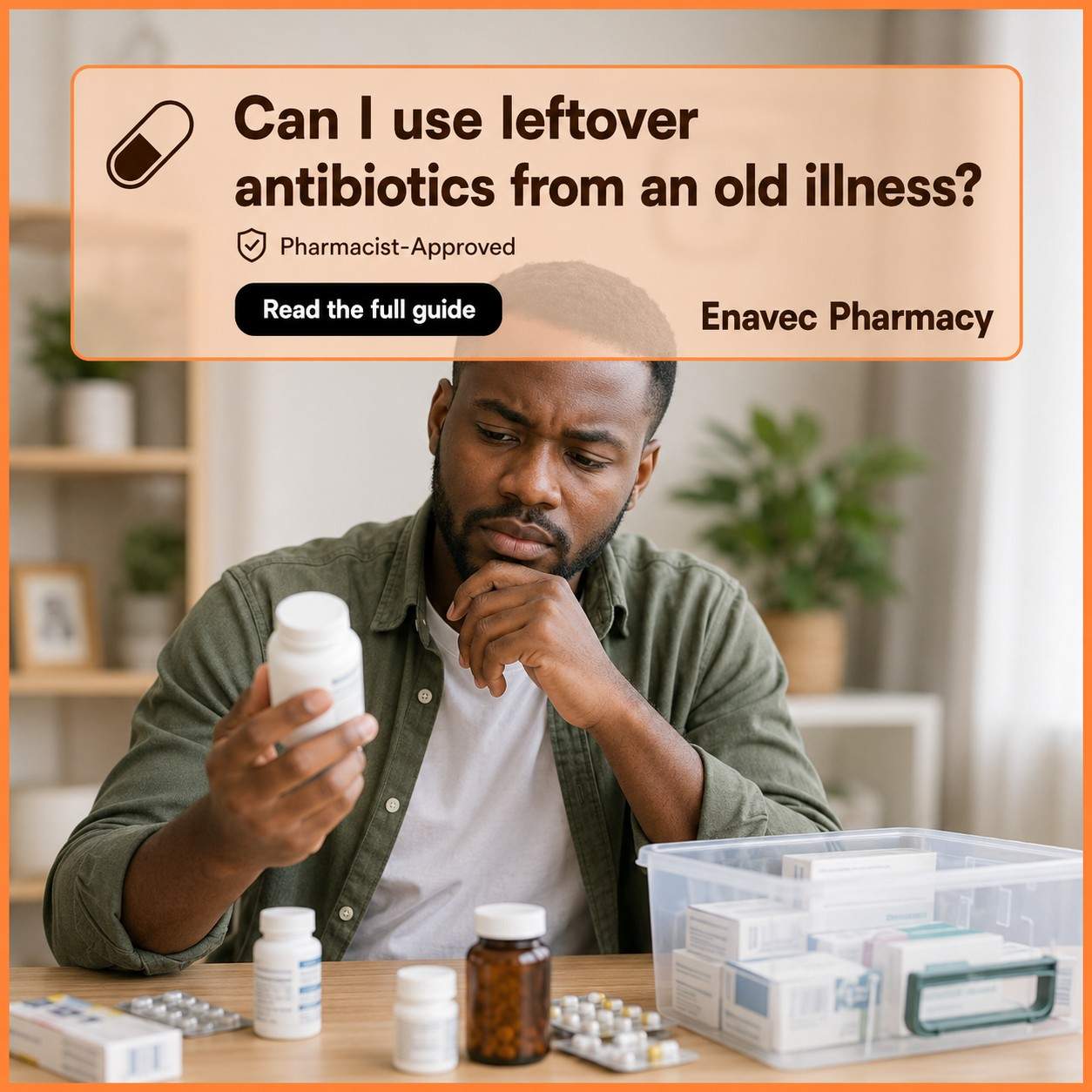
No, you should not use leftover antibiotics from an old illness to treat a new one, even when the symptoms feel identical to what you had before. I get this question often at my counter, usually from someone holding a half finished blister pack and hoping it will save them a trip to the clinic. The honest answer is that those leftover tablets carry more risk than most patients realise, and the reasons go well beyond the usual warning about finishing your course.
Self-medicating with leftover antibiotics is more common than most people admit. In one regional study, a third of participants said they had used antibiotics left over from a previous infection without asking a pharmacist or doctor first.[1] And that single habit is one of the clearest drivers of the antibiotic resistance crisis the World Health Organization tracks every year,[2] fitting into a much larger pattern of antibiotic misuse and resistance that touches almost every prescription you are ever handed.
Why Reusing Old Antibiotics Is a Bigger Risk Than You Think
Every antibiotic you have ever been prescribed was matched to a specific bacterial infection, at a specific dose, for a specific number of days. Reaching for that same pack for a new illness breaks every one of those conditions at once.
A sore throat in October might be strep throat, caused by bacteria that respond well to penicillin. The same sore throat in March might be viral pharyngitis, which no antibiotic on earth will touch. From the outside, the two feel almost identical, with pain on swallowing, a scratchy voice, and maybe a mild fever. Only a proper examination tells you which one you actually have.
This is the part patients underestimate the most. You are not just guessing at a dose when you reuse old antibiotics. You are guessing at a diagnosis. And a wrong guess does not just fail to help. It can mask the real problem, delay proper treatment, and in some cases make the eventual diagnosis harder.
💡 Key Takeaway
If you do not know what is actually causing your symptoms, you do not know which antibiotic treats it. Guessing with old medication risks treating the wrong problem entirely.
The Pack You're Holding May Not Even Be the Right Drug
That uncertainty is exactly the trap patients fall into when they reach for a leftover pack instead of getting a fresh diagnosis.
💊 From the Pharmacy Counter: Iloanugo Chijioke, B.Pharm, RPh
The worst form of self-medication I encounter is not the patient who walked into a chemist and chose something. It is the patient whose friend told them what to take. Friend medication is the hardest to undo. They come in having already taken what their friend said worked for the same symptoms, and no matter what I tell them, their friend's testimony carries more weight than my clinical advice. What I always point out is this: your friend had a different body, a different medical history, possibly a different condition that only looked like yours on the surface. The drug that cured your friend may be the wrong drug entirely for what you have. Two people with the same fever can have malaria, typhoid, a urinary tract infection, or viral illness, and the treatment for each is completely different. What I have learned is that when a patient comes with a prescription from a doctor, they are far more willing to accept a brand substitute. When they come based on a friend's recommendation, they defend that choice like it was given to them by God.
Two infections that look identical from the outside can need two completely different antibiotics. A leftover pack was matched to your old infection. It was never matched to whatever is happening in your body right now.
💡 Key Takeaway
The drug that cured your last illness is not automatically the right drug for this one, even if the symptoms feel the same. Get a fresh diagnosis before you reach for old medication.
What Actually Happens to Antibiotics Sitting in Your Cabinet
Even in the rare case where your guess about the diagnosis happens to be correct, the medication itself has changed since the day it left the pharmacy.
Three things work against a leftover antibiotic pack. It is usually an incomplete course, because the whole reason it is leftover is that you stopped a course before finishing it. Home storage conditions are rarely as controlled as a pharmacy shelf, and heat or humidity can degrade some formulations faster than the printed expiry date assumes.[3] In Lagos heat, a blister pack left on a kitchen shelf can sit at temperatures well above what the manufacturer tested for, and the active ingredient breaks down faster than the label suggests. And you genuinely do not know the remaining potency once a pack has been opened, partly used, and left in a bathroom cabinet or kitchen drawer for months.
Look for NAFDAC registration on any medicine you buy in Nigeria, and NSF or USP certification if you are buying supplements internationally. But registration at the point of sale says nothing about what happens to that same drug after six months sitting in your cabinet.
💡 Key Takeaway
A half used pack is, by definition, an incomplete course at best. Even in the best case scenario, you would be under treating a new infection from day one.
Myth vs Fact: Leftover Antibiotics
❌ MythIf it worked before, it will work again.
✅ FactDifferent infections, even ones that feel similar, are often caused by different organisms. The antibiotic that cleared your last infection may have no effect on whatever you have now.[2]
❌ MythAntibiotics do not go bad if the expiry date has not passed yet.
✅ FactPotency can drop well before the printed date if the pack was opened, exposed to heat, or stored somewhere humid. The expiry date assumes ideal, unopened storage, not months in a hot kitchen drawer.[3]
❌ MythA few leftover tablets cannot cause real harm since it is not a full course.
✅ FactLow, inconsistent doses of antibiotics are exactly the pattern that helps surviving bacteria adapt. Partial exposure is one of the most resistance promoting habits there is.[2]
Have a question about leftover antibiotics or anything else medicine related? Our PCN-licensed pharmacist answers within 2 hours on WhatsApp.
💬 Chat on WhatsApp
What to Do Instead of Reaching for the Old Pack
None of this means you are stuck waiting around every time you feel unwell again.
See a pharmacist or doctor for a fresh assessment, even a quick one. If your current symptoms turn out to need an antibiotic, getting the correct one prescribed for the correct organism, which is part of why doctors choose between broad-spectrum and narrow-spectrum antibiotics, takes only a few extra minutes and protects you from the guesswork above. If a new course is prescribed, ask about pairing it with a probiotic, because antibiotics do not distinguish between harmful bacteria and the beneficial bacteria living in your gut.
Pharmacist Recommended
✦ Pharmacist Pick
Take 2 hrs after antibiotic dose
NOW
Foods 50B CFU PROBIOTICS
10 Strains
Foods 50B CFU PROBIOTICS
10 Strains
Multi-strain
Probiotic
Probiotic
NOW Foods
Probiotic-10™ 50 Billion · 50 Veg Capsules
★★
★★
★
/ 5 · 4,115 reviews
- ✓10 clinically validated strains: L. acidophilus + B. lactis
- ✓Helps restock gut flora disrupted by a correctly prescribed antibiotic course
- ✓DNA fingerprint strain verified, dairy and soy free
This post contains affiliate links. If you purchase through our iHerb links, we may earn a small commission at no extra cost to you. We only recommend products we would genuinely suggest to our patients. This probiotic supports gut health when you are correctly prescribed a new antibiotic. It is not a substitute for proper diagnosis or treatment.
And do not let the old pack sit in your cabinet waiting for the next excuse to use it. The safest place for leftover antibiotics is a pharmacy take back point or, where none exists, mixed with something unappealing like used coffee grounds before sealing the bag and binning it.[4] That single step removes the temptation entirely.
🧮 Know Your Numbers: Wondering how your own antibiotic habits affect your resistance risk? Use our free Antibiotic Resistance Risk Quiz to get a personalised assessment in under 2 minutes, no sign up needed. → Take the quiz
Pharmacist Verdict
My verdict is simple: put the leftover pack down and come in for a proper assessment, even if that feels inconvenient. I have seen too many patients arrive after weeks of treating the wrong problem with the wrong drug, by which point the original infection has had time to settle in properly. The few extra minutes it takes to get diagnosed correctly the first time is the safety margin you give up when you self-prescribe from an old pack. If you take nothing else from this article, take this: finish every course you are given, and start every new illness with a fresh conversation with your pharmacist, not a half empty blister pack.
Iloanugo Chijioke, B.Pharm, RPh, PCN Reg. No. 020322
Frequently Asked Questions
No. Symptoms that feel the same can still come from a different organism or a viral illness that antibiotics cannot treat. The drug that worked last time was matched to that infection, not to whatever is happening in your body now. See a pharmacist or doctor for a fresh assessment before taking anything.
Not necessarily. Potency can drop before the printed expiry date if the pack was opened, exposed to heat, or stored somewhere humid. An unopened, properly stored pack is one thing. A partly used pack sitting in a cabinet for months is another, even if the date on the box still looks fine.
Hand them to your pharmacist for safe disposal at a take back point. If that is not available, mix the tablets with something unappealing such as used coffee grounds, seal them in a bag, and discard them. Do not save them for the next time you feel unwell.
Yes. A leftover pack is usually an incomplete course, which means low or inconsistent dosing against bacteria that may not even be the right target. That pattern is one of the most resistance promoting habits there is, and it is a major reason antimicrobial resistance keeps rising worldwide.
Get assessed by a pharmacist or doctor so the correct antibiotic is matched to the correct infection. If a new course is prescribed, finish it completely and ask about taking a probiotic alongside it to support your gut while the antibiotic does its job.
Commonly Searched Topics
Leftover antibiotics
Antibiotic resistance
Stopping antibiotics early
Broad-spectrum vs narrow-spectrum
Antibiotic disposal
Self-medication risks
- Alshammari TM, et al. Awareness and Knowledge of Antibiotic Resistance and Risks of Self-Medication With Antibiotics, Aseer Region, Saudi Arabia. Available at: ncbi.nlm.nih.gov/pmc/articles/PMC10361840
- World Health Organization. Antimicrobial Resistance Fact Sheet. Available at: who.int/news-room/fact-sheets/detail/antimicrobial-resistance
- Temperature Variations in Pharmaceutical Storage Facilities and Knowledge, Attitudes, and Practices of Personnel on Proper Storage Conditions for Medicines in Southern Malawi. Available at: pmc.ncbi.nlm.nih.gov/articles/PMC10556513
- U.S. Food and Drug Administration. Disposal of Unused Medicines: What You Should Know. Available at: fda.gov/drugs/safe-disposal-medicines
This article is for informational purposes only and does not constitute medical advice. Always consult your pharmacist or doctor before starting any medicine or supplement.
Found this helpful? Share it:
⚠️
Medical & Affiliate Disclaimer This article is for informational purposes only and does not constitute medical advice. Always consult a qualified healthcare provider before starting any supplement or medication. Some links in this post are affiliate links - if you purchase through them, Enavec Pharmacy may earn a small commission at no extra cost to you.
