
- Your cart is empty
- Continue Shopping
What happens if I take antibiotics when I do not need them?
- Antibiotics
- Posted on
-
by enavec_pharmacy
- 0 comments
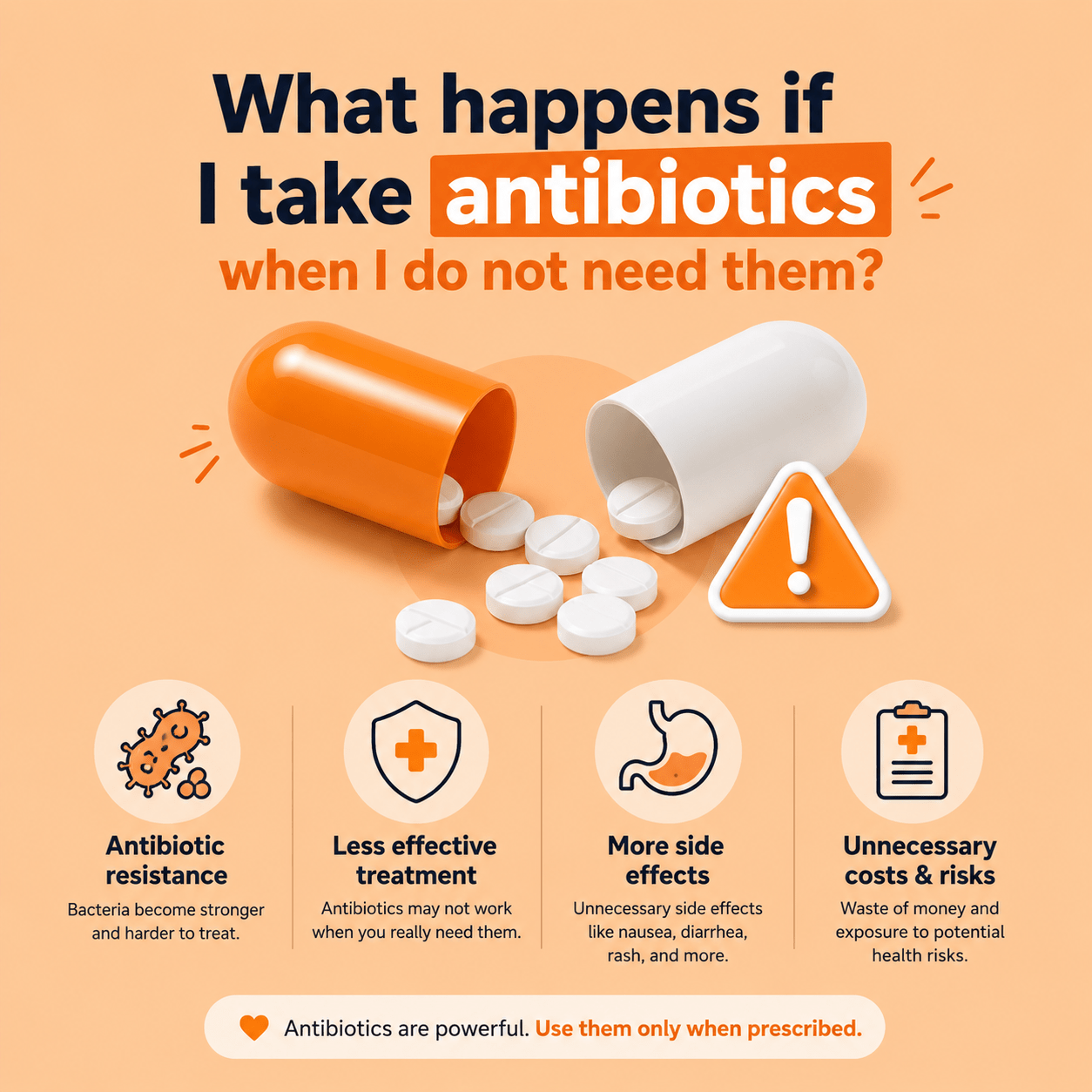
What Happens If I Take Antibiotics When I Do Not Need Them?
Taking antibiotics when you do not need them does not protect you. It actively harms you, and it harms the next person who needs those antibiotics to work. Unnecessary antibiotic use kills off beneficial gut bacteria, triggers side effects ranging from diarrhoea and yeast infections to severe allergic reactions, and — most dangerously — breeds antibiotic-resistant bacteria that can make future infections almost impossible to treat.[1]
This is not a theoretical concern. The World Health Organization lists antibiotic resistance as one of the greatest threats to global health today.[2] And the habits driving it — taking antibiotics for colds and flu, keeping leftover courses, stopping treatment early — are happening in every country, every day.
At my counter in Lagos, the most common reason patients take antibiotics they do not need is a belief that stronger medicine works faster. It does not. If your infection is viral, no antibiotic will shorten your illness by a single day. Understanding why starts with understanding what antibiotics are actually designed to do — explained in full in our guide on antibiotics: uses, misuse, and resistance.
What Antibiotics Are — And What They Are Not
Antibiotics are antibacterial agents. They were designed to target bacterial structures — cell walls, protein synthesis machinery, DNA replication enzymes — that exist in bacteria but not in human cells or viruses. That is the whole of it.
A cold? Viral. Flu? Viral. COVID-19? Viral. Most sore throats? Viral.[3] Giving an antibiotic for any of these is the clinical equivalent of using a fly swatter to fight a fire. And it is worse than simply not working: antibiotics cannot tell the difference between the harmful bacteria you are trying to kill and the hundreds of beneficial bacteria living in your gut and skin. When you take an antibiotic you did not need, you are not doing nothing. You are dismantling a protective ecosystem built up over your entire life.
💡 Key Takeaway
Antibiotics work on bacteria only. Taking them for a viral illness provides zero clinical benefit and causes direct biological harm. If you are unsure whether your infection is bacterial or viral, ask a pharmacist or doctor before taking anything.
4 Things That Happen Inside Your Body When You Take Antibiotics You Don't Need
1. Your Gut Microbiome Takes a Hit
Your gut houses roughly 38 trillion bacteria representing hundreds of species.[4] These bacteria produce vitamins, regulate immune function, protect against pathogens, and maintain the gut lining. Antibiotics — especially broad-spectrum types like ciprofloxacin, amoxicillin-clavulanate, and metronidazole — wipe out large sections of this community indiscriminately.
Research published in Nature found that a single five-day course of ciprofloxacin reduces gut bacterial diversity by up to one third.[5] Some species may not return to baseline for months. Others never fully recover without probiotic intervention. The gut symptoms — bloating, loose stools, cramping — are the visible sign of this disruption. But the downstream immune consequences are harder to see and longer-lasting.
2. You Are More Likely to Get Diarrhoea
Antibiotic-associated diarrhoea affects between 5% and 35% of people who take antibiotics, depending on the specific drug.[6] Clindamycin and amoxicillin-clavulanate carry the highest risk. When gut bacteria are wiped out, normal water absorption in the colon is disrupted, and opportunistic organisms — most notably Clostridioides difficile — can proliferate and cause severe, sometimes life-threatening colitis.
For most people, antibiotic-associated diarrhoea resolves when the course ends. But C. diff infection is a different matter — it can persist for weeks, recur multiple times, and in elderly or immunocompromised patients, it can be fatal.[7] See our full article on how antibiotics cause diarrhoea for more.
3. Yeast Infections Become More Likely
Lactobacillus bacteria colonise the vaginal tract and gut, maintaining the acidic environment that keeps Candida yeast populations in check. When antibiotics clear them out, Candida overgrows.[8] Vaginal yeast infections affect up to 30% of women after a course of broad-spectrum antibiotics.[9] Oral thrush is the equivalent in the mouth and throat. Our full explainer on antibiotics and yeast infections covers what to do if this happens.
4. Antibiotic Resistance Develops — In Your Own Body
Every time antibiotics are used, natural selection operates on the bacteria present. The weakest die. The bacteria with any genetic advantage that helps them survive live on, reproduce, and pass that resistance to their offspring.[1]
And here is the part most people do not hear: resistant bacteria do not stay neatly in one place. They transfer resistance genes horizontally to other species through conjugation — passing resistance like passing a note in a classroom. The resistant E. coli in your gut today can share resistance traits with a Salmonella strain tomorrow. But there is a practical step that helps protect your gut. Read on.
Estimated resistance risk contribution by misuse type[10]
Relative contribution to AMR risk — not additive percentages.
💡 Key Takeaway
The immediate side effects — diarrhoea, yeast infections, gut disruption — are unpleasant but usually temporary. The long-term consequence — resistance — can make your next real infection life-threatening. Both reasons matter. Neither is hypothetical.
Supporting Your Gut If You Must Take Antibiotics
When antibiotics are genuinely needed, the most evidence-backed strategy for protecting your gut is taking probiotics alongside the course — at least 2 hours apart from each antibiotic dose so the antibiotic does not kill the probiotic bacteria before they reach the gut. Continue for at least 4 weeks after finishing.
Pharmacist Recommended
✦ Pharmacist Pick
Take 2 hrs after antibiotic dose
California
Gold 25B CFU PROBIOTICS
10 Strains
Gold 25B CFU PROBIOTICS
10 Strains
Multi-strain
Probiotic
Probiotic
California Gold Nutrition
LactoBif Probiotics 25B CFU · 180 Veggie Caps
★★
★★
★
/ 5 · 2,400+ reviews
- ✓10 clinically studied strains — L. acidophilus + B. lactis
- ✓Restores gut microbiome disrupted by antibiotics
- ✓Third-party iTested verified — no contaminants
This post contains affiliate links. If you purchase through our iHerb links, we may earn a small commission at no extra cost to you. We only recommend products we would genuinely suggest to our patients.
Have a question about antibiotic use or resistance?
Our PCN-licensed pharmacist answers within 2 hours on WhatsApp.
💊 From the Pharmacy Counter — Iloanugo Chijioke, B.Pharm, RPh, PCN 020322
One of the clearest cases of antibiotic resistance I have witnessed in practice came in the form of a patient who had been on three different antibiotic courses in two months for what he described as a persistent throat and chest infection. He came to me after the third course failed and was asking for something stronger. When I reviewed what he had taken — ciprofloxacin, amoxicillin, and azithromycin — and asked how he had taken them, the pattern was immediately obvious. He had not completed a single course. Each time he felt better after four or five days, he stopped. Each time the infection returned, slightly changed, slightly more resistant.
What I explained to him was this: imagine you are fighting an army. You defeat 90% of them, declare victory, and go home. The 10% that survived are not the weak ones. They are the ones who survived because they were stronger. When they regroup and attack again, they bring those survival traits with them. The next antibiotic has to fight a tougher enemy. That is what he had been doing to his own body for two months.
— Iloanugo Chijioke, B.Pharm, RPh | PCN Reg. No. 020322 | Enavec Pharmacy, Lagos
The Broader Problem: What Antibiotic Resistance Actually Means
Antibiotic resistance does not just affect the person who misused the drugs. The resistant bacteria your body generates can spread to family members, to the wider community, through water and food systems. This is a public health emergency, not a personal health matter.
At the current trajectory, drug-resistant infections are projected to cause 10 million deaths annually by 2050 — more than cancer.[2] We are already losing antibiotics faster than we are developing new ones. And the resistance accumulating in Nigerian hospitals today, in American emergency rooms, in UK GP practices — it was built one unnecessary prescription at a time, in homes, by people who believed they were doing something safe.
For a deeper explanation of why antibiotics cannot touch a virus at all, read our dedicated guide on why antibiotics do not work for viral infections.
🧮 Know Your Numbers — Wondering how your antibiotic use history affects your personal resistance risk? Use our free Antibiotic Resistance Risk Quiz — under 2 minutes, no sign-up needed.
💡 Key Takeaway
Antibiotic resistance is not a hospital problem. It starts in your home. Every unnecessary antibiotic course contributes to a global crisis that is already killing people who need these drugs to work.
Who Is Most at Risk From Unnecessary Antibiotic Use?
Children are particularly vulnerable because their microbiomes are still developing. Early childhood antibiotic overuse has been linked to increased rates of asthma, eczema, obesity, and inflammatory bowel disease in later life — all attributed to microbiome disruption during a critical developmental window.[11]
Pregnant women face risks both to themselves and to the developing baby. Disruption to the vaginal microbiome during pregnancy increases preterm labour risk, and the altered gut environment can affect the bacterial colonisation the baby receives during birth.[12]
Elderly patients, immunocompromised individuals, and anyone with a history of C. diff are at significantly elevated risk of severe antibiotic-associated diarrhoea. But no age group is truly safe from the effects of antibiotic misuse.
⚠️ Important: If you have been prescribed antibiotics by a doctor and the course is genuinely needed, the risks of not completing treatment outweigh the side effects. This article addresses unnecessary use. Never stop a prescribed antibiotic course early without speaking to your prescriber.
Myth vs Fact: Common Antibiotic Misconceptions
❌ Myth
"Taking an antibiotic when you have a cold will help it clear faster or prevent it getting worse."
✅ Fact
Colds are viral. Antibiotics have zero effect on viral replication. A cold runs its course in 7 to 10 days whether or not you take an antibiotic.[3]
❌ Myth
"If I only take half the course and feel better, the rest is a waste — I can save it for next time."
✅ Fact
Stopping early leaves surviving — and now more resistant — bacteria in your system. Saving antibiotics for later is dangerous because future illnesses may need a completely different drug.[1]
❌ Myth
"Antibiotic resistance only matters if you take them all the time. One extra course won't make a difference."
✅ Fact
A single unnecessary antibiotic course can drive resistant strains to dominate your gut microbiome within days. That resistance can persist for months to years after the course ends.[5]
❌ Myth
"Broad-spectrum antibiotics are better because they cover more bacteria."
✅ Fact
Broad-spectrum antibiotics cause more collateral damage to beneficial bacteria and drive resistance faster. Narrow-spectrum antibiotics targeted at the specific organism are the clinical standard.[10]
What Should You Actually Take for a Viral Infection?
What do you take when you feel terrible with a cold or flu and the answer is not an antibiotic? Supportive care — rest, hydration, paracetamol or ibuprofen for fever and pain, saline nasal rinses for congestion, and time. The immune system is built to handle these infections. It needs the right conditions, not a drug that cannot help it.
Zinc lozenges started within 24 hours of symptom onset may modestly reduce cold duration, and vitamin C appears to reduce severity in physically stressed individuals.[13] Neither replaces rest and hydration. But neither causes harm either.
Seek medical review if any of these appear — because some viral infections do develop bacterial complications:
- Fever above 39°C or lasting beyond 3 days
- Severe facial pain or pressure (possible sinusitis)
- Ear pain or muffled hearing
- Cough producing thick green or brown mucus worsening after day 5
- Feeling significantly worse after initially improving
- Difficulty breathing or swallowing
💡 Key Takeaway
Most viral infections need rest, hydration, and time — not antibiotics. If bacterial warning signs develop, see a doctor. The rule is simple: antibiotics when you need them, not instead of finding out if you do.
🩺 Pharmacist's Verdict
Let me be direct about what I see happening. Patients come to my counter wanting antibiotics for colds and flu, and in many settings across Nigeria they get them — because the patient expects them, because a relative swore by them, because doing something feels better than doing nothing. But handing over an antibiotic that cannot work is not care. It is a missed opportunity to explain what is actually happening, and it is a direct contribution to resistance that is already killing people.
The antibiotic you take unnecessarily today may be the one that does not work when your child develops pneumonia next year. That is not an exaggeration. That is what antibiotic resistance means in practice. If you are unsure whether your infection needs an antibiotic, come to a pharmacist. That conversation costs nothing and could matter more than you expect.
— Iloanugo Chijioke, B.Pharm, RPh, PCN Reg. No. 020322 | Enavec Pharmacy, Lagos
Frequently Asked Questions
Taking unnecessary antibiotics kills beneficial gut bacteria, triggering diarrhoea, yeast infections, and digestive disruption. More seriously, it promotes antibiotic resistance — meaning the next time you genuinely need antibiotics for a bacterial infection, those drugs may no longer work effectively.
Yes. Every unnecessary antibiotic course applies selective pressure to bacteria in your body. The weakest die; the strongest survive and reproduce, passing resistance traits to the next generation. This is how individual antibiotic misuse contributes directly to the global resistance crisis.
No. Antibiotics only target bacteria. Viruses lack the cell walls and bacterial enzymes that antibiotics attack. Taking antibiotics for a cold, flu, or COVID-19 does not shorten your illness, reduce symptoms, or prevent complications. Antivirals are a completely different drug category designed specifically for viral infections.
The gut microbiome begins recovering within weeks, but full restoration can take one to six months depending on the antibiotic used, treatment duration, your diet, and your individual microbiome. Some bacterial species may not fully recover without probiotic support continued for several weeks after the course ends.
No. Leftover courses are almost always incomplete and insufficient to cure a new infection. You cannot know without assessment whether the new infection is bacterial, or which bacterium is causing it. Using the wrong antibiotic or an insufficient dose accelerates resistance without treating the actual illness.
Yes. Antibiotics kill lactobacillus bacteria that keep Candida yeast in check in the gut and vaginal tract. When these protective bacteria are eliminated, Candida overgrows, causing oral thrush or vaginal yeast infections. This is one of the most common side effects of broad-spectrum antibiotic treatment.
Related Articles
References
- World Health Organization. (2021). Antibiotic resistance. WHO Fact Sheet. who.int
- O'Neill J. (2016). Tackling Drug-Resistant Infections Globally. Review on Antimicrobial Resistance. amr-review.org
- Kenealy T, Arroll B. (2013). Antibiotics for the common cold. Cochrane Database Syst Rev. doi:10.1002/14651858.CD000247.pub3
- Sender R, Fuchs S, Milo R. (2016). Revised estimates for human and bacteria cells. Cell, 164(3), 337–340. doi:10.1016/j.cell.2016.01.013
- Dethlefsen L, Relman DA. (2011). Incomplete recovery of the human gut microbiota to repeated antibiotic perturbation. PNAS, 108(S1), 4554–4561. doi:10.1073/pnas.1000087107
- McFarland LV. (2008). Antibiotic-associated diarrhea: epidemiology, trends and treatment. Future Microbiology, 3(5), 563–578. doi:10.2217/17460913.3.5.563
- Leffler DA, Lamont JT. (2015). Clostridium difficile infection. NEJM, 372, 1539–1548. doi:10.1056/NEJMra1403772
- Pirotta MV, Garland SM. (2006). Genital Candida species in women in Melbourne. J Clin Microbiol, 44(9), 3356–3364. doi:10.1128/JCM.00536-06
- Sobel JD. (2007). Vulvovaginal candidosis. The Lancet, 369(9577), 1961–1971. doi:10.1016/S0140-6736(07)60917-9
- Laxminarayan R, et al. (2013). Antibiotic resistance — the need for global solutions. The Lancet, 382(9893), 1057–1098. doi:10.1016/S0140-6736(13)62229-6
- Arrieta MC, et al. (2015). The intestinal microbiome in early life. Front Immunol, 5, 427. doi:10.3389/fimmu.2014.00427
- Romero R, et al. (2014). Vaginal microbiota of normal pregnant women. Microbiome, 2(1), 4. doi:10.1186/2049-2618-2-4
- Hemila H, Chalker E. (2013). Vitamin C for preventing and treating the common cold. Cochrane Database Syst Rev. doi:10.1002/14651858.CD000980.pub4
This article is for informational purposes only and does not constitute medical advice. Always consult your pharmacist or doctor before starting any medicine or supplement.
Found this helpful? Share it:
⚠️
Medical & Affiliate Disclaimer This article is for informational purposes only and does not constitute medical advice. Always consult a qualified healthcare provider before starting any supplement or medication. Some links in this post are affiliate links - if you purchase through them, Enavec Pharmacy may earn a small commission at no extra cost to you.
