
- Your cart is empty
- Continue Shopping
What is the difference between ampiclox and amoxicillin?
- Antibiotics
- Posted on
-
by Enavec Pharmacy
- 0 comments
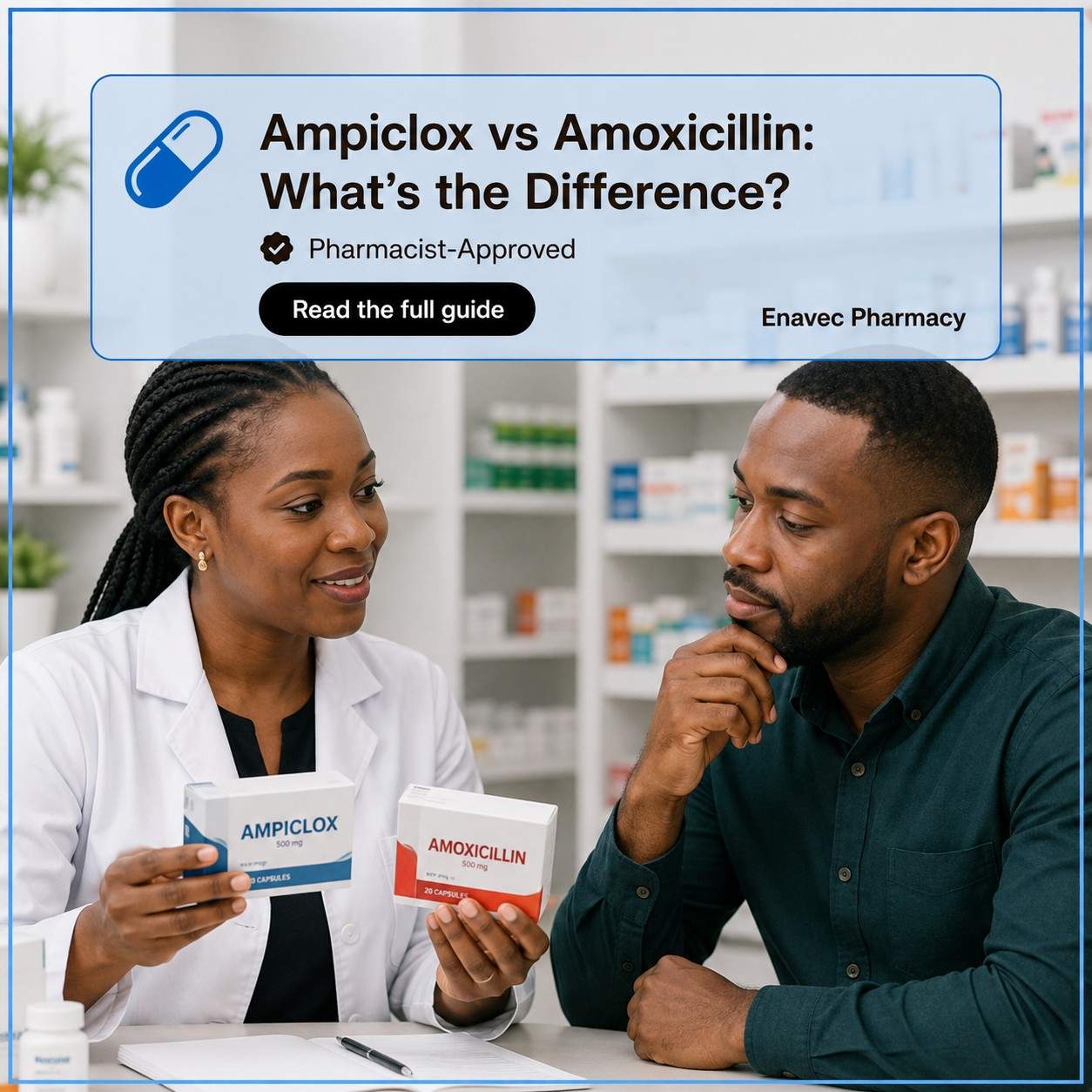
What Is the Difference Between Ampiclox and Amoxicillin?
ℹ️ All recommendations are for informational purposes. Always consult a healthcare provider before starting any new medicine.
Ampiclox is a fixed-dose combination of ampicillin and cloxacillin built specifically to kill penicillin-resistant Staphylococcus aureus, while amoxicillin is a single, better-absorbed penicillin with no built-in staph coverage at all. Mixing up which one you actually need is one of the most common antibiotic questions I get asked at my counter, and getting it wrong matters more than most patients realise.
Both drugs belong to the penicillin family. Both are prescription medicines in most of the world. And both are frequently confused for each other because they sound similar, look similar in packaging, and get recommended interchangeably by people who mean well but do not actually know the difference. That confusion is exactly what this guide is here to fix.
What Is Ampiclox, Exactly?
Ampiclox pairs two different penicillins in one capsule or syrup: ampicillin, a broad-spectrum aminopenicillin, and cloxacillin, a narrower penicillin built to survive an enzyme called penicillinase.[1] But that is not just a bureaucratic quirk of the same word repeated twice. Cloxacillin exists because many strains of Staphylococcus aureus, a bacterium responsible for a large share of skin, wound, and soft tissue infections, produce penicillinase, an enzyme that destroys ampicillin before it can act. Cloxacillin resists that enzyme, which is exactly what lets Ampiclox reach bacteria that ampicillin alone would miss entirely.[3]
In practice, this makes Ampiclox a reasonable choice when a clinician suspects a mixed infection, one where both staph and other susceptible bacteria could be involved, such as an infected wound, a boil, or certain skin and soft tissue infections. It is not a universal upgrade over plain ampicillin or amoxicillin. It is a targeted addition for a specific gap in coverage.
💡 Key Takeaway: Ampiclox exists to cover penicillin-resistant staph bacteria that ampicillin cannot touch on its own. It is not a stronger, all-purpose antibiotic, it is a combination built for a specific coverage gap.
What Is Amoxicillin, Exactly?
Amoxicillin is a single aminopenicillin, closely related to ampicillin but with one practical advantage: it absorbs far better when taken by mouth, which is why it largely replaced ampicillin as the go-to oral penicillin decades ago.[2] It covers a wide range of gram-positive bacteria, including most strep species, and extends into useful gram-negative territory too, covering organisms like Haemophilus influenzae and some strains of E. coli.[2]
What amoxicillin does not do, on its own, is reliably kill penicillinase-producing staph. If your infection needs that coverage, your prescriber reaches for either amoxicillin-clavulanate, sold as Augmentin, which pairs amoxicillin with a beta-lactamase inhibitor rather than a second antibiotic, or for a combination like Ampiclox.[6] The two solutions are built differently, but the underlying problem they solve is the same.
💊 From the Pharmacy Counter · Iloanugo Chijioke, B.Pharm, RPh
I will never forget a businesswoman in her late 50s who walked into my pharmacy with a dry cough that had plagued her for over two years. She had visited multiple hospitals, run several tests, and spent significant money on expensive medications, tablets and injectables. Nothing worked. When she sat down and described everything to me, I told her I had an idea. She looked at me and said directly: "A pharmacist cannot be better than a doctor." I told her that was fine and gave her Amoxil 500mg every 8 hours for two weeks. A week later she came back, the dry cough had changed to productive phlegm. I told her that was the infection breaking down. Two weeks later she walked back completely cured, stunned that one cost-effective antibiotic had done what two years of treatment could not. She has trusted me with her family's health ever since. The lesson: sometimes the most important clinical skill is listening long enough to understand what the body is actually saying.
Iloanugo Chijioke, B.Pharm, RPh · Enavec Pharmacy · Lagos, Nigeria
💡 Key Takeaway: Amoxicillin is the better-absorbed, broader-reaching single penicillin. But breadth is not the same as completeness. It genuinely cannot touch penicillin-resistant staph, which is the exact gap Ampiclox and Augmentin were each built, differently, to close.
The Core Difference: What Each One Actually Covers
Once you line the two up side by side, the difference stops being confusing and starts being obvious. It comes down to one bacterium: penicillin-resistant staph.
| Feature | Ampiclox (ampicillin + cloxacillin) | Amoxicillin (alone) |
|---|---|---|
| Drug class | Combination of two penicillins | Single aminopenicillin |
| Staph aureus coverage | Yes, via the cloxacillin component | No, unless combined with clavulanate |
| Gram-negative coverage | Similar to ampicillin | Slightly broader, better absorbed |
| Oral absorption | Comparable to ampicillin | Superior, a key reason it replaced ampicillin |
| Typical uses | Skin and wound infections, mixed infections | Ear, throat, chest, urinary infections |
| Common Nigerian brand names | Ampiclox, various generics | Amoxil, various generics |
💡 Key Takeaway: The decision is not "which one is stronger." It is "does this infection likely involve penicillin-resistant staph." That single question decides which drug actually fits.
Does the Combination Actually Work Better? What the Evidence Says
Here is where I have to be honest with you, because the pharmacist's job is not to defend a product, it is to tell you what the evidence actually shows. A 2021 literature review that specifically searched for evidence on ampicillin-cloxacillin as a fixed-dose combination found only twelve usable studies worldwide, and none of them showed a clear safety or efficacy advantage over using the two component antibiotics separately.[1] The World Health Organization's AWaRe antibiotic classification has gone further, listing several ampicillin-cloxacillin fixed-dose products among combinations it does not recommend, largely because the fixed ratio in many commercial products does not deliver enough of either drug to reliably treat the infections they are marketed for.[5]
And that does not mean the underlying microbiology is wrong. Cloxacillin genuinely does protect against penicillinase, and that mechanism is well documented.[3] But a poorly dosed fixed-ratio tablet is a different thing from two correctly dosed drugs given deliberately together, or from a single agent that already covers what you need. This is exactly why the choice between Ampiclox, amoxicillin, and amoxicillin-clavulanate should come from a clinician who has actually assessed your infection, not from whichever brand happens to be on the shelf at the counter you walked into.
💡 Key Takeaway: A combination antibiotic sounding like it covers more ground does not automatically mean it works better. The dose of each component matters as much as which components are present.
Why Ampiclox Is Often Bought Without a Prescription in Nigeria
NAFDAC classifies every antibiotic, Ampiclox and amoxicillin included, as prescription-only. But enforcement at the pharmacy counter and in open markets is inconsistent, and Ampiclox in particular has become a household name that patients ask for by brand rather than by diagnosis. That familiarity is part of the problem. A drug that gets requested because it worked for a neighbour's boil is being used without any confirmation that your own infection is the same one, or that it is even bacterial at all.
This pattern connects directly to the wider resistance picture covered in our complete guide to antibiotics, misuse, and resistance. Every course taken without a proper diagnosis, whether it is Ampiclox for a skin bump that turns out to be viral or an antibiotic drip given for an ordinary cold, applies the same selective pressure that leaves resistant bacteria standing in your own body.
💡 Key Takeaway: Easy over-the-counter access to Ampiclox reflects gaps in enforcement, not a special safety profile. Buying it by brand name instead of by diagnosis is a habit worth breaking.
🧮 Know Your Risk
How much does self-medicating with antibiotics like Ampiclox actually contribute to your personal resistance risk? Take our free Antibiotic Resistance Risk Quiz for a personalised assessment in under 2 minutes, no sign-up needed.
→ Take the Antibiotic Resistance Risk QuizSide Effects and Safety: Are They Different?
Because both drugs are penicillins, the safety profile overlaps considerably. Rash, diarrhoea, and nausea are the most common side effects for either one, and true penicillin allergy, the most frequently reported drug allergy worldwide, applies equally to both.[2][3] If you have ever reacted to any penicillin, ampicillin, amoxicillin, or Ampiclox, tell every prescriber and pharmacist every time, not just the first one who noted it in your file.
Cloxacillin, the added component in Ampiclox, carries its own additional consideration: rare but documented liver enzyme changes with prolonged use, which is one more reason these combination products are meant for short, supervised courses rather than repeated self-directed use. Neither drug treats a viral infection, and taking either one for a cold or flu gives you the side-effect risk with zero benefit.
💡 Key Takeaway: Same drug family, overlapping side effect profile, same allergy risk. The extra cloxacillin component in Ampiclox is one more reason it should be a short, supervised course rather than a routine self-treatment habit.
Myth vs Fact: Ampiclox and Amoxicillin
❌ MythAmpiclox is just a stronger version of amoxicillin, so it is always the safer pick when you are unsure.
✅ FactAmpiclox covers penicillin-resistant staph that amoxicillin misses, but the fixed-ratio combination has weak evidence behind its overall added benefit, and using it for infections it was never built for adds unnecessary risk.[1][5]
❌ MythIf amoxicillin did not clear an infection, switching to Ampiclox will definitely finish the job.
✅ FactNeither drug treats viral illness, and treatment failure is more often a sign the infection was never bacterial, or needed a proper diagnosis, than a sign you simply chose the weaker drug.[2]
❌ MythBecause Ampiclox is easy to buy over the counter, it must be gentler or safer than amoxicillin.
✅ FactOver-the-counter availability in Nigeria reflects inconsistent enforcement of NAFDAC's prescription-only rule, not a different safety category. Both drugs carry the same penicillin allergy risk.[3]
💊 Pharmacist's Verdict · Iloanugo Chijioke, B.Pharm, RPh, PCN Reg. No. 020322
Here is what I actually tell patients who come in asking which one to buy. Stop asking which brand is stronger and start asking what infection you actually have, because that single question decides the answer every time. Amoxicillin is my first reach for a straightforward strep throat, ear, or chest infection. Ampiclox earns its place when staph is genuinely on the table, a boil, an infected wound, a mixed skin infection, and even then I want the diagnosis confirmed rather than assumed.
My real concern with Ampiclox specifically is how casually it gets requested by brand name for anything that looks like an infection. The evidence on the fixed-dose combination itself is thinner than most patients assume, and buying it without a diagnosis is not a shortcut to getting better faster. It is a shortcut to feeding resistance in your own body. If you are not certain which one your situation calls for, that ten-minute conversation with a pharmacist or doctor before you buy either one is the difference between treating the actual problem and just guessing at a shelf.
Iloanugo Chijioke, B.Pharm, RPh, PCN Reg. No. 020322 · Enavec Pharmacy · Lagos, Nigeria
Questions Patients Ask Me Most
Ampiclox is a combination of ampicillin and cloxacillin used for infections where staph is a likely cause alongside other bacteria, such as skin infections, boils, wound infections, and some respiratory infections. The cloxacillin component specifically targets penicillin-resistant Staphylococcus aureus that ampicillin alone cannot kill.
No, not automatically. They cover different bacteria and are not interchangeable substitutes. Amoxicillin is usually preferred for ear, throat, chest, and urinary infections where staph is not the main concern. Swapping one for the other without knowing the likely cause of your infection can leave the actual bacteria untreated.
Not in a simple sense. Ampiclox adds staph coverage that amoxicillin lacks, but amoxicillin is better absorbed and has broader activity against certain gram-negative bacteria. Neither drug is universally stronger. The right choice depends on which bacteria is actually causing the infection, not which drug sounds more powerful.
Regulatory enforcement gaps, not any special safety profile, explain why Ampiclox is often available over the counter in Nigerian pharmacies and open markets. NAFDAC classifies all antibiotics as prescription-only, but enforcement varies widely, and easy access is a documented driver of antibiotic misuse and resistance.
No. Ampicillin and amoxicillin are two related but distinct penicillin antibiotics, and amoxicillin is generally better absorbed orally. Ampiclox is a separate, fixed-dose product that combines ampicillin with cloxacillin, a different penicillin added specifically to cover staph bacteria that ampicillin cannot touch alone.
Commonly Searched Topics
ampiclox vs amoxicillin
what is ampiclox used for
amoxicillin for staph infection
ampicillin cloxacillin combination
penicillin allergy amoxicillin
antibiotics over the counter Nigeria
Related Guides
References
- Sayer B, Bortone B, Sharland M, Hsia Y. Fixed-dose combination antibiotics: The search for evidence using the example of ampicillin-cloxacillin. British Journal of Clinical Pharmacology. 2021;87(7):2996-2999. doi:10.1111/bcp.14711
- Akhavan BJ, Khanna NR, Vijhani P. Amoxicillin. StatPearls. Treasure Island (FL): StatPearls Publishing; 2026. ncbi.nlm.nih.gov
- Ampicillin. StatPearls. Treasure Island (FL): StatPearls Publishing; 2026. ncbi.nlm.nih.gov
- Beta-Lactam Antibiotics. StatPearls. Treasure Island (FL): StatPearls Publishing. ncbi.nlm.nih.gov
- Not recommended fixed-dose antibiotic combinations in low- and middle-income countries, the example of Tanzania. Antimicrobial Resistance & Infection Control. 2023. pmc.ncbi.nlm.nih.gov
- Amoxicillin Clavulanate. StatPearls. Treasure Island (FL): StatPearls Publishing. ncbi.nlm.nih.gov
- Macy E, Romano A, Khan D. Practical Management of Antibiotic Hypersensitivity in 2017. Journal of Allergy and Clinical Immunology: In Practice. 2017;5(3):577-586.
Disclaimer: This article is for informational purposes only and does not constitute medical advice. Ampiclox and amoxicillin are prescription medicines in most countries. Always consult your pharmacist or doctor before starting, stopping, or switching any antibiotic. If you experience a severe allergic reaction, including facial swelling or difficulty breathing, call emergency services immediately.
Found this helpful? Share it:
⚠️
Medical & Affiliate Disclaimer This article is for informational purposes only and does not constitute medical advice. Always consult a qualified healthcare provider before starting any supplement or medication. Some links in this post are affiliate links - if you purchase through them, Enavec Pharmacy may earn a small commission at no extra cost to you.
