
- Your cart is empty
- Continue Shopping
What is the difference between Maalox and Gaviscon?
- Uncategorized
- Posted on
-
by Enavec Pharmacy
- 0 comments
ℹ️ All recommendations are for informational purposes. Always consult a healthcare provider before starting a new supplement or medication.
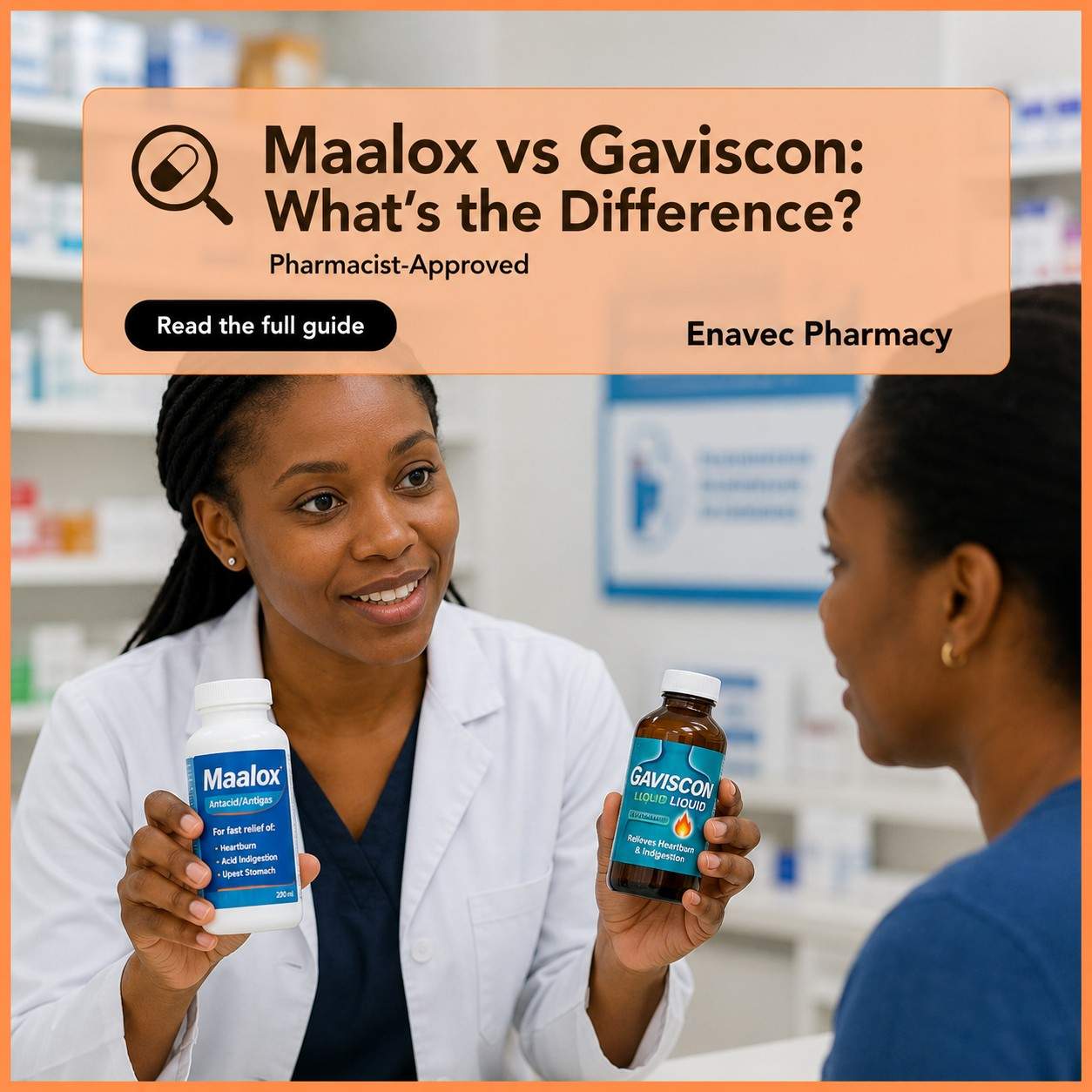
Maalox neutralizes acid that is already sitting in your stomach. Gaviscon neutralizes acid too, but it also forms a floating gel raft that physically blocks acid from splashing back up into your esophagus, so the two are not interchangeable even though they sit on the same pharmacy shelf.
Patients frequently ask me whether it actually matters which one they grab, and my answer is always the same: it depends on what your heartburn is doing. If the burn just needs neutralizing after a heavy meal, either product works. But if it strikes the moment you lie down or bend forward, one of these two has a mechanical trick the other simply does not.
What Maalox and Gaviscon Actually Do Inside Your Stomach
Both products start the same way. From there, the mechanisms split, and that split is the entire reason this comparison exists.
Maalox contains aluminum hydroxide and magnesium hydroxide, usually alongside simethicone for gas.[1] These are mild bases. They react directly with the hydrochloric acid already sitting in your stomach, lowering the burn within minutes. Nothing about that reaction stops your stomach from producing more acid a few minutes later.
Gaviscon works differently at its core. Alongside similar neutralizing minerals, most formulations also contain sodium alginate.[2] The moment alginate meets stomach acid, it thickens into a gel. Carbon dioxide released by the accompanying bicarbonate gets trapped inside that gel, and the whole thing floats to the top of your stomach contents like a raft on water.[3] That raft sits above the acid and physically blocks it from splashing into your esophagus, which matters most when you lie down, bend forward, or exercise on a full stomach.
| Medicine | Core Mechanism | What Makes It Different |
|---|---|---|
| Maalox | Neutralizes acid already present (aluminum hydroxide + magnesium hydroxide) | Adds simethicone, so it also relieves trapped gas and bloating |
| Gaviscon | Neutralizes acid AND forms a floating alginate raft | The raft is a physical barrier, not just a chemical one, so it keeps working after the minerals are used up |
💡 Key Takeaway: Both products calm the burn on contact. Only Gaviscon adds a mechanical barrier on top of that, which is the real reason the two are not simply interchangeable versions of the same idea.
Maalox: Straightforward Neutralizing, Plus Relief From Gas
That barrier difference does not make Maalox the weaker option. It just makes it the right tool for a different job.
In my experience at the pharmacy counter, Maalox earns its shelf space with patients dealing with heartburn and bloating together after a heavy meal, not heartburn on its own. The simethicone component does nothing to acid. It works on trapped gas bubbles, merging small ones into larger ones that pass more easily, which is why Maalox often feels like it is doing more than a plain antacid when a meal leaves you both burning and uncomfortably full.
Maalox's aluminum content tends to slow the gut, so it can cause constipation with regular use. And anyone with reduced kidney function should be cautious with repeated dosing, since both aluminum and magnesium clear through the kidneys and can build up over time.[4]
💡 Key Takeaway: Reach for Maalox when heartburn shows up alongside gas or bloating after a meal. The simethicone is doing real, separate work there that Gaviscon's formula was not built for.
Gaviscon: The Raft That Keeps Working After You Lie Down
Gaviscon earns its place for a narrower reason than Maalox, but a more specific one.
From what I see in practice, this is the antacid I point patients toward when their heartburn strikes specifically at night or right after bending over, because the alginate raft keeps blocking reflux even after the neutralizing minerals inside it have been used up. The raft forms within seconds of contact with stomach acid and can keep floating for up to four hours, considerably longer than the plain neutralizing action Maalox offers on its own.[3]
Gaviscon does carry meaningful sodium, which matters for anyone managing blood pressure on a sodium-restricted diet, and the exact mineral pairing (magnesium carbonate rather than magnesium hydroxide in most markets) varies by formulation, so it is worth reading the specific label in front of you rather than assuming every box is identical.[5]
💊 From the Pharmacy Counter, Iloanugo Chijioke, B.Pharm, RPh
The most dangerous habit I see every single day is taking paracetamol for every symptom without asking why the symptom is there. A headache, body aches, slight fever, patients reach for paracetamol as a reflex. What most Nigerians do not know is that these recurring symptoms are often signalling stress, poor sleep, or low iron, things paracetamol cannot fix. Meanwhile the liver processes every milligram silently. I have seen patients stack Panadol, Emzor, and a combination cold tablet in the same day without realising they all contain paracetamol, sometimes totalling over 3,000mg before they reach my counter. I always tell them: the day you take paracetamol for stomach pain is the day it has stopped being used correctly.
I bring that story up here because the same reflex shows up with antacids, just with less obvious stakes. Patients grab whichever box is closest without checking what it is actually built to do, and most of the time that works fine. But when the wrong mechanism meets the wrong symptom night after night, the relief never quite lands, and nobody stops to ask why.
Pharmacist Recommended
✦ Pharmacist Pick
Take at first sign of heartburn
Gaviscon
Extra Strength
RAFT-FORMING
ANTACID
ANTACID
Alginate Raft
Antacid
Antacid
Gaviscon
Liquid Antacid, Extra Strength, Cool Mint · 12 fl oz (355 ml)
★★
★★
★
/ 5
- ✓Sodium alginate raft physically blocks acid reflux, not just neutralizes it
- ✓Best suited for heartburn triggered by lying down or bending forward
- ✓Fast-acting, with raft protection lasting up to 4 hours
This post contains an affiliate link. If you purchase through it, we may earn a small commission at no extra cost to you. We only recommend products we would genuinely suggest to our patients.
Maalox itself was not found listed for sale on iHerb at the time of writing, so no affiliate link is included for it here. Product URL not verified. It remains widely available at pharmacies and supermarkets in Nigeria and internationally.
💡 Key Takeaway: Gaviscon is the better pick for positional heartburn, the kind that returns the moment you lie flat or bend over, because the raft keeps working long after a plain neutralizer has been absorbed.
Which One Should You Actually Reach For?
Put the mechanism together with your own pattern of symptoms, and the choice mostly makes itself.
Reach for Maalox when a meal leaves you burning and bloated at the same time and you need relief now, not for the whole night. Reach for Gaviscon when the heartburn specifically strikes once you lie down, bend forward, or exercise on a full stomach, since that is exactly the scenario its raft was designed for.
And if you have already tried an antacid a couple of times a day for more than two weeks without real improvement, neither product is the fix anymore. That pattern calls for famotidine or a supervised course of omeprazole instead, which our full guide to OTC medicine for acid reflux breaks down category by category, including when DGL licorice or mastic gum genuinely earn a place alongside either one.
💬 Have a question about which antacid fits your symptoms? Our PCN-licensed pharmacist answers within 2 hours on WhatsApp → Chat with us on WhatsApp
What Maalox and Gaviscon Have in Common: Same Limits, Same Interactions
But mechanism aside, Maalox and Gaviscon share the same practical ceiling.
Neither is meant for daily maintenance use beyond about two weeks without medical input,[4] and both can bind to certain medicines in your gut before your body gets the chance to absorb them properly. One thing I always check when a patient brings me either product alongside a new prescription is timing. Tetracycline and fluoroquinolone antibiotics, iron supplements, and levothyroxine all lose a meaningful share of their effectiveness if taken within two hours of an antacid, Maalox or Gaviscon included.[6]
Our guide on taking two different antacids at the same time covers this interaction pattern in more depth, including what happens if you stack a calcium-based product like Tums on top of either one. If heartburn has become a near-daily habit rather than an occasional flare, that pattern is worth a closer look on its own; our guide on taking antacids for three months daily walks through exactly when that calls for a doctor rather than another box.
In Nigeria, check for a valid NAFDAC registration number on any antacid pack you buy locally, alongside the international brand name you already recognise. Our guide on what a NAFDAC number means and how to verify it walks through that two-minute check.
🧮 Know Your Numbers: Wondering whether your heartburn pattern points to something beyond simple indigestion? Use our free Digestive Health & Gut Score Calculator to get a personalised assessment in under 2 minutes, no sign-up needed.
💡 Key Takeaway: Both products share the same two-week label ceiling and the same drug-binding risk. Space either one two hours from antibiotics, iron, or thyroid medicine, and treat daily use as a signal to see a doctor, not a routine.
Myth vs. Fact: Maalox and Gaviscon
❌ MythGaviscon is just a stronger version of Maalox.
✅ FactThey work through different mechanisms entirely. Gaviscon's alginate raft is a physical barrier, not a more concentrated neutralizer.[2][3]
❌ MythSince both are "just antacids," you can use them interchangeably for any heartburn.
✅ FactThe raft specifically helps positional and nighttime reflux. A plain neutralizer like Maalox does not form that barrier at all.[3]
❌ MythTaking Maalox or Gaviscon regularly controls how much acid your stomach makes.
✅ FactNeither drug reduces acid production. Both act on acid that already exists; frequent reflux needs famotidine or omeprazole instead.[4]
💊 Pharmacist's Verdict
My honest read on this one: if your heartburn shows up mostly after meals and comes with a side of bloating, Maalox is the simpler, effective choice. If it shows up the moment you lie down, bend over, or after a big dinner right before bed, Gaviscon's raft is doing something Maalox cannot, and it is worth the switch. Neither one is a long-term plan on its own. If you are reaching for either most days for more than two weeks, that pattern deserves a proper look, not a bigger bottle.
Iloanugo Chijioke, B.Pharm, RPh, PCN Reg. No. 020322 · Enavec Pharmacy, Lagos
Frequently Asked Questions
Maalox neutralizes stomach acid using aluminum hydroxide and magnesium hydroxide, plus simethicone for gas. Gaviscon neutralizes acid too, but its sodium alginate also forms a floating raft that physically blocks acid from splashing into your esophagus, which is especially useful for heartburn triggered by lying down or bending over.
Not stronger in a simple sense, just built differently. Gaviscon's raft gives it an edge for positional heartburn that returns when you lie down or bend forward, since the barrier keeps working after the neutralizing minerals are used up. Maalox neutralizes just as effectively for a straightforward after meal burn.
You usually do not need both, since they overlap in neutralizing acid. One dose of either is enough for most heartburn. If you are combining them anyway, track the total aluminum or magnesium against both labels, and space either one two hours from antibiotics, iron, or thyroid medicine.
Gaviscon is generally the better choice for heartburn that strikes after lying down, because its alginate raft keeps floating above stomach acid and blocking reflux for up to four hours. Maalox neutralizes existing acid effectively but does not form a barrier, so relief fades sooner once you are lying flat.
Maalox typically relieves heartburn for one to two hours, as long as the neutralizing minerals stay active in your stomach. Gaviscon's raft can continue blocking reflux for up to four hours after a dose, since the physical barrier persists even after the acid-neutralizing portion has been used up.
The full Over-the-Counter Medicines: The Complete Guide covers where antacids fit alongside every other category on the OTC shelf.
Related Posts
Commonly Searched Topics
Maalox vs Gaviscon
Gaviscon alginate raft
Best antacid for nighttime heartburn
Maalox vs Tums
Antacid vs PPI
References
- DailyMed, U.S. National Library of Medicine. Maalox Antacid (aluminum hydroxide, magnesium hydroxide, simethicone) drug facts label. dailymed.nlm.nih.gov
- DailyMed, U.S. National Library of Medicine. Gaviscon (aluminum hydroxide and magnesium carbonate) drug facts label. dailymed.nlm.nih.gov
- Mandel KG, et al. Review article: alginate-raft formulations in the treatment of heartburn and acid reflux. Alimentary Pharmacology & Therapeutics. pubmed.ncbi.nlm.nih.gov
- NHS. Heartburn and acid reflux. nhs.uk
- MedlinePlus, National Library of Medicine. Antacids. medlineplus.gov
- MedlinePlus, National Library of Medicine. Antacids: drug interactions. medlineplus.gov
Disclaimer: This article is for informational purposes only and does not constitute medical advice. Always consult your pharmacist or doctor before starting any medicine or supplement, particularly if you are pregnant, breastfeeding, managing a chronic condition, or taking other prescription medicines. Some links in this post are affiliate links. If you purchase through them, Enavec Pharmacy may earn a small commission at no extra cost to you.
Found this helpful? Share it:
⚠️
Medical & Affiliate Disclaimer This article is for informational purposes only and does not constitute medical advice. Always consult a qualified healthcare provider before starting any supplement or medication. Some links in this post are affiliate links - if you purchase through them, Enavec Pharmacy may earn a small commission at no extra cost to you.
