
- Your cart is empty
- Continue Shopping
What is the best over-the-counter medicine for constipation?
- OTC and Self-Care
- Posted on
-
by Enavec Pharmacy
- 0 comments
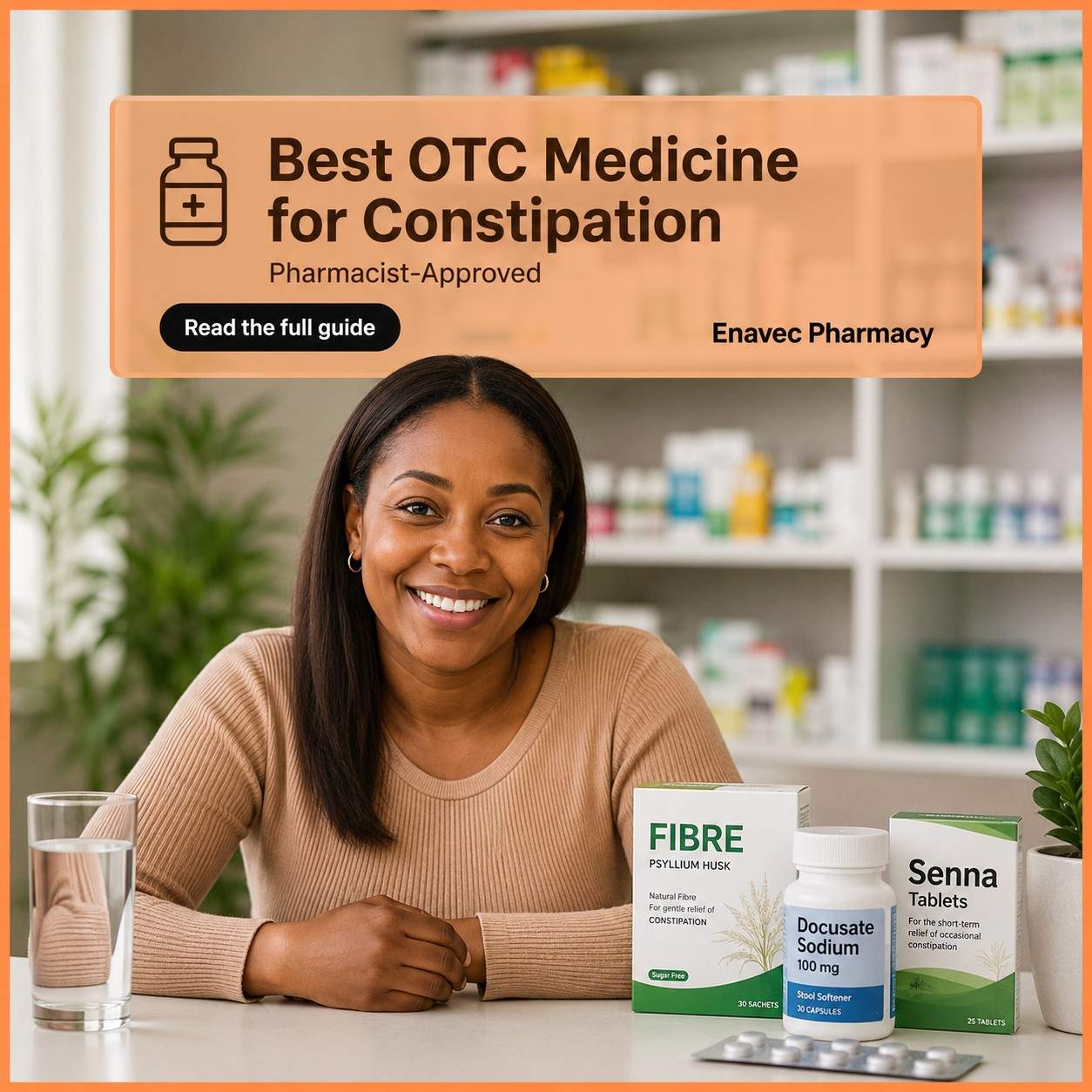
What is the best over-the-counter medicine for constipation?
For most adults, a fiber supplement such as psyllium husk is the gentlest and safest over-the-counter medicine for constipation when you have a day or two to work with. Magnesium citrate works faster, usually within a few hours, and senna is the option to reach for when you need stronger relief and have not had a bowel movement in several days.[1]
I have recommended all three of these, often to the same patient at different points in their life, depending on what was actually causing the problem. As part of your wider self-care toolkit, this topic sits inside our complete guide to over-the-counter medicines, which covers digestive health alongside five other OTC categories. For constipation specifically, here is what I tell patients at my counter, and why the "best" answer genuinely depends on your situation. If your gut trouble runs the other way entirely, with queasiness instead of a stuck bowel, our guides to the best OTC medicine for nausea and the best OTC medicine for vomiting cover that opposite end of the digestive spectrum.
ℹ️ All recommendations are for informational purposes. Always consult a healthcare provider before starting a new supplement or medication.
Why You're Constipated, and Why That Decides Which Medicine Helps
Constipation is not really one problem. It is what happens when stool moves through your colon too slowly, giving your gut wall time to pull out more water than it should, which leaves you with stools that are hard, dry, and difficult to pass.[1]
Diet, dehydration, and low physical activity are the most common drivers, but they are far from the only ones. A long list of medications slow the gut down as a side effect: opioid painkillers, iron supplements, calcium channel blockers used for blood pressure, and anticholinergic drugs such as several antihistamines and antidepressants all interfere with the muscle contractions that move stool along.[3] Some antihistamines used for travel sickness work through this exact anticholinergic pathway, which is part of why our guide to the best OTC medicine for motion sickness flags constipation and dry mouth as common side effects of that same drug class.
In my experience at the pharmacy counter, the patients who struggle most with constipation are rarely the ones eating too little fiber. They are the ones taking a medication nobody has connected to their gut.
💊 From the Pharmacy Counter, Iloanugo Chijioke, B.Pharm, RPh
An elderly woman was brought to my counter by her daughter carrying a bag, literally a bag, of medications. The daughter wanted to know if they were all still needed and if they were safe together. When I laid them out and reviewed the list, I counted eleven different medications prescribed by at least three different doctors, none of whom appeared to know what the others had prescribed. The combination included two blood pressure medications from different classes, two different sleeping tablets, an antidepressant, a stomach protector, two pain medications including one NSAID, a blood thinner, a diabetes tablet, and a multivitamin. Several of these combinations raised serious concerns. The blood thinner alongside the NSAID was the most urgent, as this combination significantly increases the risk of internal bleeding in an elderly patient. I recommended an urgent review with one coordinating physician and wrote a summary of my concerns for the daughter to take to the doctor. This is one of the most common and most invisible risks in Nigerian healthcare: patients seeing multiple specialists with no single person holding the full picture of what they are taking.
The bleeding risk that day was the most urgent finding, but it was not the only one hiding in that bag. One of her blood pressure tablets, her antidepressant, and possibly the second pain medication were also exactly the kind of drugs that quietly cause constipation in older adults, the kind nobody usually connects to a change in bowel habits until a pharmacist lays every bottle out on the counter. That is one check I always run when an older patient asks me for something for constipation: their full medication list, not just what they ate this week.
💡 Key Takeaway: Constipation has many causes, and medication is one of the most overlooked. Before reaching for a stronger laxative, check whether a new prescription, an iron supplement, or even an antihistamine started around the same time your symptoms did.
The Best OTC Option for Most People: Fiber (Psyllium Husk)
Once medication causes are ruled out, fiber is where most constipation cases should start. Psyllium husk works by absorbing water in your gut to form a soft, bulky stool, which then triggers the normal muscle contractions that move waste through your colon.[1]
Mayo Clinic guidance places bulk-forming fiber supplements as the gentlest laxative type and the one best suited to daily, long-term use, unlike stimulant or osmotic options.[1] But fiber needs water to work. Taken without enough fluid, psyllium can thicken in the gut and make constipation temporarily worse rather than better, which is the single most common mistake I see patients make with it.
Pharmacist Recommended
✦ Pharmacist Pick
Mix into 12oz water daily
NOW
Foods 7g Fiber PSYLLIUM
HUSK
Foods 7g Fiber PSYLLIUM
HUSK
Soluble
Fiber
Fiber
NOW Foods
Psyllium Husk Powder, 24 oz (680 g)
★★
★★
★
/ 5 · 22,000+ reviews
- ✓7g dietary fiber per tablespoon (6g soluble, 1g insoluble)
- ✓Gentlest laxative type, suitable for daily long-term use
- ✓Non-GMO Project Verified, vegan, finely ground for easy mixing
This post contains affiliate links. If you purchase through our iHerb links, we may earn a small commission at no extra cost to you. We only recommend products we would genuinely suggest to our patients.
Patients frequently ask me whether they can take psyllium and still expect quick relief, and my answer is always the same: fiber prevents constipation more reliably than it cures an already-stuck bowel movement. Give it 1 to 3 days of consistent use before judging whether it is working.[1]
💡 Key Takeaway: Psyllium husk fiber is the safest OTC option for everyday, ongoing constipation. Drink a full glass of water or juice with every dose, and expect results over days rather than hours.
When You Need Faster Relief: Magnesium Citrate (Osmotic Laxative)
Fiber is the right starting point, but it is not built for the night you actually need to go. That is where an osmotic laxative like magnesium citrate earns its place on the shelf.
Magnesium citrate works by drawing water into your colon, which softens the stool and stretches the gut wall enough to trigger movement.[1] Most people see results within 30 minutes to 6 hours, depending on dose and hydration, making it a reasonable option when fiber alone has not been enough and you need relief the same day.
Pharmacist Recommended
✦ Pharmacist Pick
Dissolve in warm water, sip
Natural
Vitality 350mg Mg MAGNESIUM
CITRATE
Vitality 350mg Mg MAGNESIUM
CITRATE
Osmotic
Laxative
Laxative
Natural Vitality
CALM® Magnesium Citrate Drink Mix, Original Unflavored · 16 oz (453 g)
★★
★★
★
One of iHerb's best-selling magnesium formats
- ✓pH-balanced ionic magnesium citrate, highly absorbable
- ✓Fizzy powder dissolves in warm or cold water in minutes
- ✓Vegan, non-GMO, free of sugar and artificial color
This post contains affiliate links. If you purchase through our iHerb links, we may earn a small commission at no extra cost to you. We only recommend products we would genuinely suggest to our patients.
One thing I always check before recommending magnesium citrate is kidney function. Your kidneys clear magnesium from your blood, and people with kidney disease can build up dangerously high magnesium levels on a product most pharmacies sell without a second glance.[5] If that applies to you, fiber or a stimulant laxative is the safer route, not an osmotic one.
💬 Have a question about constipation medicine or which option fits your situation? Our PCN-licensed pharmacist answers within 2 hours on WhatsApp → Chat with us now
💡 Key Takeaway: Magnesium citrate works within hours, not days, which makes it the better choice when fiber has not relieved you in time. Avoid it if you have kidney disease unless your doctor has approved it.
For Occasional, Stronger Constipation: Senna (Stimulant Laxative)
And if magnesium citrate still has not done the job, or your constipation is the kind that needs a firmer push, a stimulant laxative like senna is the next step up, not a replacement for the first two options.
Senna triggers rhythmic contractions in your intestinal muscles directly, physically pushing stool along rather than softening it from the outside.[1] A randomized trial comparing senna against magnesium-based laxatives found the two equally effective for chronic constipation, though people on senna were somewhat more likely to reduce their dose because of side effects like cramping.[5]
Pharmacist Recommended · For Occasional Use
✦ Pharmacist Pick
Take at bedtime, max 7 days
Nature's
Way 450mg SENNA
LEAVES
Way 450mg SENNA
LEAVES
Stimulant
Laxative
Laxative
Nature's Way
Senna Leaves, 100 Vegan Capsules (450 mg per Capsule)
★★
★★
★
/ 5 · 1,000+ reviews
- ✓Pure senna leaf, stimulates contraction within 6 to 12 hours
- ✓Take at bedtime for an overnight effect by morning
- ✓Vegan capsules, gluten-free, no added fillers
This post contains affiliate links. If you purchase through our iHerb links, we may earn a small commission at no extra cost to you. We only recommend products we would genuinely suggest to our patients.
But senna has one limit I am strict about with every patient: 7 days, never longer. Beyond that window, your colon can start losing some of its natural ability to contract on its own, which is exactly the dependency Mayo Clinic warns against with stimulant laxatives.[1]
There is one important exception worth knowing if constipation is caused by an opioid painkiller specifically. For opioid-induced constipation, fiber is usually the wrong first move, since bulk-forming laxatives can make a slowed, opioid-affected gut feel worse rather than better. Pharmacists typically recommend starting a stimulant like senna, or an osmotic agent, from the very first day of opioid treatment, rather than waiting for constipation to appear and reaching for fiber first.[4]
🧮 Know Your Numbers: Wondering whether your constipation points to a bigger digestive pattern worth tracking? Use our free Digestive Health & Gut Score calculator for a personalised assessment in under 2 minutes, no sign-up needed.
💡 Key Takeaway: Senna works faster and harder than fiber or magnesium, but it is a short-term tool, never a daily habit. If your constipation comes from opioid pain medication, ask about starting a stimulant laxative early rather than fiber first.
Constipation Myths vs Facts
Knowing which medicine to take matters less if a myth is steering you toward the wrong one in the first place. Here are the misconceptions I correct most often.
❌ MythAll laxatives work the same way, so it doesn't matter which one you buy.
✅ FactFiber, osmotic, and stimulant laxatives work through completely different mechanisms, and Mayo Clinic guidance recommends matching the type to your situation rather than grabbing whichever bottle is on the shelf.[1]
❌ MythSenna is herbal, so it carries none of the risks of a "real" laxative.
✅ FactSenna is a stimulant laxative with the same dependency risk as synthetic stimulants like bisacodyl, and it carries the identical 7-day limit on continuous use.[1]
❌ MythIf a laxative isn't working, the answer is always a stronger one.
✅ FactIf a medication you are already taking is the actual cause, no laxative dose fixes that fully. Identifying and adjusting the cause, with your doctor's input, often matters more than escalating the laxative.[3]
❌ MythMore fiber is always the right move, no matter what is causing your constipation.
✅ FactFor opioid-induced constipation specifically, bulk-forming fiber is generally not the recommended first step, since it can worsen symptoms in a gut already slowed by opioids. Stimulant or osmotic laxatives started early work better in that specific case.[4]
⚕️ Pharmacist Verdict
If I had to pick one product for a patient who has not told me the cause yet, I would start with psyllium husk fiber and a full glass of water, every day, for at least three days before judging the result. If you need relief faster than that, or fiber has genuinely not worked, magnesium citrate is my next recommendation, and senna comes after that for short bursts only, never as a daily habit.
The check I never skip is the medication list. I have seen too many patients escalate from fiber to magnesium to senna over months, when the actual fix was a conversation with their doctor about an iron tablet, a blood pressure pill, or an antihistamine that was quietly doing this the entire time. Treat the laxative as the short-term tool it is, and treat finding the cause as the actual job.
Iloanugo Chijioke, B.Pharm, RPh, PCN Reg. No. 020322
Frequently Asked Questions
For most adults, a fiber supplement like psyllium husk is the safest first-line OTC option for ongoing regularity. Magnesium citrate works faster when you need relief within hours. Senna is reserved for short-term, occasional use when fiber and magnesium have not helped within a day or two.
Magnesium citrate typically produces a bowel movement within 30 minutes to 6 hours, depending on the dose and how hydrated you are. It draws water into the colon to soften stool and stimulate movement, which is why it works faster than fiber but should still be taken with plenty of water.
Yes. Fiber supplements such as psyllium husk are generally considered the gentlest and safest laxative type for daily, long-term use, according to Mayo Clinic guidance. Start with a small amount, increase gradually, and drink extra fluids, since psyllium can worsen constipation temporarily if taken without enough water.
No. Senna is a stimulant laxative meant for short-term, occasional use, typically no longer than 7 days at a time. Using it for weeks or months can reduce your colon's natural ability to contract on its own, leading to dependency. Talk to a pharmacist if you need it regularly.
Opioid painkillers, iron supplements, calcium channel blockers for blood pressure, and anticholinergic drugs such as some antihistamines and antidepressants are common causes. If a new medication started around the same time your constipation began, mention it to your pharmacist, since the fix may involve adjusting that medication rather than adding a laxative.
See a doctor if constipation lasts more than seven days despite using a laxative, or if you notice severe stomach pain, bloody stools, unexplained weight loss, or a sudden change in your normal bowel pattern. These can signal a condition that needs more than an over-the-counter fix.
Related Reading
Commonly Searched Topics
Best laxative for constipation
Psyllium husk vs Metamucil
Magnesium citrate dosage
Senna for constipation
Medications that cause constipation
Constipation in pregnancy
Opioid-induced constipation
Fiber supplement for kids
References
- Mayo Clinic. Nonprescription laxatives for constipation: Use with caution. mayoclinic.org
- NHS. Laxatives. nhs.uk
- Harvard Health Publishing. What to do when medication makes you constipated. health.harvard.edu
- Drug Topics. Common Medications That Can Cause Constipation. drugtopics.com
- Consumer Reports. Best Drugs for Constipation. consumerreports.org
This article is for informational purposes only and does not constitute medical advice. Always consult your pharmacist or doctor before starting any medicine or supplement, particularly if you are pregnant, breastfeeding, managing kidney disease, or taking other prescription medicines.
Found this helpful? Share it:
⚠️
Medical & Affiliate Disclaimer This article is for informational purposes only and does not constitute medical advice. Always consult a qualified healthcare provider before starting any supplement or medication. Some links in this post are affiliate links - if you purchase through them, Enavec Pharmacy may earn a small commission at no extra cost to you.
