
- Your cart is empty
- Continue Shopping
What Is the Best Over-the-Counter Medicine for Fever?
- OTC and Self-Care
- Posted on
-
by enavec_pharmacy
- 0 comments
OTC & Self-Care · Fever
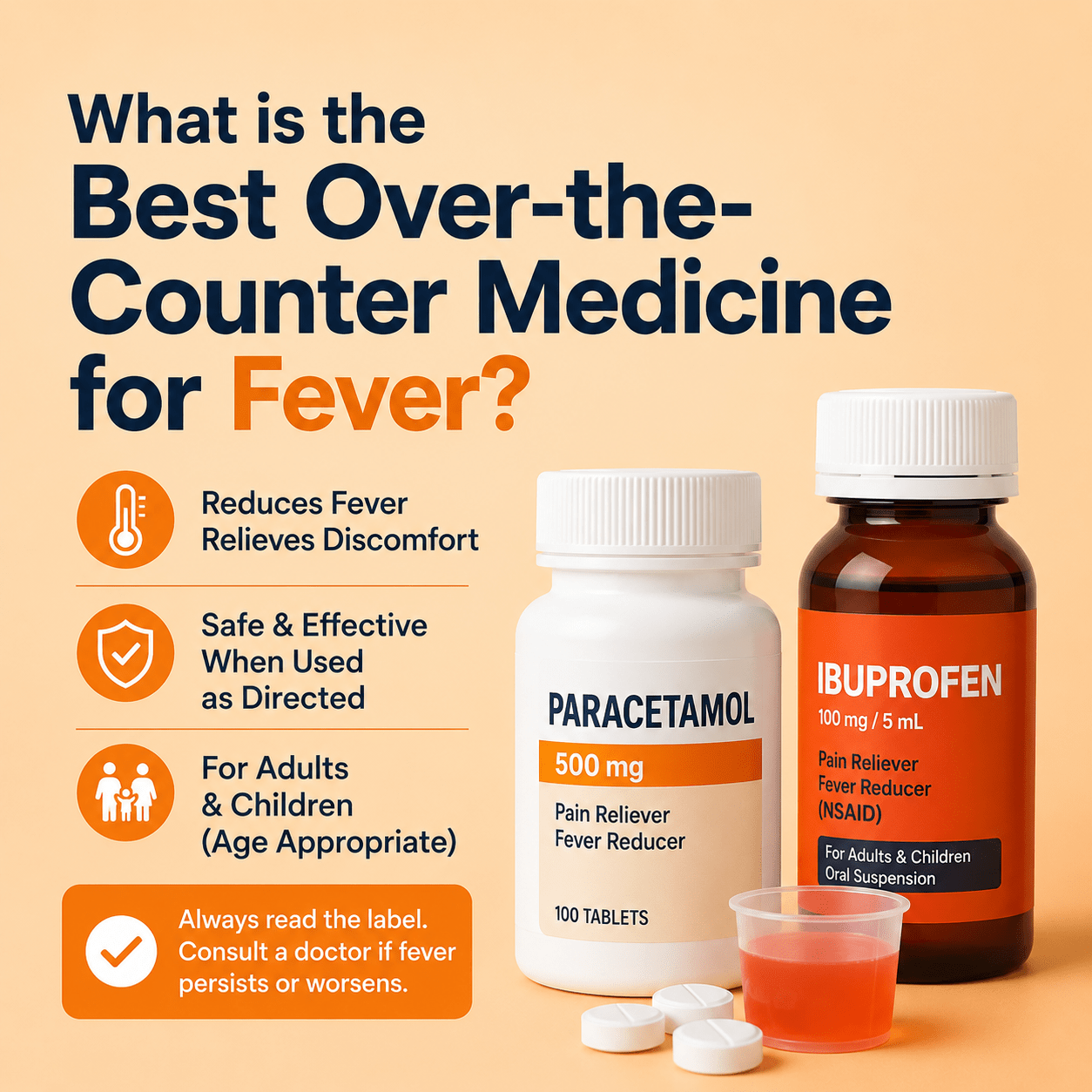
What Is the Best Over-the-Counter Medicine for Fever?
The best OTC medicine for fever in most adults is paracetamol (acetaminophen) — it brings down temperature effectively, works within 30–45 minutes, and is safe on an empty stomach. Here is everything your pharmacist wants you to know before you choose.
Fever is one of the most common reasons people visit a pharmacy. It is your immune system mounting a defence — a raised body temperature that creates a hostile environment for viruses and bacteria.[1] But knowing when to treat a fever with medicine, which medicine to choose, and when to stop and see a doctor makes a real difference to your recovery — and to your safety.
In this guide I walk you through the two evidence-based OTC options (paracetamol and ibuprofen), when to use each one, the correct doses for adults and children, and the red-flag signs that mean you need more than any OTC medicine can provide. This advice is the same whether you are buying at a Boots in London, a CVS in Chicago, a Watson's in Singapore, or a pharmacy on Lagos Island — the pharmacology is universal.
What Temperature Actually Counts as a Fever?
Before reaching for any medicine, it helps to know whether the temperature you are measuring actually requires treatment — not every elevation above 37°C needs medication.
A normal body temperature sits between 36.1°C and 37.2°C (97°F–99°F).[2] A fever is generally defined as a temperature of 38°C (100.4°F) or above. Here is how to interpret what you are measuring and what action to take at each stage:
36–37.2°C
Normal
No medicine needed. Rest and fluids.
37.3–38°C
Low-Grade
Monitor. OTC only if very uncomfortable.
38.1–39°C
Moderate
Treat with paracetamol or ibuprofen.
39.1°C+
High / Danger
Treat urgently. Seek medical help if sustained.
One thing I always check when a patient brings a child in with fever is whether the temperature was measured correctly — an axillary (armpit) reading typically runs 0.5°C lower than an oral or rectal reading. If your thermometer reads 38°C under the armpit, the true core temperature may be closer to 38.5°C. Always add 0.5°C to armpit readings when assessing severity in children.[3]
Importantly: a fever itself is not always dangerous. In healthy adults, a moderate fever does not need to be treated unless it is causing significant discomfort, preventing sleep, or is accompanied by other concerning symptoms. Treating every slight temperature spike may actually suppress the immune response your body is mounting.[4]
⚠️ Go to A&E / ER Immediately If:
Temperature above 40°C (104°F) in an adult or above 38°C (100.4°F) in a baby under 3 months. Also seek emergency care for: seizures, stiff neck, severe headache, confusion, rash that doesn't fade under pressure, or difficulty breathing alongside a fever. These are medical emergencies.
💡 Key Takeaway
A fever of 38°C (100.4°F) or above in an adult warrants OTC treatment if causing discomfort. Below 38°C, rest and hydration alone may be sufficient. Always measure correctly — armpit readings run ~0.5°C lower than oral.
The Two Best OTC Fever Medicines — And How to Choose
Two medicines dominate evidence-based fever management globally. Understanding their differences lets you pick the right one for your specific situation.
There are exactly two classes of OTC medicine with strong clinical evidence for reducing fever in adults: paracetamol (acetaminophen) and NSAIDs (primarily ibuprofen and aspirin). Both reduce fever through different mechanisms, and the right choice depends on your age, medical history, what else you are taking, and whether fever is accompanied by inflammation or pain.[5]
| Medicine | How it reduces fever | Onset | Best for | Avoid if |
|---|---|---|---|---|
| Paracetamol First Line (Tylenol, Panadol) |
Acts on the heat-regulation centre in the brain | 30–45 min | Most adults; pregnancy; stomach issues; children | Liver disease; heavy alcohol use; paracetamol already in other medicines |
| Ibuprofen (Advil, Nurofen) |
NSAID — blocks prostaglandins that raise temperature AND cause inflammation | 20–30 min | Fever WITH muscle pain, joint pain, or throat inflammation | Stomach ulcers; kidney disease; after 20 weeks of pregnancy; aspirin allergy |
| Aspirin (Disprin, Bayer) |
NSAID — same mechanism as ibuprofen | 30–60 min | Adults only — occasional fever without peptic ulcer history | All children under 16; bleeding disorders; pregnancy |
Product 1 — Best Overall for Fever: Tylenol Extra Strength (Paracetamol 500 mg)
For the vast majority of adults with a straightforward fever, paracetamol is the best first-line choice. It is effective, has fewer contraindications than NSAIDs, is safe on an empty stomach, and is the only OTC fever medicine considered acceptable during pregnancy.[6] Globally, it is sold as Tylenol (USA), Panadol (UK, Australia, Nigeria, Asia), Calpol (children's), and hundreds of generic acetaminophen products. The active ingredient — and the clinical effect — is identical across all of them.
The standard adult dose is 500–1,000 mg every 4–6 hours, with a maximum of 4,000 mg (4 g) in any 24-hour period. Never exceed this ceiling — liver toxicity from paracetamol overdose can occur without early warning symptoms and is one of the leading causes of acute liver failure globally.[7] Always check every other medicine you are taking for hidden paracetamol — combination cold, flu, and "PM" products commonly contain it.
TYLENOL
500 mg
EXTRA STRENGTH
Acetaminophen 50 Caplets
Acetaminophen 50 Caplets
Tylenol
Extra Strength Acetaminophen 500 mg · 50 Caplets
OTC · Best Overall · Fever & Pain · GlobalThe gold-standard fever reducer. Safe on an empty stomach, suitable in pregnancy, and free of NSAID side effects. Works in 30–45 minutes. Max 4,000 mg/day — never exceed this limit.
🛒 Buy on iHerbThis post contains affiliate links. If you purchase through our iHerb links, we may earn a small commission at no extra cost to you. We only recommend products we would genuinely suggest to our patients.
💡 Key Takeaway
Paracetamol 500–1,000 mg is the best first-line OTC fever medicine for most adults. It is safe on an empty stomach, the only option approved in pregnancy, and has no cardiovascular or gastrointestinal risks. The hard limit is 4,000 mg per day — check all your other medicines for hidden acetaminophen.
Have a question about fever medicines?
Our PCN-licensed pharmacists answer within 2 hours on WhatsApp →
When Ibuprofen Is the Better Choice for Fever
Ibuprofen is not always second-best — for certain types of fever, it outperforms paracetamol by targeting both the temperature and the underlying inflammation driving it.
Paracetamol reduces fever but has no anti-inflammatory effect. Ibuprofen is an NSAID (non-steroidal anti-inflammatory drug) — it blocks prostaglandins (the chemicals in your body that cause both fever AND inflammation), so it addresses both simultaneously. This makes ibuprofen the better choice when:[8]
- Fever is accompanied by significant muscle aches, joint pain, or a swollen throat
- Flu-like body aches are making the fever more distressing
- You are dealing with a tonsillitis-related fever where inflammation is the primary driver
- You need slightly faster onset — ibuprofen can begin working in 20–30 minutes vs. 30–45 minutes for paracetamol
Patients frequently ask me whether ibuprofen or paracetamol is stronger for fever, and my answer is always that neither is universally "stronger" — they work differently. For pure fever reduction in an otherwise healthy adult, both are similarly effective. For fever with inflammation or body aches, ibuprofen has the edge. The standard adult OTC dose for ibuprofen is 200–400 mg every 6–8 hours, always taken with food or milk, with a maximum of 1,200 mg per day without medical supervision.[9]
ADVIL
200 mg
IBUPROFEN
NSAID Fever 100 Caplets
NSAID Fever 100 Caplets
Advil
Ibuprofen Tablets 200 mg · 100 Coated Caplets
OTC NSAID · Fever + Inflammation · Fast OnsetBest OTC choice when fever comes with muscle aches, joint pain, or throat inflammation. Targets both fever and its underlying cause. Take with food. 200–400 mg every 6–8 hrs. Max 1,200 mg/day OTC.
🛒 Buy on iHerb
💡 Key Takeaway
Choose ibuprofen over paracetamol when your fever is accompanied by significant muscle aches, joint pain, or throat swelling. Always take with food. Avoid if you have a stomach ulcer, kidney disease, or are over 20 weeks pregnant.
OTC Fever Medicine for Children — What Parents Must Know
Children's fever management follows different rules. The dose, the form, and the permitted medicines are not the same as in adults — getting this wrong can cause serious harm.
For children, paracetamol (acetaminophen) is the first-line OTC option from birth onwards, and ibuprofen is safe from 3 months of age and over 5 kg body weight.[10] Aspirin must never be given to children under 16 — it carries the risk of Reye's syndrome (a rare but life-threatening condition affecting the liver and brain).[11] This rule applies globally without exception.
The most critical rule for children's fever medicine is this: always dose by weight, not by age. A large 6-year-old and a small 6-year-old can require very different doses. Using age alone — or guessing — is a common cause of both under-dosing (poor fever control) and over-dosing (liver toxicity risk). For paracetamol, the safe paediatric dose is 15 mg per kilogram of body weight per dose, given every 4–6 hours, up to a maximum of 5 doses in 24 hours.[12]
Liquid formulations are strongly preferred for younger children — they allow precise weight-based measurement using a dosing cup or syringe. Genexa Kids' Pain & Fever is a clean-label organic acetaminophen liquid, free from artificial dyes, preservatives, and synthetic flavours, that parents in the US, UK, and Australia have trusted for weight-based paediatric fever management.
GENEXA
KIDS' PAIN
& FEVER 160mg/5ml Ages 2–11 · Organic
& FEVER 160mg/5ml Ages 2–11 · Organic
Genexa
Kids' Pain & Fever · Acetaminophen 160 mg/5 ml · 4 fl oz
OTC · Paediatric · Ages 2–11 · Clean LabelOrganic acetaminophen liquid — no artificial dyes, parabens, or synthetic flavours. Measure precisely by weight using the included dosing cup. Safe, effective fever control for children ages 2–11. Blueberry flavour.
🛒 Buy on iHerb🧮 Free Tool — Children's Dose Calculator
Not sure of the exact safe paracetamol or ibuprofen dose for your child? Enter your child's weight in our free Children's OTC Medicine Dose Calculator for the precise amount — no sign-up needed.
→ Open Children's OTC Dose Calculator
💡 Key Takeaway
Never give aspirin to a child under 16. Dose paracetamol at 15 mg/kg per dose, max 5 doses in 24 hours. Use a liquid formulation with a measuring cup for children under 6. When in doubt, use the dose calculator — guessing is the most common cause of paediatric dosing errors.
Can You Alternate Paracetamol and Ibuprofen for Fever?
Alternating the two medicines is a widely discussed strategy — here is what the evidence actually supports and how to do it safely.
Alternating paracetamol and ibuprofen is a strategy used by many doctors and pharmacists for persistent or high fever — particularly in children — when neither medicine alone provides adequate control. The logic is sound: because the two medicines work through different mechanisms and have different dose intervals, alternating them can provide more consistent fever control over a 24-hour period than either alone.[13]
A safe alternating schedule for adults might look like this: paracetamol 1,000 mg at 8 am → ibuprofen 400 mg at 11 am → paracetamol 1,000 mg at 2 pm → ibuprofen 400 mg at 5 pm, and so on. The key rules are: never give both at exactly the same time for the purpose of fever management, space each by at least 2–3 hours, and stay within the maximum daily dose limits for each medicine independently. Most importantly: alternating is a strategy for persistent high fever — it is not a routine approach for every fever.
For children, the same principle applies, but doses must remain strictly weight-based throughout. Do not alternate without first confirming the correct dose for your child's current weight.
🧮 Drug Interaction Checker
Taking other medicines alongside your fever treatment? Use our free Drug Interaction Checker before combining any OTC or prescription medicines.
→ Check for Drug Interactions
💡 Key Takeaway
Alternating paracetamol and ibuprofen is safe when done correctly — space doses by at least 2–3 hours, stay within each medicine's individual daily maximum, and never give both simultaneously for routine fever. This strategy is most useful for persistent high fever not controlled by one agent alone.
When to Stop Self-Treating and See a Doctor
OTC medicines manage fever symptoms — they cannot treat the cause. These are the signs that your fever needs professional assessment, not more OTC medicine.
Over the years I have noticed that the patients who get into difficulty with fever are those who continue self-treating past the point where a doctor should be involved. A fever is a symptom, not a disease — and the underlying cause determines whether OTC treatment is appropriate or dangerous to delay.
Stop OTC fever treatment and seek medical assessment if any of the following apply:
- Fever above 39.5°C (103°F) in an adult that does not come down with correct OTC dosing within 1–2 hours
- Any fever in a baby under 3 months old (even 38°C / 100.4°F)
- Fever persisting beyond 3 days in adults, or 24–48 hours in young children
- Fever accompanied by: stiff neck, severe headache, sensitivity to light (meningitis signs); rash that does not fade under a glass pressed to skin; confusion or unusual drowsiness; difficulty breathing; chest pain; or severe abdominal pain
- Fever in a person who is immunocompromised (e.g. on chemotherapy, HIV, long-term steroids)
- Fever returning after 24 hours of being normal — this "biphasic" pattern can signal a bacterial superinfection
- In malaria-endemic regions (including West Africa, South Asia, Sub-Saharan Africa): any fever with chills, sweating, and headache that cycles every 48 hours — this is the classic malaria pattern and requires immediate testing[14]
⚠️ Important — Fever in Returning Travellers
If you have been in a malaria-endemic country (including parts of Nigeria, Ghana, Uganda, India, Southeast Asia) within the last 3 months and you develop a fever, tell your doctor immediately — even if you took malaria prophylaxis. Malaria can be fatal if diagnosis is delayed.
💡 Key Takeaway
A fever that does not respond to OTC medicine within 2 hours, persists beyond 3 days, or is accompanied by any red-flag symptoms (stiff neck, rash, confusion, breathing difficulty) requires a doctor — not a higher OTC dose. In malaria-endemic regions, cycling fever with chills must be tested for malaria promptly.
Myth vs. Fact — 4 Fever Misconceptions That Can Cause Real Harm
These are the four most dangerous fever myths I hear at the pharmacy counter — all of them can delay correct treatment or cause medication harm.
❌ Myth 1
"Every fever needs to be treated with medicine immediately."
✅ Fact
Fever is a natural immune response. A temperature below 38°C (100.4°F) in a healthy adult often requires only rest and fluids — treating every mild temperature spike suppresses immunity unnecessarily. [4]
❌ Myth 2
"I can give my child adult paracetamol tablets — I'll just cut them in half."
✅ Fact
Children require weight-based dosing, not a fraction of an adult tablet. A "half tablet" may be the wrong dose entirely. Always use a liquid formulation with a measuring cup and dose by weight for children under 6. [12]
❌ Myth 3
"Taking ibuprofen and paracetamol at the same time is dangerous."
✅ Fact
Paracetamol and ibuprofen can safely be taken together or alternated — they work through completely different pathways with no harmful interaction. What is dangerous is combining two NSAIDs (e.g. ibuprofen + aspirin together). [13]
❌ Myth 4
"If the fever comes back after the medicine wears off, I just need more of the same dose."
✅ Fact
A recurring fever after OTC treatment is a sign the underlying cause may need medical assessment — not just repeat dosing. Persistently recurring fever, especially with other symptoms, can indicate bacterial infection, malaria, or other conditions requiring prescription treatment. [14]
💊 Pharmacist's Verdict · Enavec Pharmacy
My single best recommendation: for most adults with a straightforward fever, paracetamol 1,000 mg (two 500 mg tablets) is your first move. It is effective, safe on an empty stomach, carries no cardiovascular or gastrointestinal risk at standard doses, and is the only OTC fever medicine acceptable in pregnancy. If your fever comes with significant muscle aches, joint pain, or a swollen inflamed throat — switch to ibuprofen 400 mg with food for its additional anti-inflammatory benefit.
For children: always dose by weight using a liquid. The Children's OTC Medicine Dose Calculator on our website gives you the precise safe amount for your child's weight in seconds. And never — under any circumstances — give aspirin to a child under 16.
The safety warning I want you to remember: check every other medicine in your cabinet for paracetamol (acetaminophen). Cold tablets, "PM" formulas, and combination flu products very commonly contain it. Taking them alongside separate paracetamol tablets can push you over the liver-toxic daily limit without realising it. When in doubt, ask your pharmacist — this is exactly what we are here for.
PCN-Licensed Pharmacist · Enavec Pharmacy · Lagos, Nigeria
Commonly Searched Fever Topics
>Best OTC for fever adults
>Paracetamol vs ibuprofen for fever
>Children's fever medicine dose
>How to break a high fever fast
>Fever in pregnancy OTC
>Alternating paracetamol and ibuprofen
>When to go to hospital for fever
>Fever after travel malaria
>Panadol dosage for adults
>Tylenol vs Advil for fever
Related Guides
Disclaimer: This article is for informational purposes only and does not constitute medical advice. Always consult your pharmacist or doctor before starting any medicine or supplement, particularly if you are pregnant, breastfeeding, managing a chronic health condition, or taking prescription medicines.
References
- Wrotek S et al. Let it burn? Understanding the role of fever in the immune response. Evolutionary Applications. 2021;14(1):20–32. doi:10.1111/eva.13144
- Geneva II et al. Normal body temperature: a systematic review. Open Forum Infectious Diseases. 2019;6(4):ofz032.
- NICE. Feverish illness in children: assessment and initial management in children younger than 5 years. Clinical Guideline CG160. NICE; 2013 (updated 2023). nice.org.uk
- Evans SS, Repasky EA, Fisher DT. Fever and the thermal regulation of immunity: the immune system feels the heat. Nature Reviews Immunology. 2015;15(6):335–349.
- Blumenthal KG et al. Antipyretics and fever management in adults: a systematic review. JAMA Internal Medicine. 2014.
- WHO. Paracetamol use in pregnancy: evidence review. World Health Organization. 2021.
- Larson AM. Acetaminophen hepatotoxicity. Clinics in Liver Disease. 2007;11(3):525–548. doi:10.1016/j.cld.2007.06.006
- Perrott DA et al. Efficacy and safety of acetaminophen vs ibuprofen for treating children's pain or fever. Archives of Pediatrics & Adolescent Medicine. 2004;158(6):521–526.
- Sostres C, Gargallo CJ, Arroyo MT, Lanas A. Adverse effects of NSAIDs on upper gastrointestinal tract. Best Practice & Research Clinical Gastroenterology. 2010;24(2):121–132.
- British National Formulary for Children (BNFc). Paracetamol — paediatric dosing guidance. NICE/BNFc; 2024.
- Committee on Infectious Diseases, American Academy of Pediatrics. Aspirin and Reye Syndrome. Pediatrics. 1982;69(6):810–812.
- NICE. Children's medicine dosing: weight-based paracetamol guidance. Clinical Knowledge Summary — Feverish Children. 2023. cks.nice.org.uk
- Wong T et al. Alternating antipyretics for fever management in children. CMAJ. 2013;185(8):E435–443. doi:10.1503/cmaj.121152
- WHO. World Malaria Report 2023. World Health Organization; 2023. who.int
Found this helpful? Share it:
⚠️
Medical & Affiliate Disclaimer This article is for informational purposes only and does not constitute medical advice. Always consult a qualified healthcare provider before starting any supplement or medication. Some links in this post are affiliate links - if you purchase through them, Enavec Pharmacy may earn a small commission at no extra cost to you.
