
- Your cart is empty
- Continue Shopping
How come OTC cold medicines make me feel worse sometimes?
- Uncategorized
- Posted on
-
by Enavec Pharmacy
- 0 comments
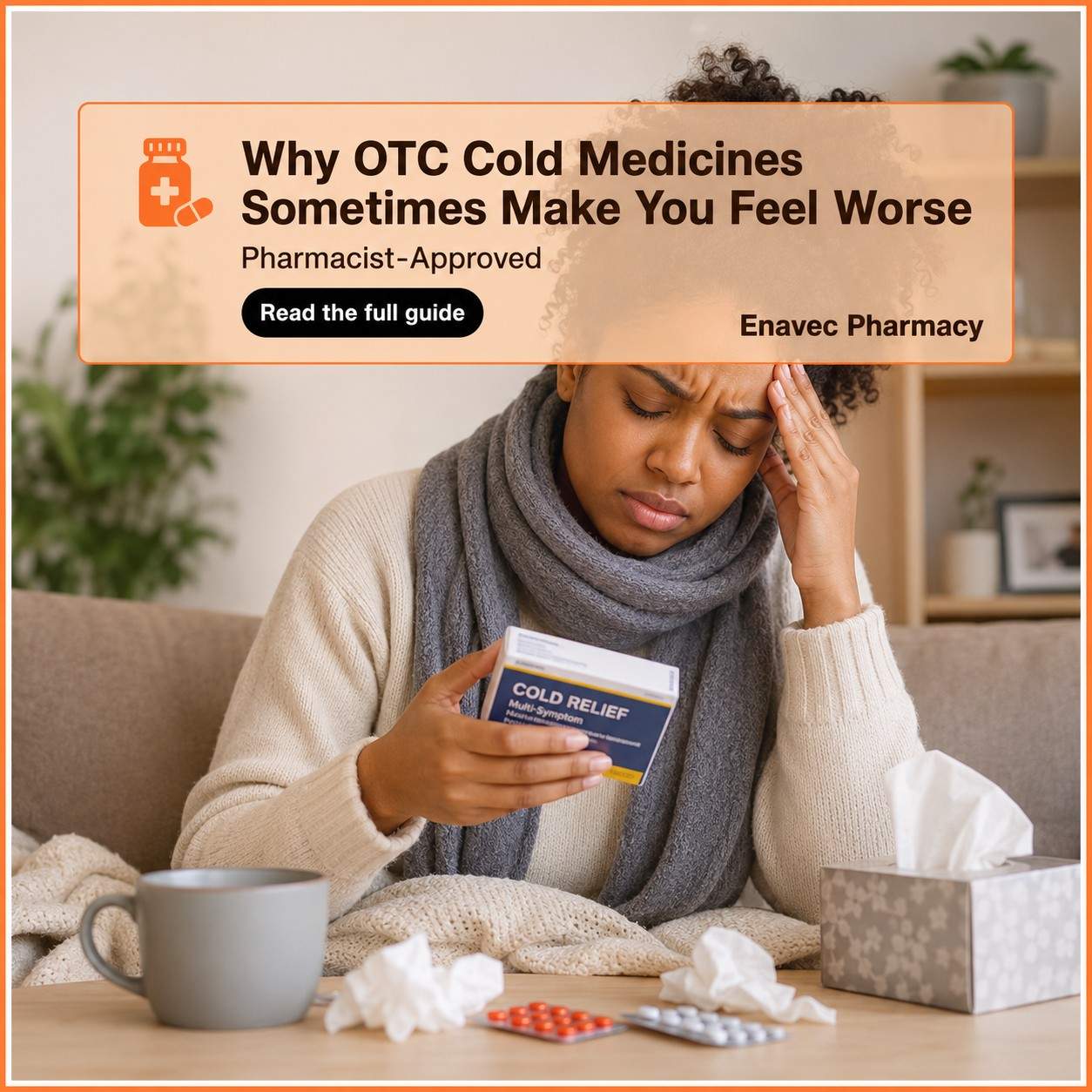
Cold medicine can make you feel worse because most multi-symptom formulas are really three or four different drugs stacked into one tablet, and at least one of them, usually the decongestant or the antihistamine, works against how your body naturally wants to respond to a cold. You are not imagining it, and you are not reacting badly to "medicine" in some general sense. You are reacting to a specific ingredient, and once you know which one, the fix is usually simple.
What Is Actually Happening When Cold Medicine Backfires
A standard cold and flu tablet is rarely one active ingredient. It is typically a painkiller, a decongestant, and an antihistamine or cough suppressant, all combined so you only need to swallow one tablet instead of three. In my experience at the pharmacy counter, patients almost never blame the specific ingredient. They blame "the medicine" as a whole, when really one component in the mix is doing something the other three are not.
Decongestants narrow blood vessels to unblock your nose. Antihistamines block histamine to dry up a runny nose and sneezing. Painkillers reduce fever and aches. Each of these mechanisms has side effects that have nothing to do with your cold itself, and when you combine them, the side effects can combine too.
💡 Key Takeaway Feeling worse after cold medicine almost always traces back to one specific ingredient, not the whole product. Identifying which one is the first step to fixing it.
Sedating Antihistamines and the Paradox Some People Feel
The drowsiness that comes with older antihistamines like diphenhydramine and chlorpheniramine is well known. What surprises most patients is the opposite reaction. In children especially, and occasionally in adults, sedating antihistamines cause restlessness, agitation, or an unusually fast heartbeat instead of calm. This is a recognised paradoxical response, not a sign that something is medically wrong with you.
Patients frequently ask me whether their child's cold medicine could be making the fussiness worse rather than better, and my answer is always to check which antihistamine is in the bottle before assuming the illness itself is the problem.
💊 From the Pharmacy Counter: Iloanugo Chijioke, B.Pharm, RPh
The question about giving adult Benylin to a child in a smaller dose is one I handle very carefully because the answer is not simply about arithmetic. Adult Benylin formulations contain antihistamines and cough suppressants, diphenhydramine, dextromethorphan, or guaifenesin depending on the variant, at concentrations calibrated for adult body weight and adult liver metabolism. A child's liver does not process these compounds the same way. In very young children, antihistamines can cause paradoxical hyperexcitability or, at higher doses, respiratory depression. The concept of 'smaller dose' is deceptively simple, the parent does not know what concentration is safe, what the child's exact weight-based dose should be, or whether the specific formulation is safe for their child's age at all. What I always say is: bring me the child's weight and age, and I will tell you exactly what is appropriate and at what dose. Paediatric cough syrups exist for a reason. I do not guess with children's medication, and I do not let parents guess either.
That paradoxical reaction is also why non-drowsy, second-generation antihistamines exist. Non-drowsy loratadine works for 24 hours without the sedating side effects of older formulas, which makes it the more predictable choice for daytime allergy and cold symptoms in most adults.
This post contains one affiliate link. If you purchase through it, Enavec Pharmacy may earn a small commission at no extra cost to you.
💡 Key Takeaway If a cold medicine is making you or your child jittery instead of sleepy, check whether it contains an older sedating antihistamine. A non-drowsy alternative usually resolves the paradox entirely.
Decongestants and the Jittery, Racing Feeling
Pseudoephedrine and phenylephrine work by narrowing blood vessels, which is exactly what clears a blocked nose. But that same narrowing effect happens throughout your body, not just in your sinuses. It raises heart rate and blood pressure, and in people who are sensitive to stimulants, dehydrated, or already borderline hypertensive, that effect is much more noticeable.
And this is the ingredient I get asked about most at my counter, more than any other cold medicine component. Patients describe a racing heart, mild tremor, or a wired feeling that has nothing to do with the cold itself. If you already take blood pressure medication, a decongestant can work directly against it, which is why checking your other medicines matters just as much as checking your cold symptoms.
💬 Have a question about OTC cold medicines? Our PCN-licensed pharmacists answer within 2 hours on WhatsApp → Chat with us now
💡 Key Takeaway A racing heart or jittery feeling after cold medicine usually points to the decongestant, not a general reaction to "medicine." This effect is stronger if you have HYPERTENSION (HIGH BLOOD PRESSURE)" data-ail-id="1778699253555">high blood pressure or take stimulant-sensitive medication.
The Hidden Paracetamol Overlap Problem
Most combination cold and flu tablets already contain paracetamol for fever and aches. The most common mistake I see is a patient taking a separate paracetamol tablet on top of the cold medicine because they did not realise the cold tablet already contained it. This does not usually cause a dramatic reaction. It shows up instead as unexplained nausea, stomach discomfort, or general malaise, days after the fact, once the cumulative dose creeps up.
From what I see in practice, this overlap is one of the most misunderstood aspects of self-treating a cold. The fix is not complicated. Before taking anything alongside a cold tablet, read the active ingredients list on both boxes.
🧮 Know Your Numbers
Taking more than one OTC product for your cold symptoms? Use our free Drug Interaction Checker to spot overlapping ingredients and potential interactions before combining anything, in under 2 minutes, no sign-up needed.
→ Check for Interactions💡 Key Takeaway Always check whether your cold tablet already contains paracetamol before taking any additional paracetamol. Stacking hidden doses is the most common preventable cause of feeling unexpectedly unwell during a cold.
When It Is the Combination, Not One Drug
Sometimes no single ingredient is the culprit. A sedating antihistamine plus a decongestant can pull your nervous system in two directions at once, sedated and stimulated, which some patients describe as feeling worse than either effect alone. Alcohol content in some liquid formulations adds a further layer, especially on an empty stomach. And if you are already taking another medicine for an unrelated condition, the combined load on your liver and cardiovascular system can be more than any one ingredient alone would suggest.
The practical takeaway is straightforward. Choose single-ingredient products for your specific symptom rather than a multi-symptom formula whenever possible. If you only have a blocked nose, treat the blocked nose. Adding three more drugs you do not need only adds three more ways to feel worse.
Myth vs. Fact: Cold Medicine Misconceptions
❌ MythNon-drowsy cold medicine is always the safer choice.
✅ FactNon-drowsy formulas usually still contain a decongestant, which carries its own cardiovascular effects regardless of sedation.[1]
❌ MythIf one dose helps a little, two doses will help twice as much.
✅ FactOTC cold medicine doses are already set at the safe maximum. Doubling up raises toxicity risk without extra symptom relief.[2]
❌ MythHerbal or "natural" cold remedies cannot interact with other medicines.
✅ FactBotanical compounds are still bioactive and can interact with prescription medicines and other OTC drugs.[3]
💊 Pharmacist's Verdict: Enavec Pharmacy
My honest advice: stop reaching for the multi-symptom tablet out of habit. Treat the symptom you actually have. If it is a blocked nose, use a decongestant alone. If it is sneezing and a runny nose, a non-drowsy antihistamine alone usually does the job better and with fewer surprises. And if you are on blood pressure medication or you have noticed your heart racing after cold tablets before, tell your pharmacist before you buy anything. That one conversation prevents most of the "feeling worse" reactions I see at my counter.
Iloanugo Chijioke, B.Pharm, RPh, PCN Reg. No. 020322
PCN-Licensed Pharmacist · Enavec Pharmacy · Lagos, Nigeria
PCN-Licensed Pharmacist · Enavec Pharmacy · Lagos, Nigeria
Frequently Asked Questions
Older sedating antihistamines like diphenhydramine and chlorpheniramine cause drowsiness that can linger into the next morning, sometimes called a medication hangover. Combined with a decongestant in the same tablet, your body can swing from sedated to jittery as the two ingredients act on your nervous system at different speeds and durations.
Yes, in some people, especially children and older adults, sedating antihistamines cause a paradoxical reaction of restlessness, agitation, or a racing heart rather than calm. This is a recognised drug response, not a sign you are doing something wrong, and switching to a non-drowsy second-generation antihistamine usually resolves it.
Most multi-symptom cold tablets contain a decongestant such as pseudoephedrine or phenylephrine, which narrows blood vessels to relieve a blocked nose but also raises heart rate and blood pressure. This effect is more noticeable in people who are sensitive to stimulants, dehydrated, or already have borderline high blood pressure.
Only if you check the label first. Most combination cold and flu tablets already contain paracetamol, so adding a separate paracetamol tablet on top can push you over the 4,000 mg daily maximum without realising it. Always read the active ingredients list before combining any OTC products.
Formulations change over time, and your own physiology changes too, through new medications, blood pressure changes, dehydration, or simply a different combination of symptoms this time. A product that suited you last winter is not guaranteed to suit you this time, which is why checking the active ingredients every time matters.
Commonly Searched OTC Topics
Best non-drowsy antihistamine
Decongestant and blood pressure
Hidden paracetamol in cold tablets
Cold medicine for children
Drug interaction checker
This complete Over-the-Counter Medicines Guide covers all six major OTC categories in more depth, including the cold, cough, and allergy section this article builds on. For a related everyday mix-up, see what to do if you have accidentally combined paracetamol and ibuprofen, and if allergies rather than a cold are behind your symptoms, our guide to the best OTC medicine for allergy walks through the non-drowsy options in more detail.
References
- American Heart Association. Over-the-counter cold remedies and blood pressure. AHA Patient Resources.
- U.S. Food & Drug Administration. Understanding Over-the-Counter Medicines. FDA Consumer Update. fda.gov
- Henderson L et al. St John's Wort: drug interactions and clinical outcomes. British Journal of Clinical Pharmacology. 2002;54(4):349-356.
- American Academy of Pediatrics. Paradoxical reactions to antihistamines in children. AAP Clinical Report.
- NHS. Cold and flu remedies: what works. nhs.uk
This article is for informational purposes only and does not constitute medical advice. Always consult your pharmacist or doctor before starting any medicine or supplement, particularly if you are pregnant, breastfeeding, managing a chronic condition, or taking other prescription medicines. Some links in this post are affiliate links. If you purchase through them, Enavec Pharmacy may earn a small commission at no extra cost to you.
Found this helpful? Share it:
⚠️
Medical & Affiliate Disclaimer This article is for informational purposes only and does not constitute medical advice. Always consult a qualified healthcare provider before starting any supplement or medication. Some links in this post are affiliate links - if you purchase through them, Enavec Pharmacy may earn a small commission at no extra cost to you.
