
- Your cart is empty
- Continue Shopping
Obesity Statistics in Nigeria & Africa: 2024 Data, Trends & What You Can Do About It
- Uncategorized
- Posted on
-
by enavec_pharmacy
- 0 comments
📊 Health Statistics · Nigeria & Africa
Obesity Statistics in Nigeria & Africa: 2024 Data, Trends & What You Can Do About It
Across Africa, one in five adults is projected to be obese in the highest-burden countries,[2] as urban lifestyles, processed foods, and sedentary work reshape the continent's health. This page brings together the latest verified statistics from the WHO, Nigeria's 2024 Demographic and Health Survey, and peer-reviewed journals — so you can understand exactly where Nigeria stands, why the numbers are moving, and what they mean for your health in Lagos, Abuja, or Port Harcourt.
Key Fact — Obesity in Nigeria
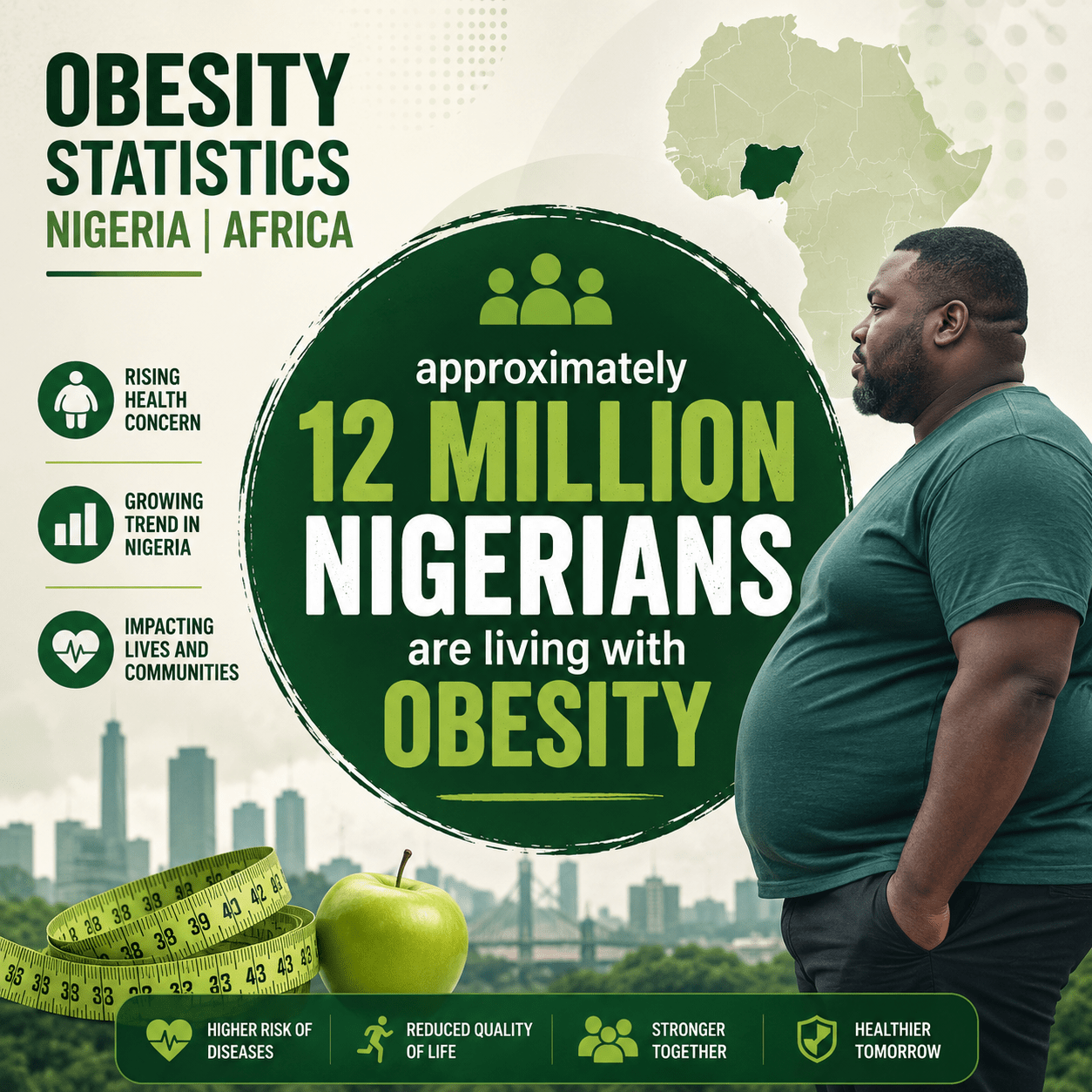
~12 Million
Nigerians are living with obesity right now
That is approximately 1 in every 17 Nigerian adults — and the number is rising fast as urbanisation, sedentary lifestyles, and the explosion of fast food in Lagos, Abuja, and Port Harcourt accelerate the crisis. Women are disproportionately affected at nearly 3× the rate of men. Most cases go undiagnosed until serious complications — diabetes, hypertension, or heart disease — have already set in.
Sources: Adeloye et al. 2021 · WHO Global Health Observatory 2024 · Global Nutrition Report
1. Nigeria Obesity: The Key Numbers at a Glance
This section summarises Nigeria's most important obesity and overweight figures, drawn from WHO modelled estimates and the 2021–2024 research literature.
Obesity in Nigeria follows a pattern familiar across West Africa but with its own distinct character: women carry a disproportionately higher burden than men, urban residents are significantly more affected than rural ones, and the numbers have been climbing steadily for three decades.[3] Understanding these headline figures is the first step to putting your own weight in context.
15.7%
of adult women (aged 18+)
Living with Obesity — Nigeria
WHO Global Health Observatory, 2024
5.9%
of adult men (aged 18+)
Living with Obesity — Nigeria
WHO Global Health Observatory, 2024
~12M
Nigerians aged 15+
Estimated Obese in 2020
Adeloye et al., PMC, 2021
25%
pooled crude prevalence
Adults Overweight in Nigeria
Systematic review, 35 studies, 2021
Nigeria's obesity prevalence is lower than the regional African average — 20.8% for women and 9.2% for men across the continent[3] — but that is cold comfort when 12 million obese Nigerians translates directly into elevated risk of type 2 diabetes (estimated to affect 6.8% of adult women and 7.5% of adult men in the country),[3] hypertension, stroke, and certain cancers. In Lagos and Abuja hospitals, these are no longer rare diagnoses — they are the leading reason for admission in many internal medicine wards.
💡 Key Takeaway: Roughly 1 in 6 Nigerian women and 1 in 17 Nigerian men are living with obesity today. The overweight category — the warning zone before obesity — affects about 1 in 4 adults nationwide, meaning a combined overweight-plus-obesity burden of close to 40% in some urban populations.
2. Obesity Across Africa: How Nigeria Compares
Africa's obesity picture is uneven — Southern African nations carry the heaviest burden, while West Africa sits mid-range. Here is where Nigeria sits relative to its neighbours and the wider continent.
The global obesity crisis has a distinctly African dimension. [4] Globally, the prevalence of obesity more than doubled between 1990 and 2022, with Africa experiencing a similarly steep trajectory. [5] The WHO African Region currently has an overweight prevalence of 31% among adults — comparable to South-East Asia but far below the Americas (67%).[5]
Adult Obesity Prevalence (Women, %) — Selected African Countries, 2022 NCD-RisC Estimates
Source: NCD-RisC via World Obesity Federation, 2024; WHO African Region Fact Sheet, June 2024
South Africa stands out as the highest-burden country, with nearly 50% of adult women meeting the BMI ≥ 30 threshold[6] — the greatest gender disparity on the continent.[7] Nigeria sits in the lower-middle range. Rwanda records the lowest adult female obesity in the region, below 20%.[6] The trend lines, however, tell the more alarming story: every country is moving upward.
Nigerian Adult Obesity Trend: Estimated Prevalence 2000–2024 (Women & Men)
Source: WHO GHO, Global Nutrition Report, Adeloye et al. 2021 meta-analysis
🌍 Africa Children: A Growing Crisis
In Africa, the number of overweight children under five has increased by nearly 12.1% since 2000. In 2019, Africa was home to 24% of the world's overweight children under five.[5] Among Nigerian school-aged children, about 8% are now overweight — a sharp rise from a decade ago, driven by sugary drinks, processed snacks, and shrinking play spaces in cities like Lagos.[8]
💡 Key Takeaway: Nigeria's obesity rate is below the African average — but the trend is upward. Southern African nations like South Africa already show what unchecked urbanisation can produce. Nigeria is at a critical inflection point where policy and individual action can still change the trajectory.
3. Urban vs Rural: Why Lagos Looks Different from Ekiti
Where you live in Nigeria has a measurable effect on your obesity risk — urban dwellers face substantially higher rates than their rural counterparts, driven by diet, lifestyle, and access to physical activity.
One of the most consistent findings across Nigerian obesity research is the urban-rural gradient. Studies show overweight prevalence among urban Nigerians (27.2%) versus rural Nigerians (16.4%), and obesity follows a similar gap — 14.4% urban versus 12.1% rural.[1] In Lagos urban slums such as Ijora, Ajegunle, and Makoko, obesity prevalence has been measured as high as 25.2% even in lower-income communities, as residents adopt urbanised diets without the physical activity that historically balanced them.[9]
The Nigerian urban diet has changed dramatically. In Lagos and Abuja, a typical office worker may eat shawarma from a roadside stand for lunch, wash it down with a bottled malt drink (often 250–450 kcal per bottle), and spend 8–10 hours seated. Contrast this with a rural community in Ekiti or Kebbi, where freshly pounded yam with efo riro (vegetable stew), roasted maize, garden eggs, and groundnut soup still anchor daily meals, and farming or walking provides baseline physical activity.[8] Modernisation is creeping into rural areas, but the gap remains significant.
Urban vs Rural Obesity Prevalence in Nigeria (Adults ≥15)
Source: Adeloye et al. (2021), Annals of Medicine — pooled meta-analysis of 35 Nigerian studies
⚠️ The Urban Slum Paradox
Counter-intuitively, obesity is no longer confined to wealthy Nigerians. Research from Lagos urban slums found significant obesity burden even in low-income communities. The combination of calorie-dense street food (akara, fried yam with palm oil, chin-chin), sugary drinks, and minimal physical recreation creates obesity in conditions of economic precarity. If you live in Ajegunle, Makoko, or similar communities in Port Harcourt or Abuja, your risk is comparable to middle-class urban Nigerians.[9]
💡 Key Takeaway: Urban Nigerians — particularly those in Lagos, Abuja, and Port Harcourt — face overweight and obesity rates nearly double those of rural Nigerians. If you live and work in a city, eat largely from fast food or roadside vendors, and sit for most of your working day, your personal risk profile is significantly elevated compared to national averages.
4. Gender & Age: Who Bears the Greatest Burden?
Obesity in Nigeria is not evenly distributed. Nigerian women face obesity rates nearly three times those of men, and the burden peaks sharply in mid-life — ages 40 to 60.
The gender disparity is one of the most pronounced features of Nigeria's obesity landscape. Across 35 pooled studies, obesity prevalence was 19.8% in women versus 12.9% in men.[1] At the individual clinical level, studies in mixed Nigerian populations have found obesity affecting up to 36% of women versus 19.6% of men in the same cohort.[10] This gap is driven by a combination of biological factors (hormonal differences in fat storage), cultural factors (certain body shapes being perceived as signs of prosperity or good health in some communities), and activity patterns (women in urban Nigeria often have more sedentary domestic and office roles with less recreational exercise).
Age matters enormously. Adults aged 41–60 have over four times the odds of obesity compared to those aged 18–40 years.[10] The BMI typically peaks in the 51–60 age group for both men and women in Nigerian populations.[11] This means your 40s and 50s are the highest-risk decade — precisely when many Nigerian professionals are most sedentary and most likely to be consuming high-calorie business meals.
19.8%
pooled obesity rate
Nigerian Women (adults)
Adeloye et al., PMC 2021
12.9%
pooled obesity rate
Nigerian Men (adults)
Adeloye et al., PMC 2021
4.3×
higher odds of obesity
Adults Aged 41–60 vs 18–40
NCBI/PMC, 2015
💡 Key Takeaway: If you are a Nigerian woman aged 40–60 living in an urban area, your personal obesity risk is well above the national headline figure. This is the demographic that most urgently needs regular BMI screening, dietary guidance, and movement planning — conversations your Enavec pharmacist can support today.
5. What Obesity Does to Your Body: The Nigerian Disease Burden
Obesity is rarely an isolated condition — it is the upstream cause of a cascade of serious diseases that are now filling Nigerian hospital wards.
Obesity is not just about how you look or feel in your clothes — it is a metabolic state that damages your heart, kidneys, liver, and pancreas over time. In Nigeria, the most urgent consequences are:
Type 2 Diabetes
Diabetes is estimated to affect 6.8% of adult Nigerian women and 7.5% of adult men.[3] Obesity is the primary modifiable risk factor. The fat stored around your abdomen (visceral fat — the "belly fat" that makes trousers tight at the waist even before BMI reaches obese levels) produces inflammatory chemicals that make your body resistant to insulin. Once insulin resistance sets in, your blood sugar climbs silently for years before the diagnosis. In Lagos and Abuja pharmacies, medications like metformin (available as Glucophage® and generic metformin), glibenclamide, and newer agents like sitagliptin are dispensed daily — almost always to patients whose diabetes traces directly back to weight gain.
Hypertension
Research from urban Lagos shows BMI has the strongest correlation with both systolic and diastolic blood pressure among all measured indices.[12] Abdominal obesity — measured by waist circumference — is the strongest independent predictor of hypertension ≥140/90 mmHg in Nigerian populations.[12] Hypertension prevalence of 38.3% has been recorded in urban Abuja communities.[9] NAFDAC-registered antihypertensive medications such as amlodipine, lisinopril, and losartan are among the most dispensed drugs in Nigerian pharmacies — and the majority of new hypertension diagnoses occur in overweight or obese patients.
Cardiovascular Disease & Stroke
Nigeria's age-standardised cardiovascular disease rate (9,475 per 100,000) is the highest in western sub-Saharan Africa — well above the global average of 6,403 per 100,000.[12] Obesity is a direct upstream contributor through its effect on blood pressure, blood lipids (especially high triglycerides and low HDL — the "good" cholesterol), and blood glucose.
💊 A Note on Nigerian Food Interactions with Obesity-Related Medications
Common Nigerian foods can interact with medications used to manage obesity-related conditions:
• Zobo (Hibiscus tea) — large amounts can lower blood pressure further when taken with antihypertensives like amlodipine; space consumption by at least 2 hours.
• Egusi soup (high in fat) — slows absorption of metformin; consistent timing with meals is important.
• Suya (high sodium) — frequent consumption counteracts blood pressure-lowering medication; limit to occasional intake.
• Groundnut oil (palm oil in large amounts) — contributes to dyslipidaemia (abnormal blood fats) in already obese patients; discuss switching to healthier cooking oils with your pharmacist.
Ask your Enavec pharmacist about your specific medication-food interactions.
💡 Key Takeaway: Obesity is not cosmetic — it is the engine driving Nigeria's rising rates of diabetes, hypertension, and cardiovascular disease. Tackling your weight directly reduces your need for multiple long-term medications and their associated costs. Your pharmacist at Enavec is trained to support weight management alongside your existing prescriptions.
6. Quick Reference Data Table & Methodology Notes
This section provides a consolidated, citable data table with freshness indicators and an honest account of where different sources report different numbers.
| Metric | Figure | Population | Source | Year |
|---|---|---|---|---|
| Adult female obesity prevalence (Nigeria) | 15.7% | Women aged 18+ | WHO GHO / Global Nutrition Report | 2024 ✓ |
| Adult male obesity prevalence (Nigeria) | 5.9% | Men aged 18+ | WHO GHO / Global Nutrition Report | 2024 ✓ |
| Pooled adult overweight prevalence (Nigeria) | 25.0% | Adults aged 15+, 35 studies | Adeloye et al., Annals of Medicine | 2021 ~ |
| Pooled adult obesity prevalence (Nigeria) | 14.3% | Adults aged 15+, n=52,816 | Adeloye et al., Annals of Medicine | 2021 ~ |
| Estimated obese Nigerians (population) | ~12 million | Aged 15+, 2020 projection | Adeloye et al., PMC | 2021 ~ |
| Urban adult overweight (Nigeria) | 27.2% | Urban adults | Adeloye et al., Annals of Medicine | 2021 ~ |
| Rural adult overweight (Nigeria) | 16.4% | Rural adults | Adeloye et al., Annals of Medicine | 2021 ~ |
| African region adult overweight prevalence | 31% | All adults, WHO African Region | WHO Fact Sheet 2022 | 2022 ✓ |
| South Africa adult female obesity | ~50% | Women aged 18+ | NCD-RisC, via World Obesity Fed. | 2022 ✓ |
| Nigeria childhood overweight (under 5) | 1.6% | Children under 5 | Global Nutrition Report / WHO | 2024 ✓ |
| Nigeria school-age children overweight | ~8% | School-aged children | UNICEF/WHO/World Bank JME 2023 | 2023 ✓ |
| Nigeria diabetes prevalence (women) | 6.8% | Adult women | WHO GHO / Global Nutrition Report | 2024 ✓ |
| Nigeria diabetes prevalence (men) | 7.5% | Adult men | WHO GHO / Global Nutrition Report | 2024 ✓ |
| Global overweight adults (2022) | 2.5 billion | Adults aged 18+, worldwide | WHO Fact Sheet (Dec 2025) | 2022 ✓ |
🔬 Why Sources Differ
You may see different Nigerian obesity figures across different websites and reports. The main reasons are:
1. WHO modelled estimates vs survey prevalence: The WHO's Global Health Observatory figures (15.7% for women, 5.9% for men) are age-standardised modelled estimates using the WHO standard population. They are designed for cross-country comparison. Individual Nigerian surveys — which may sample hospital outpatients, a specific city, or a particular occupational group — often report higher figures (some urban studies find obesity rates of 25–36% in women).
2. BMI thresholds: All figures on this page use the WHO standard: overweight = BMI 25–29.9 kg/m², obese = BMI ≥ 30 kg/m². Some older Nigerian studies used different cut-offs or used waist circumference only, producing non-comparable figures.
3. Study population: Studies based in Lagos or Abuja will report higher figures than national surveys that include rural and Northern Nigeria populations, where obesity rates remain lower.
The safest approach: Use WHO figures for national context, and the Adeloye et al. 2021 meta-analysis (n=52,816) for the most robust pooled Nigerian estimate. Both are cited on this page.
💡 Key Takeaway: Nigeria's "official" obesity rate of 15.7% for women and 5.9% for men reflects WHO's standardised model. In real-world Lagos or Abuja clinical settings, the figures are often considerably higher. Both are valid — they answer different questions. The trend direction in all sources is the same: upward.
7. What You Can Do: Practical Steps for Nigerians
Statistics only matter if they move you to action. Here is practical, pharmacist-reviewed guidance rooted in Nigerian food culture and healthcare realities.
You cannot change your genetics, your age, or where you grew up — but you can change what you eat, how much you move, and whether you seek professional support. These are the three levers that determine whether your weight trends up or down over the next decade.
Know Your Numbers First
Calculate your BMI: weight (kg) ÷ height (m)². A BMI above 25 kg/m² means overweight; above 30 means obese. For Nigerians specifically, waist circumference is equally important — in women, above 80 cm signals risk; in men, above 94 cm.[10] Measure both. Enavec Pharmacy can perform both measurements and give you a clear, honest reading.
Adapt Nigerian Meals — Don't Abandon Them
Nigerian traditional food is not the problem. Eba with egusi soup made with leafy vegetables, small fish, and palm oil in moderate quantity is nutritionally sound. The problem is portion escalation, frying in excess oil, heavy white-bread additions, and the sugar load from drinks. Practical swaps: swap white rice for ofada rice (lower glycaemic index), swap fried plantain for boiled or roasted plantain (dodo vs. boli), reduce palm oil to 2 tablespoons per pot rather than half a cup, drink water or zobo without added sugar instead of malt drinks and carbonated soft drinks.
Movement Without a Gym
Most Nigerians in cities do not have access to, or cannot afford, a gym. That is not a barrier. The WHO recommends 150 minutes of moderate activity per week — achievable by walking briskly for 30 minutes five days per week. In Lagos, this could be walking to the next bus stop instead of the closest one, taking the stairs in your office building at Lagos Island, or a morning walk around your estate in Lekki or Wuse 2 before the heat peaks.
Medications & Pharmacy Support
Weight management medications are not routinely available or recommended without medical supervision, but your Enavec pharmacist can: review your current medications for any that contribute to weight gain (including some antidepressants, antipsychotics, and some antidiabetics like glibenclamide), screen your BMI, blood pressure, and blood sugar, and refer you to appropriate clinical services. NAFDAC-registered weight management products are available — ask specifically about evidence-based options rather than unregulated supplements.
💡 Key Takeaway: Managing obesity is achievable without dramatically changing Nigerian food culture. The changes that make the biggest difference are portion size, reducing frying, replacing sugary drinks, and adding daily walking. Start with one change this week — your pharmacist can help you track progress and stay accountable.
8. Share These Stats
These cards are designed for Nigerian WhatsApp groups, Facebook, and Twitter/X. Screenshot and share to spread awareness.
Commonly Searched Topics
Metformin for weight loss
BMI calculator Nigeria
Diabetes statistics Nigeria
Hypertension prevalence Nigeria
Weight loss Nigeria
Childhood obesity Nigeria
Diet and obesity Africa
Obesity Lagos
NAFDAC weight management
Obesity complications
📄 How to Cite This Page
Enavec Pharmacy Clinical Team. (2025). Obesity Statistics in Nigeria & Africa: 2024 Data, Trends & What You Can Do About It. Enavec Pharmacy. Retrieved from https://enavecpharmacy.com/health/obesity-statistics-nigeria-africa. Last updated May 2025.
Ready to Take Control of Your Weight?
Our PCN-licensed pharmacists at Enavec Pharmacy can measure your BMI and waist circumference, review your medications, and give you a personalised plan — no appointment needed at our Lagos and Abuja locations.
📍 Find Your Nearest Enavec 💬 WhatsApp a PharmacistReferences
- Adeloye D, Ige-Elegbede JO, Ezejimofor M, et al. (2021). Estimating the prevalence of overweight and obesity in Nigeria in 2020: a systematic review and meta-analysis. Annals of Medicine. PMC8018557. ncbi.nlm.nih.gov/pmc/articles/PMC8018557/
- WHO Regional Office for Africa. (2022). Obesity rising in Africa, WHO analysis finds. afro.who.int
- Global Nutrition Report. Nigeria Nutrition Profile. globalnutritionreport.org
- NCD Risk Factor Collaboration (NCD-RisC). (2024). Worldwide trends in underweight and obesity from 1990 to 2022. The Lancet.
- World Health Organization. (2025). Obesity and overweight Fact Sheet. who.int
- World Obesity Federation Global Obesity Observatory. (2024). Nigeria Country Data. data.worldobesity.org
- Sex disparities in adult obesity prevalence across 47 African countries. PLOS ONE, December 2025. journals.plos.org
- Leadership Nigeria. (2025, September). Surging Obesity & Overweight in Nigeria: Urban Lifestyle vs Rural Foodways. leadership.ng
- Survey of Hypertension, Diabetes and Obesity in Three Nigerian Urban Slums (Lagos). Academia.edu.
- Prevalence and Socio-Demographic Determinants of Overweight and Obesity in a Nigerian Population. NCBI/PMC4483373, 2015. ncbi.nlm.nih.gov
- Prevalence and pattern of overweight and obesity in three rural communities in southwest Nigeria. PMC4026024. ncbi.nlm.nih.gov
- Adegoke O, Ozoh OB, et al. (2021). Prevalence of obesity and blood pressures in urban Lagos. Scientific Reports. nature.com/articles/s41598-021-83055-w
Found this helpful? Share it:
⚠️
Medical & Affiliate Disclaimer This article is for informational purposes only and does not constitute medical advice. Always consult a qualified healthcare provider before starting any supplement or medication. Some links in this post are affiliate links - if you purchase through them, Enavec Pharmacy may earn a small commission at no extra cost to you.
